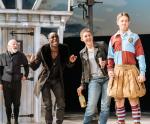
Review – The Merry Wives of Windsor, Royal Shakespeare Company at the Royal Shakespeare Theatre, Stratford-upon-Avon, 14th August 2018

Ah, The Merry Wives of Windsor. The name sounds so innocent doesn’t it? Tea on the lawn at Runnymede. Happy jumble sales at Datchet. Street parties for the Queen down Windsor High Street. Well indeed, it was the Queen who wanted this in the first place, as the first scene of Fiona Laird’s new production at the RSC showed at first hand; a projection of Queen Elizabeth I querulously observing that her favourite Falstaff was being written out of Shakespeare’s next play, so she demands a new offering, showing Sir John in love, to be ready in two weeks. Much to Shakespeare’s chagrin.

FalstaffThe ever constant challenge to make new productions of Shakespeare plays modern and relevant is just as valid in the frothy comedies as it is in the heavyweights. But Merry Wives is a significant play in many ways and deserves treating seriously. It’s one of the few Shakespeare plays that is completely original. It is the only one to be written entirely in prose. It’s the only one to be concerned with middle-class life in a small English town; to that extent, it’s the most similar in structure to a modern-day sitcom. Not uniquely, but it’s one of the plays where the action is most driven by female characters; and where female characters win the day. It’s also a contender for being Shakespeare’s funniest play. No wonder it keeps coming around, again and again.

Evans, Pistol, Bardolph, NymThis is the 5th time I’ve seen the play; George Murcell as Falstaff at the now defunct St. George’s theatre in Tufnell Park in 1977; Peter Jeffrey in the RSC’s production at the Barbican in 1986; the Oxford Shakespeare Company’s productions in the grounds of Wadham College in 2005 and 2013; and now David Troughton as the randy big man with the RSC again in Stratford. Each one marvellous in their own way; and this latest production has more entertainment value than you can shake a stick at.

CaiusAnd that’s down to the engagement of one Mr Toby Park, boss of Spymonkey, as Physical Comedy Director. We’ve seen Spymonkey several times, with their endlessly creative, pomposity-puncturing, ridiculousness-worshipping productions; if you’ve never seen a Spymonkey production, You Haven’t Lived. There are elements of Spymonkey-business running through this show like a stick of rock. But does the double-directorship work, dovetailing the comic business with the rest of it? Or is it an Eton Mess? (See what I did there?)

Mistresses Ford and PageI usually agree with the old saying, less is more. Maybe it’s because of my innate conservatism (small C, please note.) Maybe it’s due to my Public School upbringing – you’re not meant to have fun. If it hurts, it’s doing you good. Or maybe it’s because I value quality over quantity, in virtually all matters. However, when it comes to Spymonkey, I change my mind. In this production they throw absolutely everything at it. From the disgusting wheelybin to the pink flamingos by the side of the Fords’ swimming pool, from the stagestruck golf cart to Falstaff’s extravagant codpiece, from Dr Caius’ frenchisisms to Master Brook’s false nose; no visual joke, no audio prompt, no quirky playing with the script goes unmissed. It’s a numbers game. The more funny business you put in, the funnier the end product comes out. I’d say a good 95% of the comic content sticks solidly like… well you provide your own simile. If the main intention of a production of Merry Wives is to make the audience laugh – and why would it be anything else – this is a five-star extravaganza.

Falstaff, QuicklyFiona Laird has picked this production up and moved it from west of the M25 to the east, to create a TOWIE version of the play – The Merry Wives of Billericay. The wise woman of Brentford has become the wise woman of Brentwood, which is somehow strangely funnier; Mistress Ford has her own beautician, which I’m sure isn’t in the original; the refuse guys who come to take away the lurid pink coloured wheelybin (belonging to the Royal Borough of Windsor and Essex) exchange jokes in Polish. Mistress Page hides behind a decadently large electric barbecue; Falstaff hides under a poolside lounger.

Caius, Shallow, Slender, Hostess, PageLez Brotherston’s fantastic costume designs enhance this Estuary Grandeur; Mistress Ford is genuinely stunning in her Versace trousers and tight-fitting top; the Hostess of the Garter is a vision in leopard skin; Pistol’s handbag (you read that right), Dr Caius’ bandana (ditto) and Fenton’s suitcase all reek of expense; and, above all, Master Ford and Master Slender are so trendy that they’ve given up on the socks. And the costumes and padding for Falstaff are genuinely hilarious and incredibly inventive; a quite remarkable achievement.

HostessI can’t decide whether the creative team encouraged the cast to portray their characters partly as impersonations, or whether it’s some natural, evolutionary by-product of the rehearsal procedure. But in any event it’s a delight to see Sybil Fawlty as Mistress Page, Julia Davis as Mistress Ford, Tracy Emin as the Hostess of the Garter, Ricky Gervais as Shallow, Del Boy Trotter as Master Ford, and my cousin Trevor as Slender. No offence, Trevor, but Tom Padley had you down to a T.

Mistresses Ford, Page and QuicklyThe performances are gleefully brilliant from first to last. David Troughton is just magnificent (and only barely recognisable) as Falstaff, completely self-obsessed and repulsive, so puffed up in his own affairs that duping him is like taking candy from a baby. Of course, when a character is so set up in a high and mighty fashion, it makes you deliriously happy to see them crash and scarper in shame. Rebecca Lacey’s Mistress Page, outwardly so respectable but in reality a truly tough nut, can’t wait to interfere in Falstaff’s plans and eggs Beth Cordingly’s sassy Mistress Ford into playing the tart for the fat knight. Together they are a perfectly mischievous pair, and make a great comedy duo.

EvansDavid Acton almost steals the show with his childishly excitable performance as Evans the Welsh parson, his face lit up with joy as he revels in every prank; encouraging us all to join him in a Cardiff Arms Park (his words) chorus of Cwm Rhondda. He’s also a great partner-in-crime for Jonathan Cullen’s Dr Caius, murdering the French language with fantastic ease, espousing all the Spymonkey tenets of making yourself look as ridiculous as possible. I’ve been an admirer of Mr Cullen since I first saw him perform in the First Year Students’ competition at Oxford, when I was in the second year. We always knew he’d go far.

Caius, RugbyTim Samuels is a beautifully mealy-mouthed (and violent) Shallow and Tom Padley simply hilarious as his gormless nephew Slender, constantly trying to cover up his incessant faux pas. Luke Newberry invests the otherwise worthy but dull Fenton with a string of brilliantly performed pratfalls, Josh Finan is an irrepressible Nym, Katy Brittain a superb lush of a Hostess at the Garter, Vince Leigh a fabulously jealous Ford and Paul Dodds a proper bossy Page. But the whole cast work together to make a really funny and entertaining ensemble show.

Anne PageAt the end of the day, it’s up to you whether you like the transferred location away from small town Berkshire to somewhere Chez Lakeside. I thought it worked fine. There are numerous liberties taken with the script, but if any Shakespeare play can take messing around with, it’s this one.

FordMrs Chrisparkle pointed out that in previous productions of Merry Wives that we’ve seen, Falstaff has been even more humiliated in that final horns and spirits scene. In this production, his shame is quickly achieved, and quickly over, which actually made a pleasant change – there’s only so far that you can humiliate one fat randy old knight. However, I sense something didn’t go quite right with that scene; there were a few spirits just hanging around doing nothing and blundering into each other. And the whole imagery of the ghosts and ghoulies is much scarier in its original location of a woodland glade than in a town centre piazza. Maybe it needs a little tightening up.

SimpleStill that’s a small quibble with such a great show. We laughed, and laughed, and laughed. I’m sure you would too. Can’t recommend it strongly enough. It’s in the RSC repertoire at Stratford until 22nd September and then it’s on at the Barbican from 7th December until 5th January 2019 – that would be a perfect Christmas treat!

Production photos by Manuel Harlan

Theatre Censorship – 26: The blasphemy of Edward Bond and David Mercer

Edward Bond’s Black Mass was written for the Anti-Apartheid movement in 1970, and contains that unforgivable sin of two years earlier, the representation of the deity on stage. In this play, which was written to commemorate the Sharpeville Massacre, the South African Prime Minister is receiving communion from a priest in a church in Vereeniging. During the service, you hear the rifle fire of the police shooting seventy “Kaffirs”; the Prime Minister interrupts the communion so that he, the priest and a Police Inspector can go and congratulate the police on their fine work. Christ is so infuriated at the bigotry of the Prime Minister and the Inspector, and the weakness of the Priest, that, unseen, He leaps down from the cross and poisons the Communion wine. On their return, the Prime Minster drinks the wine and dies. In this act of basic revenge, Christ shows Himself also to be capable of committing a crime, to be capable of evil; indeed, as the wine represents His own blood in the Communion service, He poisons part of Himself and therefore you can consider it an act of self-mutilation or suicide. Justice must then be seen to be done, so Christ is questioned, and, as in the Bible, He offers no defence. With delicious irony, the Inspector asks Christ to account for His presence on the premises.

Christ’s treachery reflects very badly on the Priest, who turns on Him and dismisses Him from His post with the hilarious (or disgusting, depending on your point of view) words: “I can’t risk your contaminating the young people we have here”. Christ’s place on the cross is then taken by a stupid fascist policeman who is suited to the task because it is “a nice easy job”; thus, the symbol of Christian love has been replaced by a symbol of corruption and torture. Even today it’s quite shocking to hear the phrase “wank in your own time” used about the Christ figure, especially in a church. By the end, Christ has been subjugated and finally eliminated by the evil of the bigoted South African authoritarians. It is a simple, emblematic play, designed to show the hypocrisy of those who undertake persecutions in the name of religion. However, the treatment of Christ in the play might well be offensive to many people, including those who were vehemently opposed to Apartheid. Bond’s strong imagery might have alienated them, but it certainly shows up the topsy-turvy morals of the Apartheid regime.

Persecution and hypocrisy also feature in David Mercer’s Flint (1970). The eponymous character’s first words are “Do not go into the Church, Ossian, my grandmother said to me – because God is not fun”. Fun is the Reverend Flint’s main occupation and therefore he always leaves a string of lovers and ex-lovers in his wake, like Miss Biggin, the organist. Swash, the curate, pours scorn on Flint’s enjoyment of the bowling alley because he feels it’s demeaning for a vicar to behave like this. However, there is nothing morally wrong with bowling alleys, and his enjoyment of them is one way in which Flint bridges the gap between the church and the people.

The dual aspect of Flint’s character is instantly shown in this first appearance. First, having heard reports of his behaviour, you’re immediately struck by the fact that he’s not a young man. Secondly, his motorbike apparel, which (certainly in those days) was associated with the rowdiness of youth and a fast life, contrast with his being a member of the clergy, which you might think should be a life of quiet contemplation. He cannot be both young and old, quiet and racey; one must be false. The crux of his difficulties is expressed plainly in the line: “I’ve been an agnostic for forty years”. We already sympathise with him because he is tied to a job for which he is scarcely suited, although it is revealing that he is able to give Dixie, his current lover, the comfort she needs and which the “standard Christianity” of Swash’s service totally failed to give her. His only outlet is to disrupt the meaningless ritual of Christian hypocrisy which surrounds him, choking his every move. Therefore, he takes on mistresses, sets fire to buses and to the church, and other such irreverent actions.

At one point he talks about how he has hosed down some little boys; his Ortonesque explanation for their nudity: “It would have been aggressive to hose down four little boys with their clothes on!” has that outrageous yet undeniable logic you’d attribute to the best of Orton’s works. For example, when Mrs Prentice in Orton’s What the Butler Saw announces that she will take an Indian lover in New Delhi, her husband is shocked, but for the wrong reason: “You can’t take lovers in Asia! The air fare would be crippling” is his response. Again, it’s logic, but it’s the wrong kind of logic. And both Flint and Mrs Prentice believe their explanations are perfectly reasonable.

Flint’s life is full of tragedies and crimes, not because he is wilful or malicious, but simply because he is careless and getting old. One can imagine that any intrigues set up in Bishop Auckland (we never know quite what happened there) came as a result of his mistaking the name of the town for that of a senior colleague. He is, nevertheless, kind to Dixie, which creates a direct contrast to his wife, Esme: “You are a monster, Ossian”, she says. “The best thing that could happen to you would be a sudden coronary.” Despite this malice she assumes a godly superiority and even takes the virginity of Mary to extremes in her refusal to consummate her marriage. When Esme dies, Swash tries to comfort Flint with his belief that “she is with God”; Flint replies, “they certainly deserve each other.” Esme’s religion is kept firmly in its respectable place and never allows her to become a good person. “Earl’s Court is an underground station and not a place where one finds Jesus”, she grumpily explains, conveniently forgetting that He is, apparently, everywhere.

However, in Flint’s keenness to cross lines and not to draw them, he is most definitely open to the charge of blasphemy. When he feels the need for a quick drink, he suggests taking some of the Communion wine: “I believe we have a few untransmogrified bottles; mere wine until somebody does the abracadabra bit on it”. Dixie, a devout but easily misled Catholic, cannot take Anglicanism seriously as a religion, and Flint is not the right person to help her out. His religious idol is usually “the incumbent Biggin”, in this case Dixie herself: “The flesh tints of Rubens. The ribald calligraphy of Rowlandson. The sensuality of Renoir. All combined for the terrible sacrament of my disintegration”.

The play ends with Flint, flustered by the responsibility of having to find some midwifely assistance for Dixie, rapidly plummeting over a hill on his motorbike “into an army truck full of something explosive”. Perhaps Flint’s death comes as a salvation for the “sentiment of religious reverence”; alternatively, his death comes at a moment of selfless risk; this could be Mercer’s way of ensuring that Flint is not eternally damned. Whichever interpretation one places on Flint’s death, it feels like a highly moral end to the play.

In my next blog, there’ll be more blasphemy from Edward Bond, and from Mary O’Malley.

Review – The Meeting, Minerva Theatre, Chichester, 11th August 2018

The second of our three Chichester weekends this year saw Mrs Chrisparkle and me meet up with Professor and Mrs Plum for our usual fantastic lunch at the Minerva Brasserie – I can really recommend the Whiston Blanc de Blancs for a beautifully tasty sparkling English wine; it would perk up any social event! And the chicken is a real winner.

As usual it was to be a double-header at Chichester, and our first stop was at the Minerva for The Meeting. I think it’s fair to say that unless you are a Quaker, or are personally acquainted with a Quaker very well, you’re unlikely to know much about them. You don’t stumble across and visit their places of worship like you pop into an English Country Church in the Church of England tradition, for example. There aren’t big versions of their Meeting Houses like there are Cathedrals. And you don’t learn about their worshipping traditions, because, as far as I can make out, there aren’t any. The pinnacle of a great Quaker Meeting is to stay as silent as possible for the longest time.

That’s what makes Charlotte Jones’ new play, The Meeting, which has just finished its run at the Minerva theatre, so very intriguing. Set in a Sussex Quaker community in 1805, this small group of people get along by very much keeping themselves to themselves, marrying within the community, not venturing into “the town”; committed to the sanctity of human life, so they cannot fight at war; believing in equality so that even the most junior in the community would not address the most senior with any kind of reverent title. They are a Society of Friends and Friends are always equal. I learned a lot.

But just because this is a community of Quakers, it doesn’t mean they’re not subject to the same emotions, temptations, and desires as the rest of us. Take Rachel, for instance, living with her deaf mother Alice and her husband Adam, a stonemason; three sons she has borne him, each one stillborn or died at birth, each one named Nathaniel in the hope that they might eventually have a survivor. Biddy, on the other hand, married to James, the Elder of the community, is as fecund as the Indus Valley. I lost count how many children they had, but there’s a baby in tow at the moment and older daughter Tabitha is on the lookout for a husband.

One day, Rachel meets a soldier; a young man apparently invalided out of the army, with nothing to do and nowhere to go. His name? Nathaniel. Adam has only recently said he needs a young apprentice, as his strength and eye for detail are on the wane; Rachel sees it as a sign, and suggests that Nathaniel come back with her to meet Adam to see if he thinks he would be a good apprentice. Trouble is, he’s not a Quaker; but Rachel will teach him and encourage him, and, as far as she’s concerned, it’s just a little white lie for The Greater Good. But you know what might happen if an attractive older woman and a handsome young man start living under the same roof….. The gasp of shock from the audience at the final tableau before the interval told its own story!

The play very satisfyingly lets us in to see the secrets of this closed community, that few of us to this day know much about, so it piques our interest initially on the simple level of widening our general knowledge. But then we see the community face the age-old problem of a love-triangle, something we see in many plays and films over the course of a lifetime; and maybe indeed personally experience its pain and complications. It’s a very familiar event in a very unfamiliar setting. At times – as when Adam encouraged Nathaniel to accompany Rachel to keep her company – it reminded me of the previous play we’d seen at the Minerva, The Country Wife – although of course, much less raucous. Adam’s blissful ignorance about Nathaniel’s intentions towards Rachel and Lord Fidget’s similar encouragement to Horner to spend time with Lady Fidget are not a million miles apart.

It’s a fascinating play, beautifully and sensitively written, with much to say about friendship and faithfulness; forgiveness and redemption; expression and suppression. Dry stonewalls provide the backdrop to Vicki Mortimer’s simple but flexible set, a circular mosaic floor providing the setting for the meetings, where the attendees sit around on simple chairs in a circle; when the meeting is over they simply hook the backs of the chairs to a circular roof that descends and ascends to take the chairs out of the way. The costumes are uniformly puritanical grey and drab; I had to cut myself a little chuckle when Tabitha displays her “beautiful” wedding dress which is only fractionally less grey and drab than everything else the women wear. The only exception is the bright red of the soldier’s jacket which must, perforce, be hidden; let’s hope nobody finds it…

Charlotte Jones has written two great parts for women. Lydia Leonard is superb as Rachel; trying her best to be dutiful, bursting forth at the Quaker Meetings because she is full of ministry – or, in her case, emotion and expression which desperately needs an outlet; powerless to fight the attractive force that is the new young man under her roof. And Olivia Darnley is also brilliant as Biddy; on the one hand, the comedy gossip role, always irrepressible with good humour and accentuating the positive; on the other hand, with a past full of resentment and bitterness that she too finds it hard not to revisit.

Gerald Kyd plays Adam with stolid dignity and quiet assertiveness; he is a man whose emotions will always only be revealed behind closed doors. And there’s an excellent, assured performance from newcomer Laurie Davidson as Nathaniel, the seemingly decent and honest worker who turns into something of a sneak and a louse. There’s also the meaty role of Alice, powerfully performed by deaf actor Jean St Clair, eloquent in her sign language and amazingly articulate facial expressions. And there’s great support from Jim Findley as the well-meaning and responsible Elder James Rickman and Leona Allen as his enthusiastic and surprisingly self-confident daughter Tabitha.

We saw this on its final matinee after its three-week run, and sadly the theatre was only about 60% full, which isn’t a great audience turnout for Chichester. Those of us who were there really enjoyed it and were thoroughly carried away by its great story-telling and emotional charge. Whether or not there could be a life for this play in the future, I’m not sure. But I’m very pleased we managed to catch it, as it was a very rewarding and thought-provoking play.

The James Bond Challenge – Dr No (1962)

In which we meet Bond (James Bond, that is) who is summoned to Jamaica to investigate the disappearance of Secret Agent Strangways, and eventually locates Dr No’s secret hideaway at Crab Key – and defeats the scoundrel. In my Agatha Christie Challenge blog posts I endeavour not to give the game away as to whodunit; James Bond films are a different kettle of fish and so I recommend that if you haven’t seen the film first – well, let’s just say the blogs will be full of spoilers!

Also – apologies in advance. This is quite a long blog, gentle reader, so I wish you the best of luck in getting through it all. There’s a lot of introductory material that I thought I should grapple with, that shouldn’t be necessary as the film series continues. So, please, may I crave your indulgence just this once?

Dr No was the first of the films to be made, an adaptation of Ian Fleming’s novel of the same name published four years earlier. In 1961, Canadian film producer Harry Saltzman read Fleming’s Goldfinger, and loved it so much he bought the film rights to the novels. Albert R. Broccoli (Cubby, to you and me) also wanted to transfer Bond to the Silver Screen only to find that Saltzman had beaten him to it. Saltzman refused to sell but they went into partnership together and, under the title of Eon productions, they made eight Bond films together between 1962’s Dr No and 1974’s The Man with the Golden Gun. Although Thunderball had been the original target for the first Bond movie, there was a long drawn out and ultimately acrimonious legal battle over the work between Fleming and Irish writer Kevin McClory, whom Fleming had originally brought in to write a screenplay for a Bond movie in the late 50s. Broccoli and Saltzman wisely chose Dr No instead.

Before this recent re-watch, I think I’d seen Dr No just once before – on television, probably in the 1980s. I remember enjoying it, but my only memory of it, and probably the memory I share with most people, is the vision of Ursula Andress as Honey Rider, emerging from the sea, clad in not very much at all. So it was great fun to watch it again all these years later, and to discover there’s more to the film than just that scene.

How does it start? The opening credits blend into the first scene as we see three (apparently) blind men, all walking in tandem for safety to the tune of Three Blind Mice, crossing a road, holding out a begging tin, then walking up to the Queen’s Club where John Strangways, the MI6 Station Chief in Jamaica, is playing Bridge with geologist Professor Dent, retired military man General Potter, and Government House Chief Secretary Pleydell-Smith. As Strangways leaves to file his usual secret daily report back to London, he is assassinated by one of the (clearly not) blind men, who then take a getaway car to Strangways’ House. There they surprise and murder his assistant Mary, then steal secret files on Crab Key and Doctor No. As the transmission from Jamaica faltered and broke up, London’s suspicions are aroused. So M summons Bond to deliver him his next task: find out what has happened to Strangways. I’m not going to tell you the rest of the story at this point – you’ll just have to watch the film for yourself!

Produced on a low budget of just $1.1 million, there are many stories about how cheaply certain effects were achieved. Dr No’s aquarium, for example, was represented by some stock footage of goldfish magnified many times over. M’s office features cardboard paintings and the expensive looking upholstered door to his office was made of plastic. Dr No had clearly stolen Goya’s Portrait of the Duke of Wellington from the National Gallery, as you can see it in one scene in his lair. It’s true; the painting had genuinely been stolen in 1961 and was missing for four years. In reality, Doctor No wasn’t the thief; over the course of a weekend, production designer Ken Adam painted up a copy using a slide from the National Gallery as his source. The UK arm of United Artists put up an extra $100,000 specifically to film the scene where Dr No’s hideaway is blown to smithereens – that’s an extra 10% of the entire budget spent on that one brief scene. However, they needn’t have worried about the financial risk; the film went on to be a huge success, taking $59.5 million at the box office.

To direct the film, the producers eventually decided on Terence Young, after it had been declined by Guy Green, Guy Hamilton (who went on to direct four later Bond movies), Hammer movie expert Val Guest and Ken Hughes (most famous for directing Ian Fleming’s Chitty Chitty Bang Bang). Guest and Hughes would also be two of the six credited directors (which tells its own story) of the spoof film Casino Royale. Terence Young ended up directing three of the first four Bond movies, and is credited with moulding the character of Bond from Fleming’s original characterisation into someone more sophisticated, tasteful and with an eye to humour as well as to women.

I haven’t read any Ian Fleming books, but the synopses are readily available on the Internet, so I can (hopefully) make a reasonable estimate of how faithful each adaptation was. But first a word or two about Ian Fleming himself. Educated at Eton and Sandhurst, he was the naval intelligence Commander in charge of Operation Goldeneye (recognise the name?) which was a plan to monitor and sabotage Spain’s activity during the Second World War if the country had been invaded by the Nazis or indeed had offered their support to Hitler. It was vital that British communication with Gibraltar was unhindered during that sensitive period. As it was, there was never any need to put the plan into full operation; and in later years, Fleming used the name for his home in Jamaica. Of course, it would also become the name of the 19th film in the series.

In real life Fleming was no stranger to the more enjoyable things in life; a serial womaniser from his time at Eton onwards – he left Sandhurst with no commission but with gonorrhoea – and a heavy addiction to cigarettes which no doubt brought about his early death at the age of 56. Perhaps it’s no surprise that Bond has these attributes too. Fleming clearly brought his experience with military intelligence into his prize creation!

Dr No was published in 1958 and was the sixth in his series of James Bond novels. Many elements of the story are reasonably faithfully portrayed in the film; although there are a few major alterations. In the book, Dr No runs a guano mine; in the film, it’s a bauxite mine, but with a nuclear pool reactor. In the book No dies through being buried alive in guano; in the film, Bond submerges him in the pool so that No boils to death – neither is a nice way to go. In the book No subjects Bond to the ordeals of electric shocks, burns, an encounter with large poisonous spiders and a fight with a giant squid. In the film, Bond is assaulted by guards and has to crawl through a ventilation shaft that fills with water. The book features a scene where Bond’s life is threatened by a deadly centipede, whereas in the film it’s a giant tarantula. In the film, No is working for SPECTRE, that‘s the Special Executive for Counterintelligence, Terrorism, Revenge and Extortion; in the book he’s operating solo. Much of the rest of the story is true to the book. No’s plans to interrupt the rocket launches from Cape Canaveral; the characters of Honey Rider and Quarrel; the local fear of “dragons” (which turn out to be flame-throwing swamp buggies); even M’s insistence on Bond changing guns, are all to be found in Fleming’s book.

This was the first of his written works to receive some harsh words from the critics. Famously, Paul Johnson of the New Statesman, under the title, “Sex, Snobbery and Sadism”, wrote: “I have just finished what is, without doubt, the nastiest book I have ever read […] by the time I was a third of the way through, I had to suppress a strong impulse to throw the thing away [..] three basic ingredients in Dr. No, all unhealthy, all thoroughly English: the sadism of a schoolboy bully, the mechanical, two-dimensional sex-longings of a frustrated adolescent, and the crude, snob-cravings of a suburban adult”.

Many of the film reviews were equally grudging. Time Magazine called Bond a “blithering bounder” and “a great big hairy marshmallow” who “almost always manages to seem slightly silly”. The New Republic said that the film “never decides whether it is suspense or suspense-spoof” – but I personally think that’s one of the film’s strengths. The Vatican described it as “a dangerous mixture of violence, vulgarity, sadism and sex”, whilst the Kremlin said that Bond was the personification of capitalist evil; well, they would, wouldn’t they. However, on a positive note, The Daily Express said that “Dr No is fun all the way, and even the sex is harmless”, The Observer said it was “full of submerged self-parody”, and The Guardian‘s critic called Dr. No “crisp and well-tailored” and “a neat and gripping thriller.” Just goes to show that you can’t please all the people all the time.

The opening credits always set the scene and the vibe for any film. With the expectation that Dr No would be the first of many movie adaptations of Bond stories, it was important for them to get it right first time round. And that they surely did. We can thank Maurice Binder, an American film title designer, for the idea of having Bond walk across the screen whilst being captured by the barrel of a gun, only for him to turn around, see us, and shoot; and then for the blood to start filling up the screen. Simple, but incredibly effective. For this first film, a stuntman by the name of Bob Simmons played 007 in this sequence (it was also Simmons over whom the tarantula crawls – not Sean Connery).

The rest of the title sequence consists of coloured flashing discs and squares against a black background with white lettering, representing nightlife signs, traffic lights, casino chips, computer on/off lights – it could be any or all of these; it’s however you want to interpret them, really. This then breaks and becomes a sequence of coloured silhouettes of intertwining people dancing to Latin American rhythms, before another break, revealing the black silhouettes of the Three Blind Mice assassins, hobbling along to a calypso version of the famous nursery rhyme tune.

And the locations? The action of the story takes place in London and Jamaica, and those are the two locations where the film was shot. Pinewood Studios was used for M’s office, Dr No’s lair and the ventilation duct that Bond has to crawl through. Le Cercle club, where we first meet Bond, was based on Les Ambassadeurs Club in Mayfair, but was another indoor set created by Ken Adam. The external views of MI6 were shot at Queensborough House in London. In Jamaica, the Queens Club scene was shot at the Courtleigh Manor Hotel in Kingston, and Strangways’ House actually belonged to Dolores Keator, the actress who played Strangway’s assistant Mary. Most of the other locations used in Jamaica were very close to Ian Fleming’s home and he frequently popped round whilst they were shooting.

Bond, James Bond. Apart from George Lazenby’s one-off portrayal of 007, Sean Connery was the only Bond I’d seen until I saw Daniel Craig in Skyfall. Roger Moore, Timothy Dalton, and Pierce Brosnan are mere names to me at the moment (until I get around to seeing their films), so, for me, Connery is the one and only truly original. Prior to landing this role, he’d had a few parts, both major and minor, in some obscure films. He’d earned a reputation of being something of a hard man as, on a couple of occasions, he’d shown how handy he was with his fists, both on and off set; and it was director Terence Young who introduced him to the fashionable London scene, with glamorous women and decadent casinos, that knocked some of his rough edges off. But they wanted an actor who had strong, masculine charisma, and he truly fitted the part. Producer Cubby Broccoli had been slightly less than complimentary about some of the names in the frame for the role before they chose Connery.

He was 32 years old when the film was released; in the books Bond is meant to be in his mid-thirties, so that was a perfect match. Our first impression of him, seated at the casino table, gaining from Sylvia Trench’s losing streak, is of a suave, immaculately dressed, arrogant and maybe dangerous gentleman. He’s introduced to us gradually in that first scene; Sylvia Trench is centre stage, gambling extensively against her invisible opponent. At first, we just see his hands with the cards; then, on side profile, his face is masked by one of the others at the card table; then we see him from behind. We don’t see that iconic first look until he says the magic words “Bond, James Bond”. But it’s not only his words that express his thoughts. His eyes are firmly rooted on Miss Trench, and flirt outrageously with her when he observes, with something of a double meaning, “it looks like you’re out to get me”. When he gets up to attend to business, once again his eyes are more eloquent than any of his words; see you upstairs later, they say, rather than just goodbye. And indeed, by the end of the scene, he has already sorted out a golfing date with her the next afternoon with the prospect of dinner afterwards too. In the words of Sade, no need to ask, he’s a smooth operator.

Film editor Peter Hunt realised that the key to success in this film was to keep everything moving as quickly as possible, so that the audience doesn’t start to analyse it. As a result, this vital, iconic opening scene contains a terrible continuity gaffe. On uttering the immortal “Bond, James Bond” line, his cigarette is posed decadently between his lips. As Sylvia speaks her next line, “Mr Bond, I suppose you wouldn’t care to raise the limit”, he removes the cigarette from his mouth and we see it, from behind, held between the fingers of his left hand. However, when the camera pans back up to his face for his next line “I have no objections”, the cigarette is already, magically, back up there in his mouth. Pan back for Sylvia’s next line and the cigarette is back in his hand. There’s a lot of this kind of thing in Dr No. By all accounts, Peter Hunt’s very idiosyncratic style frequently sacrificed continuity for pace and impact. The film is riddled with continuity and factual errors and inconsistencies; no wonder Peter Hunt didn’t want to give the audience time to think. I particularly like the way Bernard Lee as M accidentally says he works for MI7 rather than MI6 – they kept it in, but dubbed “6” over “7”. Watch it back and you realise his mouth is all over the place.

The Bond Girl. Whilst Sylvia Trench is the first “girl” we meet in connection with Bond, and with whom there is definitely a romantic connection – that’s quite a warm kiss whilst she’s practising golf in his hotel room; and whilst Miss Taro is the first girl with whom he (almost certainly) has some kind of sexual congress, I wouldn’t classify either of them as the first Bond Girl. That accolade surely has to go to Honey Rider, played by the 26-year-old Ursula Andress. Apparently, at first the role was to be given to Julie Christie, but the producers didn’t think she was sufficiently voluptuous.

Ms Andress had arrived in Hollywood in the mid-50s but made no films because she couldn’t learn English lines. For Honey Rider, her Swiss-Germanic accent had to be dubbed, in speech by Monika van der Zyl, and in singing by Diana Coupland (Bond theme composer Monty Norman’s wife). But it was definitely the breakthrough moment in her career – she said later that “she owed her career to that white bikini” which was sold at auction in 2001 for £41,125.

Over the years the “Bond Girl” has developed into its own phenomenon, and of course the books, which by 1962 were extremely popular, substantially feature these glamorous female sidekicks. But it was with this first film that the idea of the Bond Girl really took off; and Ursula Andress’ performance obviously set the tone for future portrayals. Let’s take her performance as Honey Rider as a starting point for What Bond Girls Are Like. Sexy, obviously. With an exotic background? Unpredictable. As equally likely to attack Bond as to support him. Strong and self-reliant up to the point when they just have to collapse into his arms and allow him to rescue them. Tragic? Sometimes. Honey Rider tells Bond how a local landowner took advantage of her against her will; and how she got her revenge by putting a female black widow spider inside his mosquito net – he took a week to die.

Just as Sylvia Trench had introduced herself as Trench, Sylvia Trench, and Bond was of course, Bond, James Bond, it’s strangely satisfying that Honey also introduces herself to Bond as Rider, Honey Rider, subtly suggesting a level of equality between the two. This continues with the way that they face their foe together, throughout the majority of the movie.

Another cinematographical anomaly; whilst Bond and Honey are talking seashells on the beach at their first meeting you can distinctly see a grey figure bobbing up and down at the foot of the screen, which disappears when you see them at a greater distance. It must be some kind of film equipment, or even a person trying (and failing) to keep out of shot. Click on the picture to take a closer look!

It’s a full hour before Honey Rider appears in the film. Well they say good things come to him who waits. Mind you, we don’t get sight of Doctor No himself until there’s just 21 minutes left to go.

The Villain. For every Bond Girl, there’s also a Bond Villain. In this case, it’s the eponymous Dr Julius No, a fiendish creation that Fleming based on the evil scientist made famous in the works of Sax Rohmer, Dr Fu Manchu. More recently, he is unquestionably the inspiration for Austin Powers’ Dr Evil. Dr No is half Chinese, half German; he has hands made of metal, which can crush with a vice-like pincer grip; but are also useless for delicate work, for obvious reasons, and are the reason why he cannot escape his fate from the boiling nuclear reactor pool. Displeased at the many failed attempts by his henchmen to kill Bond before his arrival at No’s lair, No even considers welcoming Bond into working for SPECTRE, which of course the latter refuses, although No changes his mind anyway believing Bond is too stupid. However, I can’t help but think that No is remarkably unobservant that things are going wrong in his reactor room, and that Bond has escaped and is slowly but surely punching all his assistants up the throat to sabotage No’s ambitions. I suppose that’s the typical conceit of the arch-evil enemy. Synchronise radio beam for toppling is a great masterplan. I’d have loved to recreate that in the playground. Too young, sigh.

Dr No was played by the Canadian actor Joseph Wiseman, who was mainly known for his extensive stage work on Broadway. It was his appearance in the 1951 film Detective Story that convinced Harry Saltzman that he was the right man to play No. Apparently, in later years, Wiseman treated the film with disdain and preferred to be remembered for his theatre career. He died in 2009, aged 91.

Other memorable characters? I felt rather sorry for Sylvia Trench, who loses loads of money at the Baccarat table just to get Bond’s attention, only to have him stand her up for their golf date with a difference and she never reappears throughout the rest of the film. She will, however, be back for the next film, From Russia With Love. She’s played by Eunice Gayson – again with her voice dubbed by Monika van der Zyl – who was originally due to play Miss Moneypenny, and Lois Maxwell was to play Sylvia; but Ms Maxwell didn’t like the part of Sylvia, so their roles were swapped. Originally Sylvia was expected to be in the first six films – yes, they were thinking that far ahead – but it wasn’t to be.

I also feel sorry for Quarrel, the Cayman Islander, who worked for Strangways and then accompanied Bond on his trip to Crab Key, and who dies at the hands (or should that be breath?) of the dragon that he and Honey insisted roamed the island. The dragon was of course a flame-throwing swamp buggy that wipes out Quarrel with one roar. Bond and Honey, with no room for sentimentality towards others, simply never mention him again. He was played by John Kitzmiller, who had appeared in dozens of European (mainly Italian) films in the 1950s, and who died in 1965 at the age of just 51.

Miss Taro, who is ostensibly Mr Pleydell-Smith’s secretary at Government House, but in reality a spy working for No, is a very engaging character. Ruthless in her desire to kill, she is expert at using her womanly wiles to entrap any unsuspecting man into her clutches. Bond can see through her like a window pane, but he’s perfectly happy to fill his boots up before ensuring her arrest, even if he has to suffer the indignation of being spat at as a result. She was played by Zena Marshall, who appeared in dozens of films from 1945 on but retired from the film industry in 1967 – she died in 2009, aged 83.

Jack Lord – of Hawaii 5-0 fame – plays Felix Leiter, the CIA man with whom Bond has to work whilst he’s in Jamaica, and, in all honesty, it’s quite a dull role. He appears a few times, mainly to give factual support and advice, and he’s head of the Royal Navy launch to rescue Bond and Honey; but there’s nothing particularly memorable about him. Interestingly, the character, though frequently recurring throughout the books and films, doesn’t appear in the novel version of Dr No, and was, I guess, written in simply to provide a useful reference for future films. Leiter would be played by many different actors throughout the series, with a particularly uncompromising lack of continuity.

The other interesting characters are the regular favourites M, Miss Moneypenny, and Major Boothroyd, otherwise known as Q. They only have a brief appearance in Dr No, but they would come back again and again in future films. Bernard Lee played M, as he would on ten other occasions, Moonraker being his last appearance. Major Boothroyd was played by Peter Burton, a jobbing actor who appeared in minor roles in endless films and TV programmes up till his death in 1989. He would return to the world of Bond in Thunderball, although not as Q. For devotion to duty, Lois Maxwell outshines them all, appearing as Miss Moneypenny in all the films (bar the parody Casino Royale) from Dr No till 1985’s A View To A Kill. She discussed with director Terence Young what Moneypenny and Bond’s backstory might have been; and they concluded that the two had probably spent an idyllic dirty weekend away when they were very junior officers but they realised that if they carried on together, she’d have her heart broken and he’d never make a spy. So they just settled for various levels of flirtation. She’s also the first person to call him 007, as she announces his arrival to M on the phone. A security necessity no doubt, but you get the feeling she thinks of it as a rather affectionate nickname. M confirms it’s real significance: if you carry a 00 number it means you’re licensed to kill.

And what about the music? Over the years we’ve got used to associating the James Bond films with some remarkable theme songs – as well as the main James Bond Theme, written by Monty Norman. Whilst there is plenty of incidental music, Dr No doesn’t have any big song; just the arresting original theme, arranged by John Barry, who would later go on to compose the music for eleven Bond films. The incidental music features a few numbers performed by Byron Lee and the Dragonaires, the Jamaican calypso and ska band. The only other recurring song is Under the Mango Tree, also written by Monty Norman.

Few pieces of music so compellingly and arrestingly attract your attention as Norman’s Main Bond theme. You cannot hear it without associating it with 007. It’s as iconic a sound as the opening titles are visually, and another great example of the production team getting it right the first time.

Car chases. I don’t know about you, but one of the things I always associate with a James Bond film is a good car chase. So I thought I’d take a look at all the car chases in all the films and see how satisfying each of them is. Dr No benefits from two such chases. The first – of moderate interest – is after he has been met at Kingston Airport by “Mr Jones”, allegedly a chauffeur sent by Government House, but in fact he’s in the pay of the nasty Dr No. Bond gets in the car, a 1957 Chevrolet Bel Air 2434, knowing full well that Jones is not a bona fide chauffeur, but nevertheless Bond instructs him to “take him for a ride” as he’s in no hurry to get to Government House. Playing into the hands of the enemy, one might think? But he is pursued by Felix Leiter and Quarrel in a 1959 Alfa Romeo Giulietta Spider 101-03. As it becomes clear to Mr Jones that they are being followed, Bond suggests he tries to lose the pursuers. Bond tells him to swerve off the main road and, careering through the dust, they come to a panicky halt, whilst Leiter sails past. Jones is just collecting his thoughts when he feels a gun in the small of his back, and Bond interrogates him as to who he is working for. Despite Jones’ insistence he was hired by Government House Bond forces him out of the car, and some fisticuffs ensue. Jones knows he is no match for Bond so says he will talk, but first he wants a cigarette. Just as you think he’s going to spill the beans, he bites into the cigarette which proves to be laced with cyanide. Result: one dead chauffeur, and Bond has to do his own driving. By the way, I know nothing about vintage cars; I’ve gleaned the information about the vehicle models from someone on the Internet whom I hope knows what he’s talking about.

The second – and more exciting – car chase follows Miss Taro’s invitation to Bond to join her at her house on Magenta Drive. He follows her instructions – now driving a 1961 Sunbeam Alpine Series II – and at first it’s an enjoyable, relaxing, sporty drive down some hairpin roads. But then he’s suddenly pursued by a 1939 LaSalle Funeral Coach Miller Combination Series 50 hearse. It’s all hammy studio stuff, you can virtually see the joins, but nevertheless the thrill starts to kick in. Bond, despite an initial sense of alarm, is clearly loving the chase, trying to outwit his opponents and force them off the road. Suddenly Bond sees the road is blocked by a crane with its boom down but there is a gap underneath that he can just squeeze through. Unfortunately the gap is too small for the hearse, which also can’t stop in time, so swerves left and plummets down a cliff subsequently bursting into flames. Some bright spark has observed that the hearse that gets destroyed is a different vehicle from the one in the chase – a 1949 Humber Super Snipe Mk II Hearse, apparently. I expect it was less valuable than the LaSalle. Budgets mattered enormously.

Cocktails and Casinos. One always thinks of Bond in the glamorous environment of a casino, discreetly pocketing thousands of pounds worth of gambling wins, whilst always stipulating to an obsessive degree how his cocktail should be prepared. So I thought I’d take a regular look at his gambling habits and alcoholic beverage choices throughout the series. We’ve already taken a look at the casino scene that introduces Bond to the world. He’s playing the Chemin-de-Fer variant of Baccarat, neither of which mean a thing to me, and he’s fleecing poor Miss Trench. I hope she gets a chance to win some back in the next film.

As far as drinks are concerned, he starts off with a medium dry vodka martini – mixed not stirred, prepared by a waiter as he is getting ready to meet Pleydell-Smith, Dent and Potter at the club; later in the hotel room he just drinks neat vodka, from the bottle in his case, not the one that’s been left out, which I presume he suspects may have been poisoned. He pours out two glasses of neat vodka for Miss Taro and himself from a very fine looking Imperial Vodka bottle, even though she’s already been arrested and taken away – it’s a ploy to convince Dent that he and Taro are in bed together. Later, in Dr No’s lair, he’s served another medium dry vodka martini, with lemon peel; this time specified as shaken not stirred – whilst Honey appears to have a red wine.

Gadgets. This is another area of Bondlife with a high reputation – Bond always had the best and most up-to-date gadgets, issued by Q. Well, it looks like it was a soft launch for gadgetry in Dr No, as there isn’t very much to take our attention. A Geiger counter arrives from London; and for day to day assistance, Bond wears a Rolex Submariner watch; perfect for underwater use, as the name suggests, and a stylish addition to his wardrobe. The only other extra offered by M in this film is a self-destructor bag for the case notes, which Bond has to study during the flight.

In Memoriam. I assumed before I started watching Dr No – and all the subsequent films – that there would be a not inconsiderable death count. So let’s briefly remember those who gave their lives so that Bond and Honey can go off in that boat in the final scene for some nookie:

1) Strangways. Shot by the Three Blind Men.

2) Mary, his assistant. Ditto.

3) Mr Jones, the bogus chauffeur, who chomps on a cyanide cigarette rather than tell Bond who he’s working for.

4) Whoever was driving the hearse when it hurtled down the ravine. I think received wisdom suggests it’s the Three Blind Men again.

5) Professor Dent. Clinically despatched by Bond with deft expertise (and a pistol) – a scene that the censor didn’t like because it was unsporting; he took a lot of convincing by Terence Young to get it passed.

6) The guard on Crab Key who wades through the water, who gets his knifed in the back in one swift movement by Bond, much to Honey’s horror.

7) Quarrel; incinerated by the dragon.

8) The guard whose clothes Bond nicks so that he can steal inside the Big Reactor Room – neck broken from behind, or possibly knifed – hard to tell behind the screen.

9) Doctor No; whilst at first he has the upper hand in his final fight with Bond, balance, gravity and slippery hands are not his friend as he is not so gently poached in a vat of boiling nuclear reactor liquid.

10) There are two guards/scientists treated to a couple of Bond’s sucker punches which up-end them over a barrier landing heavily on a hard floor. So they may have died, or they may just be feeling pretty ropey. However, it’s all rather irrelevant as the death count continues with:

11) Everyone else left in Doctor No’s lair when the whole place erupts.

Humour to off-set the death count. It became something of a tradition (or maybe it didn’t! We will see!) for Bond to make some kind of jokey remark whenever someone died. Here are the throwaway lines that marked some of the deaths in this film:

As Bond delivers the dead body of Jones back to Government House, he tells the Sergeant on duty outside “Make sure he doesn’t get away”.

When the operator of the truck that blocked the route to Magenta Drive asks about the hearse the plummeted down the ravine, Bond quips “they were on their way to a funeral.”

Dent creeps into Taro’s bedroom and delivers six bullets into what he believes is the outline of Bond’s body in bed – whereas it’s just some pillows he’d cleverly arranged in advance. Just before Bond shoots Dent, he says “it was a Smith and Wesson, and you’ve had your six”. A good card player always counts the tricks that have already been won.

Any less frothy elements? Before wrapping up this look back at Dr No, let’s just consider if there are any outstanding themes or elements that don’t sit well with today’s audience. I couldn’t perceive any obvious homophobic or racist elements, which in itself is quite interesting, given the racial mix of people in the Jamaica half of the story. But what about sexism? I think this might be a recurring issue in Bond films, so let’s first of all consult my OED and get a definitive definition, if that’s not a tautological tautology. Sexism is: “(Behaviour, language, etc, reflecting) the assumption that one sex, esp. the female, is inferior to the other; prejudice or discrimination, esp. against women, on the grounds of sex; insistence on (esp. a woman’s) conformity to a sexually stereotyped social role.”

I interpret that as revealing that the sexism in Dr No stems from all the women having subordinate roles – Moneypenny, Mary (Strangways’ assistant), Miss Taro (Pleydell-Smith’s secretary), various hotel receptionists, airline cabin crew, and so on. 15-love. Merely playing up the sexually attractive nature of the women, like Honey in her bikini, or Miss Taro lying on the bed sensuously waving her foot in the air, is not sexist in itself, unless you view it as conforming to the sexually stereotyped social role of looking great for guys to ogle. Even so, Honey wasn’t expecting company and Miss Taro was on her own when she was on the bed, so I think in those moments they’re doing it for themselves and not for others. 15-all.

There is the scene where Honey is taking a decontamination shower (every home should have one), which clearly has sexual connotations. But then Bond is also lathering up, so there’s no assumption that the female is inferior to the male; the decontamination shower treats everyone equally. 15-30.

However, the whole notion of the Bond Girl is surely steeped in sexism. The Bond Girl is, by her very nature, an add-on to Bond; a sidekick, an assistant, someone to look up to him heroically, someone to be fluffy in comparison to his hard man image. It’s clear that a woman like that is seen as inferior to Bond, and therefore would come under the definition of sexist. Indeed, a purely vacuous Bond Girl would be both bland and sexist at the same time. But if you imagine or interpret the Bond Girl as Bond’s equal; if they work together in partnership, each bringing different skills to the table; then, perhaps, not. There are a couple of times when Honey fights back at the armed guards who capture her and Bond in Crab Key. However, his instruction to Honey before they dine with No is “leave all the talking to me” – so that’s not equality in the face of the enemy. In Dr No, I think it’s fair to say that Honey needs a lot of rescuing; she’s more eye-candy than partner in crime-fighting. 30-all.

And there’s a vital moment, in Doctor No’s lair, over their posh dinner, when Bond insists that any argument he has with No, has nothing to do with “the girl”, and he wants her safely removed from harm’s way. Despite Honey’s protestations that she wants to be involved, she is taken from the dining table and – as far as Bond is concerned – is out of the picture (literally). Gentlemanly or sexist? A mixture of both, of course. But overall, at 40-30, I’m going to call this a relatively sexist film, but with the rider (no pun intended) that it could be a lot worse than it is.

Dr No’s joint Chinese and German heritage is significant from a political point of view; at the time, China was a closed country, led by Mao Tse Tung, of whom the West was extremely suspicious. West Germany, whilst having reinvented itself after the war under Adenauer, was still an emotional hurdle for many who had sustained personal loss during the Second World War. And of course there was also Walter Ulbricht’s East Germany to fear.

Dr No’s stated aim, to interfere with the rocket launches from Cape Canaveral, sets him firmly in an anti-American, but he claims to be working neither for the East nor the West; SPECTRE are a class apart. Nevertheless, it’s pure Cold War material, which one guesses will continue simply from the title of the next film, From Russia with Love. Whilst Bond is clearly working for the British Government, it’s a given that the American and British security policies are broadly the same, and that Britain will therefore work to support America. Plus ça change…

Bizarre other stuff that occurred to me. I don’t know whether it’s deliberate or not, but the radio operator who reports that the Jamaica link has broken has the most appallingly un-ironed shirt. That could be a way of showing how long and hard they all worked; or it could be that the wardrobe department had an off day.

Dolores Keator, who played Strangway’s assistant Mary, was apparently married to Sandford Ziff, who founded Sunglass Hut.

Margaret LeWars, who played the unnamed photographer who constantly tries to take snaps of Bond, was the reigning Miss Jamaica at the time. The story goes that she was employed at Kingston Airport, which is where the production crew discovered her, and offered her the job there and then, on the spot.

When James Bond sings Under the Mango Tree back to Honey, when she first walks in from the sea – apparently that’s the one and only time Bond sings in a film. I’ll make a mental note tocheck that’s correct!

Awards and Nominations: Just the one – the Golden Globe for most promising newcomer – female went to Ursula Andress.

To sum up. Considering this was the film that launched a hugely successful series – the 25th Bond film is expected to start filming later this year – you would think that Dr No would have had high impact and be considered largely successful; and so it was, and still is. Richard Maibaum (who would go on to write 13 of the Bond films), Johanna Harwood (script editor) and Berkely Mather’s screenplay is tight and compact, witty, with no unnecessary dialogue, smart, but not too smart. It treads a delicate, and I think successful, line between being a genuine spy thriller and a slightly tongue-in-cheek affair, which raises its entertainment status without having a detrimental effect on the suspense. Strong characterisation, a memorable theme tune, and some iconic acting make it extremely watchable. My only criticism would be that the story gets a little bogged down between the time that Bond, Honey and Quarrel are hiding in the Crab Key waters and finally getting to challenge Dr No in person. However, that’s just my small quibble. I’d be fascinated to hear your opinions of Dr No – and whether or not you agree with me! Please leave a comment below. Next up – From Russia with Love!

My rating: 4 Sparkles

4 Sparkles4 Sparkles4 Sparkles4 Sparkles


All photos from the film of course belong to their various copyright holders.

Theatre Censorship – 25: Changing Rooms and Sheer Unadulterated Filth

Julian Hilton, in his essay The Court and its Favours, published in Stratford-upon-Avon Studies 19, draws attention to David Storey’s fascination with what may be termed the off-centre: “he deliberately presents, as it were, the two outside panels of a triptych, but consciously removes the middle”. The three acts of his 1971 play The Changing Room are set in the changing room of a Rugby League club before, during and after the match. The match is the least of his concerns, and our interest is only marginal; we never discover the final score, and we the audience are happy to ignore it. Instead Storey wants us to observe the movements and behaviour of a group of closely united people whose actions are not restrained by any external influence.

On the pitch, the rugby players know they have to put on a show because they are being watched. The changing room, however, offers them a sanctuary away from the public gaze, free from the pressure elsewhere imposed on them. This dramatic reversal provides the play’s strength; as the rugby players are being observed in private, the play offers an outstanding atmosphere of comradeship and frankness, which is certainly enhanced by the use of nudity. Storey wants to show that the characters are all members of the same “team” in two ways. First, that they are the “City” side as opposed to their unnamed rivals; secondly, that they are, for a short time, a group of twenty-two segregated men who can talk freely yet privately about wives, girlfriends and other topics of all-male interest. Such a play in such a setting would not have been feasible without the use of nudity because it couldn’t depict the team members getting undressed and bathing, and the play would not ring true. In other later productions such as Equus (1973), Privates on Parade (1977), The Elephant Man (1977) and Bent (1979), the nudity offers a sense of honesty and genuineness; again, the impression would have been obviously false if nudity had been avoided in these cases. And not just male nudity – Nell Dunn’s Steaming (1981) features the women who take refuge and support from using their local baths, and their fight to keep them open in the face of financial cuts by the Council.

In discussing sexuality, topics became daring and challenging. Stephen Poliakoff’s Hitting Town (1975), for example, deals with the incestuous relationship between Clare and her irresponsible brother Ralph. One of his pranks – and certainly the most revealing about his character – is to ring the phone-in programme on the local radio station, pretending to be an eleven-year-old and saying he has had sexual intercourse with his sister, also aged eleven. However, as in so many of Poliakoff’s early plays, the author’s main objective is to create a little colour and excitement to cry out and get noticed against the greys and neons of his soulless Leicester walkways.

Poliakoff was also involved in the writing of possibly the most significant play of its time concerning rape, the infamous Lay-By, first presented by Portable Theatre at the Edinburgh Festival in 1971. Apparently, after a meeting at the Royal Court, David Hare announced, “Anyone who wants to write a play with me join me in the bar”. Thus Poliakoff, Hare, and five other accomplished playwrights – Howard Brenton, Brian Clark, Trevor Griffiths, Hugh Stoddart and Snoo Wilson – collaborated on this work. The play took as its inspiration a newspaper report discussing the apparent innocence of a van driver, Jack, who had been sentenced to eight years’ imprisonment for rape, which, it was alleged, took place in the back of his van. In “Lay-By”, the facts of the rape are very blurred; the presence of Jack’s mistress in the van at the same time as the alleged rape adds to the complexity. The play shows the adverse effects of pornography and drugs, and culminates with two hospital orderlies abusing an unconscious girl who is about to die from the effects of a back-street abortion. Finally, her dead body, and those of Jack and his mistress, whose deaths remain unexplained, are washed in what appears to be blood.

The play is a strange mixture of dramatised documentary and fantasy, its unevenness being an inevitable consequence of its group composition. The different styles of Poliakoff and Brenton, for example, may be seen with regard to their artistic treatment of realism. They are at opposing ends of the spectrum: Poliakoff is deeply concerned with realistic presentation – the Wimpy Bar in “Lay-By” is definitely of his invention – whereas Brenton uses more imaginative and fantastic devices, such as the horses in Epsom Downs or the raising of Churchill in The Churchill Play. “Lay-By” had been commissioned by the Royal Court but they eventually refused to present it because it was too daring, and possibly liable to prosecution on the grounds of its possibly tending “to deprave and corrupt persons…likely…to attend it”. Nevertheless, the Royal Court finally accepted it for occasional Sunday performances, and I’m sure the irony of that wasn’t lost on the theatregoing public of the day.

The inclusion of homosexuality in plays was as frequent as it was before the new Act. Peter Nichols created gay characters for both tenderness and ridicule in Privates on Parade, as well as for the humour involved in Terri Dennis’ drag appearances as Marlene Dietrich, Vera Lynn and Carmen Miranda. Earlier in 1967, Simon Gray’s Wise Child had featured female impersonation for much more sinister ends. The play was originally written for the BBC, but the producer to whom it was sent turned it down on the grounds that it would offend the general public. Surprisingly, perhaps, the Lord Chamberlain passed it, with a few cuts. Norman Krasna’s Lady Harry (1978) involved female impersonation and was a total box office failure, running for less than a week at the Savoy Theatre. In 1979 Martin Sherman’s Bent won critical accolades for its boldness and maturity, although its very fragmentary and extended structure detracts from the play as a whole, in my humble opinion. In December 1980 Brenton’s The Romans in Britain arrived at the National Theatre to great scandal and I’ll be looking at this episode in theatre history separately later.

In the 1970s you could find much cruder examples of religious irreverence than were around before 1968. Two notable examples are “God? Are You there? Bastard… Well fuck you, God the fucking father, and fuck you Jesus Creepers and fuck you, God the Holy Fucking Ghost” (Deeds by Brenton, Griffiths, Campbell and Hare, 1978) and “Shitting, pissing, spewing, puking, fucking Jesus Christ” (Light Shining in Buckinghamshire by Caryl Churchill, 1976). The latter example, in particular, appears solely to set out to shock, and although it is a fairly effective device, and certainly an alliterative curse, its very frankness detracts from its meaning and, in the final analysis, it’s just a bunch of words. At least when Samuel Beckett wrote “He doesn’t exist!” in Endgame he substantiated his claim.

It’s interesting to think what might have happened if these plays had been written ten years earlier. They would then have been open to prosecution under the old Blasphemy Act of 1697 which was not repealed under the 1967 Criminal Law Act. Paragraph 44 of the 1967 Committee’s report states that “violation of religious reverence is covered by the law of blasphemy” and cited this as a safeguard against offensive texts in its recommendation that censorship be withdrawn. However, in the same year the Criminal Law Act repealed the 1697 Act, and as a result, the “violation of religious reverence” is not held a crime under any circumstances. The old Act, which had been passed for general suppression of blasphemy and profanity, read:

“An offence is committed in:
(1) shockingly or irreverently ridiculing or impugning the doctrines of the Christian faith, or
(2) uttering or publishing contumelious reproaches of Jesus Christ, or
(3) profane scoffing at the Holy Scriptures or exposing any part thereof to contempt or ridicule.”

Caryl Churchill’s description of Christ mentioned above is clearly contumelious, and under the strict codes of law, the passage would have been illegal. One can only speculate whether this forgotten old law would have been brought into practice against such writing.

In my next blog post I’ll take a look at blasphemy in post-1968 theatre.

The James Bond Challenge

“The name’s Sparkle. Chris Sparkle.” You might have realised, gentle reader, that I often enjoy a challenge. For three years now I’ve been working away at my Agatha Christie Challenge, re-reading all her books and then writing a blog post about each of them. At my current rate it’ll be at least 2021 before I finish, maybe even later.

Juggling that alongside all my usual blatherings about theatre, travel, films, Eurovision and all that lark, I’m going to introduce another thread – The James Bond Challenge. Now, I’ve never read any of the Ian Fleming books, but as a youngster I was quite a fan of Mr Bond on film. In the 70s they frequently brought back the 1960s Sean Connery films as double-bills, and I remember seeing From Russia With Love and Diamonds Are Forever on the same cinema ticket with my schoolfriend John – I expect we chatted all the way through it, much to the annoyance of the other cinemagoers. My cousin also worked with and was personal friends with George Lazenby, so we all felt we had a family allegiance to On Her Majesty’s Secret Service.

But then something strange happened… I never saw any more in the series. I loved the Wings single of Live and Let Die, but never got around to seeing it at the cinema. So I never saw (and still haven’t) Roger Moore, Timothy Dalton or Pierce Brosnan in the role. I did see Skyfall at the cinema, but missed out on Spectre. I decided this was Something About Which Something Must Be Done.

So very kindly Mrs Chrisparkle bought me for my birthday this year a box set of all the James Bond films from Dr No to Quantum of Solace, excluding the erroneous comic Casino Royale – which I saw at the cinema as a youngster with the Dowager Mrs Chrisparkle and I remember laughing like a drain at it. But I have that Casino Royale, Skyfall and Spectre all downloaded on my Freeview box anyway, so every James Bond film is now at my fingertips. Lucky me!

As a result I’m going to start the James Bond Challenge. I’ll be re-watching each and every Bond film in chronological order (maybe with Mrs C, if she’s of a mind to join me) and then giving each one a little write-up afterwards every few weeks or so. Mrs C and I have already sat down and watched Dr No again and we were both really impressed! So watch this space and, all being well, Dr No will kick off the season in a couple of days’ time! And if you’re fancying dipping your toes back into Bond-land, and have access to the films, it would be great if you wanted to watch along at the same time and we can compare notes!

Theatre Censorship – 24: Oh, Quel Cul T’as

The 1909 guidelines make an interesting comparison with the provisions of the 1968 Theatres Act, whose chief points are below:

(a) There should be an abolition of the present system of pre-censorship.

(b) “A play shall be deemed to be obscene if, taken as a whole, its effect was such as to tend to deprave and corrupt persons who were likely, having regard to all relevant circumstances, to attend it.”

(c) “…if there is given a public performance of a play involving the use of threatening, abusive or insulting words, any person who… presented or directed that performance shall be guilty of an offence… if:

  • (i) he did so with intent to stir up hatred against any section of the public in Great Britain distinguished by colour, race, or ethnic or national origins; and
    (ii) that the performance, taken as a whole, is likely to stir up hatred against that section on grounds of colour, race, or ethnic or national origins.”

(d) “…if there is given a public performance of a play involving the use of threatening, abusive or insulting words, any person who… presented or directed that performance shall be guilty of an offence… if:

  • (i) He did so with intent to provoke a breach of the peace; or
    (ii) the performance, taken as a whole, was likely to occasion a breach of the peace.”

In a nutshell, the chief difference introduced by the new Act is that, apart from the removal of the Lord Chamberlain as the pre-censor, before 1968 plays were liable to be censored if they were likely to offend, whereas after 1968, plays were liable to be prosecuted if they could be proved to have offended. Comparing the two highlights the different preoccupations of the two eras; in 1909 figures of authority were still on guard against immorality, a legacy of the Victorian period perhaps; strict “religious reverence” was still the order of the day; and governments were also keen to be on good terms with foreign powers because of the considerable political tension in Europe. 1968 saw the Swinging Sixties in full throttle, and self-expression and liberation was the name of the game. In 1968 there was, of course, tension as ever, but the new sensitive area was that of race. The 1909 guidelines give a good indication of how controlled life was in those days – there was very little scope for self-expression and the guidelines only served to keep artistic freedom at bay.

The chief effect of the lifting of the regulations against indecency was that free, expressive nudity became completely permissible. As has been mentioned, Hair included male and female nudes; after Kenneth Tynan’s Oh! Calcutta! (1970), it was totally acceptable to stage nudity for nudity’s sake. There had been so much pre-production publicity for the play – whose unusual name was derived from anglicising the French phrase “Oh, quel cul t’as” (Oh what an arse you’ve got) – which anticipated the threat (or promise, depending on your point of view) of so much corruption and on-stage degradation, that when it finally appeared at the Round House, its effect was something of an anti-climax. Peter Lewis remarked in his Daily Mail review on 28th July 1970 that “Oh! Calcutta! […] is five years too late to be the great liberating sensation it was obviously intended to be”; however, John Barber, reviewing it in the Daily Telegraph enjoyed its frankness: “there is poetry in its celebration of the human body, and much to laugh at in its mockery of sex. So far as I can judge, I was neither depraved nor corrupted by its impudent humanity.”

Both these reviews help explain why Oh! Calcutta! was a remarkable box office success, running nearly ten years, whereas Tynan’s 1976 follow-up, Carte Blanche, was a dismal failure, both financially and artistically. By this time “nudity for nudity’s sake” was outdated and Sandy Wilson’s savage review of the production in the December 1976 edition of Plays and Players Magazine summed up critical opinion: “Carte Blanche is billed as “an adult entertainment”, and in describing it thus the producers are guilty of gross misrepresentation, since it is about as adult as the Beano and a good deal less entertaining. They are also guilty, in my opinion, of greed, incompetence, complacency and a betrayal of every standard which… it is their duty to uphold.”

“Oh! Calcutta!” had heralded the arrival of many other similar revues: The Dirtiest Show in Town, Pyjama Tops, Let My People Come and so on. I am only aware of one show since 1968 that was withdrawn from performance owing to a successful prosecution; this was Manchester’s Dee Jay (1971), and it seems likely that this was because of the extreme youth of some of the performers. In her famous autobiography Spend, Spend, Spend, the late Vivian Nicholson noted that a sixteen-year-old boy took part in a scene involving a simulated rape.

However, titillation aside, the lifting of the ruling against nudity broadened the scope of the theatre to tackle interesting subjects which were not previously possible. A good example of this is David Storey’s The Changing Room (1971), which I’ll discuss in my next blog post.

The Agatha Christie Challenge – One, Two, Buckle My Shoe (1940)

STOP PRESS: The Agatha Christie Challenge is now available as a book in two revised volumes – details at the end of this blog post!

In which Hercule Poirot unwillingly attends an appointment at the dentists, only to find out that a murder takes place at the dental surgery later on the same day. Inspector Japp invites him in to help discover what really happened, and soon Poirot is immersed in a web of political intrigue and activists – but is it a crime of passion or of politics? As usual, if you haven’t read the book yet, don’t worry, I promise not to tell you whodunit!

The book is dedicated to “Dorothy North who likes detective stories and cream, in the hope it may make up to her for the absence of the latter.” Dorothy North, daughter-in-law to the 12th Baron North, was a close member of Christie’s London social circle in the 1930s. North’s daughter, Susan and Christie’s daughter, Rosalind, were best friends in their 20s, and in fact it was Dorothy who presented the eighteen-year-old Rosalind at Court; as Christie was had been divorced, she was not entitled to have the honour herself. And presumably you couldn’t get your hands on cream during the war.

One, Two, Buckle my Shoe was first serialised in the US in Colliers’ Weekly in August and September 1940, under the title The Patriotic Murders. Interestingly, and unusually, it does not appear to have been previously serialised in the UK. The full book was first published in the UK in November 1940 by Collins Crime Club and then subsequently in the US by Dodd, Mead & Co in February 1941, still as The Patriotic Murders. A later American edition in 1953 republished the book under the title An Overdose of Death. But I understand that today it is usually known as One, Two, Buckle my Shoe in the US as well.

When I started to re-read this book, I instantly remembered the dental surgery scene and that a murder would be committed there. However, I had completely forgotten by whom, and what the whole story was about, so it was very enjoyable to get re-acquainted with it. It’s an enjoyable book, but a highly complex crime, and it takes a lot of concentration for the reader to really get to grips with what’s going on, and not just rely on Poirot to do the work for you. It’s definitely a book of its time, with a number of references and influences relating to the political turmoil at the beginning of the Second World War. The original American title, The Patriotic Murders, both helps and hinders the reader with the motive for the crimes committed within its covers.

Just like And then there were none, A Pocket Full of Rye, Five Little Pigs and Hickory Dickory Dock, Christie named this book after a nursery rhyme. But it’s in this book that the association with the rhyme is tied in most strongly, as the ten chapters are named after the various lines of the rhyme. However, I’m not entirely satisfied that the association works that well. The significance of the shoe buckle in the first part of the rhyme is strong and immediate, but from then on, the rhyme gets progressively weaker and more irrelevant in its association. In fact the denouement – perhaps the most important part of the book – comes in the chapter Seventeen, Eighteen, Maids in Waiting which title has absolutely no bearing on the story whatsoever!

Have you noticed how the plots of many of Christie’s books run over quite a short time scale? Frequently it’s only a matter of days that elapse between the beginning of the story and the denouement. One, Two, Buckle my Shoe isn’t like that. I’ve worked out that it takes a good eight weeks, maybe more, between Poirot’s dentist’s appointment and the solution to the crime. Given the complexity of the story, that’s probably not an unreasonable length of time for it all to be sorted out.

Christie doesn’t adopt one simple narration style in this book. Whilst most of it is in the 3rd person narrative, a few passages are written purely as conversations, almost as though they are lines from a play written in prose format. That gives greater emphasis on the information offered in those passages, and less on the characters involved; and also makes the account feel livelier and up-to-date. By contrast, Poirot’s talk with Mrs Adams isn’t expressed as a conversation but as a reported account. This has a different effect, distancing us from it, increasing a sense of irony and detachment.

Without giving the game away, a major stumbling block in Poirot’s contemplations over this case is to what extent this is a “private” crime or a “public” crime; in other words a crime motivated by the usual personal reasons like money, greed, love, revenge and so on, or a crime motivated by a desire for political purposes, the right ideology, backing the correct political party, eradicating activists who work against the cause of the party. As a result, the story almost relocates itself half-way through, away from the dentists and the London addresses of all those who were present there on that day, to the private home and offices of the rich banker Alistair Blunt, reflecting the relocation of suspicion away from a domestic situation and towards international affairs. But is that a clever ruse on Christie’s part to blind us from the real motive for the crime, or is it simply natural plot development? You can clearly see how the book is very carefully plotted and structured – in addition to its artificially being tied to the various elements of the nursery rhyme.

It’s taken a while, but regular Christie readers would have at last rejoiced in a book that brought Poirot back to his usual, meddling, opinionated best. But on our first encounter with him, we have the upper hand. He is terrified of the dentist, and cuts a tragic, if not cowardly figure as he clutches at straws hoping the appointment will be cancelled. It’s a very funny, and recognisable scene, if you too are not completely relaxed when you visit the dentist, right down to the observation that he didn’t find the jokes in Punch funny (who did?) “There are certain humiliating moments in the lives of the greatest of men. It has been said that no man is a hero to his valet. To that may be added that few men are heroes to themselves at the moment of visiting their dentist.” Poirot’s “morale was down to zero. He was just that ordinary, craven figure, a man afraid of the dentist’s chair.” Of course, once he’s reached that nadir, the only way is up. Poirot’s natural vanity is beautifully expressed when Morley, the dentist in question, talks about the important Mr Blunt in one respect and “you and me” in another: “A momentary resentment rose in Poirot at this off-hand coupling of names. Mr Morley was a good dentist, yes, but there were other good dentists in London. There was only one Hercule Poirot.”

Do we get any new insights into Poirot in this book? Perhaps. Certainly, his outer appearance gets many a mention, raising the usual Christie spectre of xenophobia, with Miss Sainsbury Seale calling him “a very peculiar looking foreigner”, Mrs Adams says he is a “quaint little foreigner” and Frank Carter swears he is a “ruddy little foreigner”. Not enormously inventive invective there. Jane Oliveira has a very low opinion of him, cornering Poirot with this outburst: “You’re a spy, that’s what you are! A miserable, low, snooping spy, nosing around and making trouble!” It’s not often that Poirot is confronted like that.

Mind you, Poirot is not above having a low opinion of others, even those of comparable social standing. Whilst he’s waiting, petrified, in the dentist’s waiting room, he observes Colonel Abercrombie eyeing him back. Abercrombie shares the usual distrust of foreigners: “he looked at Poirot with an air of one considering some noxious insect”. Poirot, in response, says to himself: “In verity, there are some Englishmen who are altogether so unpleasing and ridiculous that they should have been put out of their misery at birth.” In truth, Poirot finds many aspects of England depressing; from the lack of chic amongst the girls in Regent’s Park, to the national obsession with its favourite beverage. Consider his thoughts when Gladys Nevill comes to call, and Poirot suggests having a cup of tea. “”Well, really, M. Poirot, that’s very kind of you. Not that it’s so very long since breakfast, but one can always do with a cup of tea, can’t one?” Poirot who could always do without one, assented mendaciously.”

We do get a reminder of Poirot’s love interest; memories of the Countess Vera Rossakoff come flooding back whilst he’s watching the young ladies in Regent’s Park; the Countess primarily featured in The Big Four but also in the short story The Double Clue which we won’t get around to reading until we reach Poirot’s Early Cases published in 1974. We also meet Poirot’s manservant George again; in the absence of Hastings, George provides Poirot a board to bounce ideas off, without the professional tension of always needing to be correct in front of Japp. However, in this case, George’s only insight is that Poirot will need to find a new dentist.

Two other points directly relating to Poirot in this book; firstly, his age. When he is completely baffled by the “contradictory and impossible problem of Miss Sainsbury Seale”, Poirot asks himself, “with astonishment in the thought: “Is it possible that I am growing old?”” Well, yes, Monsieur Poirot, it is. Poirot’s age is always a matter of some blurring; but if we go back to his first outing, The Mysterious Affair at Styles, it is noted that he and Japp first worked together on the Abercrombie Forgery Case in 1904. That is stated as a fact. But by the time he is working on the Styles case, he is retired. Let’s say he retired at the age of 65 in 1916 – that would make him 89 at the time of One, Two, Buckle my Shoe. Of course, Poirot never ages; not until his final case, Curtain, anyway. But yes, one must always think of Poirot as in that indistinct age bracket between, say, 65 and 85.

Another absolute fact about Poirot: for the first time, he reveals his telephone number! Whitehall 7272 – conveniently similar to Scotland Yard’s Whitehall 1212! The WHI of the exchange converted to the numbers 944, so today that number would be 0207 944 7272. Google searches don’t come up with anything interesting for that number, sadly. It would be great to ring it, only to hear a “funny little foreigner” say “Allo?”

Regular readers will know I like to have a look at the place names in Christie’s books to see if they’re genuine, made up, or a blur between the two. Much of this book is set in various locations around London, but they are largely fictitious. Amberiotis is living at the Savoy, which is of course real; Japp has been investigating fraud in Wigmore Street (real – but there’s no Lavenhams in Wigmore Street); Chelsea Embankment is real but there’s no Gothic House; Morley’s dental surgery is in Queen Charlotte Street (fictional – but there is a Charlotte Street in Mayfair). All the other London locations are made up. Outside London, Blunt lives in Exsham – completely made up; but the interview with Agnes takes place in a tea shop in Hertford (I bet there’s at least one), and Poirot admires a garden which makes him recollect other orderly gardens in Ostend, which also definitely exists! So, as usual; a mix of the real and not-so-real.

On two occasions, mention is made of “unrest in India” in the previous year – and there is an attempt on the life of the Prime Minister in this book by an Indian national. Certainly it was a time of uncertainty in India – with British action in the Second World War having a knock on effect on the government of India, and with Gandhi mobilising the crowds and many internal local governments resigning. In other references, Morley mentions Hitler and Mussolini, and King Leopold of Belgium, all of whom would have been at the forefront of the news. When they are looking for Miss Sainsbury Seale, Japp asks Poirot, “I suppose you’re hinting that she’s been murdered now and that we’ll find her in a quarry, cut up in little pieces like Mrs Ruxton?” This refers to the real-life case of the Bodies Under the Bridge, the murder of Isabella Ruxton and her housemaid Mary Jane Rogerson, by Buck Ruxton in 1935; one of the most significant murder enquiries of the 20th century, and a landmark in the use of forensic techniques.

Alfred’s book, Death at 11.45, however, is pure fiction; and the reference to “a thriller by a lady novelist” is very tongue-in-cheek, as the theory Poirot is propounding at the time, the drowning of a woman in the Thames, with weights attached to her body, thrown in to the river from a cellar in Limehouse, is precisely what happens in The Big Four; the second reference to that book in this. Quite apart from those references, I was frequently reminded of The Big Four whilst reading this book, with the constant suggestions that there are organised gangs out there committing crime on a worldwide stage.

Japp is not convinced by many of these more outlandish ideas about what might have happened to the missing woman – all my eye and Betty Martin, he says. What? And how come I’ve never heard of that phrase before? It means – as you’ve probably guessed – total and complete nonsense. But where on earth did it come from? Apparently it was first used in 1781 – but is very rare nowadays. There are a few other weird and wonderful expressions in this book: “Mistletoe bough up-to-date!” exclaims Japp at one point. “Na Poo!” he says at another. Again, these are quite beyond me. The first refers to the Legend of the Mistletoe Bough, where a new bride played hide and seek by hiding herself in a chest, but she was unable to escape and died there. The latter is a military slang meaning all finished or dead – probably a corruption of the French “il n′y a plus”.

Japp also says to himself, when he’s thoroughly confused by the crime, “Shades of Phillips Oppenheim, Valentine Williams and William le Queux, I think I’m going mad!” Those three gentlemen were all successful thriller writers in the early part of the 20th century – but where are their fans nowadays? And Christie can’t resist but to promote another of her stories, hidden amongst the lines of this book; Japp comments: ““Who’s the Home Secretary’s little pet? You are. Who’s got half the Cabinet in his pocket? You have. Hushing up their scandals for them.” Poirot’s mind flew for a moment to that case that he had named the Case of the Augean Stables. He murmured, not without complacence: “It was ingenious, yes? You must admit it.”” The Case of the Augean Stables features in the book The Labours of Hercules, which would be published seven years later in 1947, but it had been published in the Strand magazine in March 1940.

You’ll know, gentle reader, that I like to research the present-day value of any significant sums of money mentioned in Christie’s books, just to get a more realistic feel for the amounts in question. There aren’t many high value sums mentioned in this book, but just for completeness… Morley leaves Gladys £100 in his will – which is the equivalent of no more than £4000. You can therefore extrapolate that the £10 a week that Frank says he’s earning in his new job is no more than £400 today. The £2 15/- that Blunt pays his new gardener is only £108 a week today (that’s not very generous). But the £4000 a year that Barnes believes would be paid to anyone keeping Blunt safe and working on behalf of the good of the country would equate to over £150,000 a year today. Nice work if you can get it.

Now it’s time for my usual at-a-glance summary, for One, Two Buckle my Shoe:

Publication Details: 1940. Fontana paperback, 5th impression, published in December 1968. The cover illustration by Tom Adams shows a hand (unquestionably a man’s hand, with all those Hobbit-like hairs) pointing a pistol through a tear in a print of the One, Two Buckle my Shoe rhyme. Slightly fanciful, not entirely true to the story, but an intriguing design which will definitely have brought about some sales simply on the strength of the picture!

How many pages until the first death: 14. Nice. No hanging about and waiting for stuff to happen.

Funny lines out of context: Two great examples, involving that favourite old word of Christie’s that has undergone some semantic change over the past fifty years.

“There was a fierce thump on the door. Alfred’s face then appeared round it. His goggling eyes took in each detail of the two visitors as he ejaculated”

“As they went down the stairs again to No. 42, Japp ejaculated with feeling”

Memorable characters:

As in her previous book, Sad Cypress, no one really stands out. I enjoyed how Jane Oliveira stands up to Poirot and tells him what for, and she has no trouble justifying her general rudeness: “I’m rich and I’m moderately good-looking, and I’ve got a lot of influential friends – and none of those unfortunate disabilities they talk about so freely in the advertisements nowadays. I can get along all right without manners”. You wouldn’t want to meet her though. Apart from her, Morley, the dentist, who is despatched early on, amuses us in the first scene with his breakfast grumpiness. It’s a very well written chapter.

Christie the Poison expert:

No poisons as such, but overdoses of medicine. Two people are killed in this way. One with a combination of adrenaline, which is a hormone, and novocaine, which is a drug, also known as procaine. The other is killed with Medinal, which is a long-acting barbiturate that depresses most metabolic processes at high doses. It is used as a hypnotic and sedative; so basically, the victim was, literally, put to sleep.

Class/social issues of the time:

There’s a smattering of all the usual -isms found in Christie’s work of the time. Miss Morley offers us a little anti-Irish sentiment; when asked how her brother got on with Mr Reilly, she replies: “as well as you can ever hope to get on with an Irishman! […] Irishmen have hot tempers and they thoroughly enjoy a row of any kind.” Mr. Blunt’s wife is described as “a very notorious Jewess” – which is unacceptable language today whether you think of it in terms of race or religion. There’s even an unfortunate instance of the N word, when Frank is describing how hard Morley made Gladys work. In modern editions, the phrase in question has been changed to “worked like a dog”.

There’s also a little clash of the classes, as is often the case. When Christie relates anything that the character of Alfred says, she phrases and spells it in what you might call Condescending Cockney: “I can tell you orl right, […] it was orl just as usual, […] if I’d knowed a Mr Morley had done himself in […] oo-er-he wasn’t murdered, was he? […] Cor, I never thought of that”. Rather like happens in Sad Cypress, there’s also an observation that excess education can be a bad thing. Here’s Japp explaining some of the police investigations: “We didn’t really think it would lead to anything. You’ve no idea of how many of these false alarms we’ve had. However, I sent Sergeant Beddoes along – he’s a bright young fellow. A bit too much of this high-class education but he can’t help that. It’s fashionable now.”

But perhaps the most interesting theme of the time – and it’s unsurprising considering it’s 1940 – is the predominance of politics. Japp only gets involved in this case because Alastair Blunt is involved. “Blunt is the kind of person we take care of in this country” says Japp. “You mean that there are people who would like him – out of the way?” asks Poirot. “You bet there are”, he replies. “The Reds, to begin with – and our Blackshirted friends too.”

It was a time of great social and political division. Indeed, a number of the characters in the book may be seen as an embodiment of their “brand” of politics. One hand you have the American Howard Raikes, whom Poirot labels as an “idealist” but in Christie’s eyes is simply a leftie. Consider his attitude to threats made against the banker, Blunt’s, life. “You can’t save him, you know. He’s got to go – and everything he stands for! There’s got to be a new deal – the old corrupt system of finance has got to go – this cursed net of bankers all over the world like a spider’s web […] I’ve nothing against Blunt personally – but he’s the type of man I hate. He’s mediocre – he’s smug […] He’s an obstruction in the way of Progress and he’s got to be removed […] There’s got to be a new world.” On the other hand, you have Frank Carter, a fascist, “he’s one of those Imperial Shirts, you know – they march with banners and have a ridiculous salute” says Gladys. Politically, he’s not so well drawn, just a stock character from the Imperial Fascist League, presumably; but as a character, he is: “he was an unpleasant young bully of the kind that appeals to women.”

And in between you have Mr Barnes, a respectable retired Home Office man, “conservative to the backbone” who considers people like Raikes, “long-haired, earnest-eyed and full of ideals of a better world […] furtive little rats with beards and foreign accents” as enemies of the people. And Blunt himself, three times described as “stodgy”, think of these activists as “long-haired woolly idealists without one practical bit of knowledge in their heads.”

Classic denouement: Not really a classic, but nevertheless very effective; it takes the simple form of a private discussion between Poirot and the guilty party, after which two men come in (presumably police officers) and we know no more. There is however, a really smart little secret that doesn’t get revealed right until the very last page; it has no bearing on the case as such, but it does nicely tie up a very loose end. Although another loose end – that of the telegram that sends Gladys away – is never really addressed.

Happy ending? Just as I said in my Sad Cypress blog, “Probably, but it’s not a dead cert. And definitely not within the confines of the book, but maybe sometime in the future.”

Did the story ring true? Just about – but the plot is very convoluted and has many coincidences and huge complexity. So if it does ring true, it manages it by a thread.

Overall satisfaction rating: In many ways it’s a cracking yarn; very pacey, full of surprises and a tough one for the little grey cells. However, for some reason, it’s not particularly memorable. So I’m going for an 8/10.

Thanks for reading my blog of One, Two, Buckle my Shoe and if you’ve read it too, I’d love to know what you think. Please just add a comment in the space below. Next up in the Agatha Christie Challenge is Evil Under the Sun, yet another escapade with Hercule Poirot, as he grapples with death in an island off the coast of Devon. Aspects of And Then There Were None, perhaps? As usual, I’ll blog my thoughts about it in a few weeks’ time. In the meantime, please read it too then we can compare notes! Happy sleuthing!

If you enjoy my Agatha Christie Challenge, did you know it is now available as a book? In two revised volumes, it contains all my observations about Christie’s books and short stories, and also includes all her plays! The perfect birthday or Christmas gift, you can buy it from Amazon – the links are here and here!

Review – Pressure, Ambassadors Theatre, 2nd August 2018

Every month or so I meet up with my pal the Squire of Sidcup and we do lunch and browse bookshops (as you do.) To shake up the routine this time we went to see a matinee of David Haig’s play Pressure at the Ambassadors Theatre; the Squire observed that he was the youngest person there by several decades. It was my first visit to this charming, dinky little theatre in fourteen years, and it’s great to see it surviving so well. Now see here, Cameron Mackintosh, it’s bad enough you wanting to rename it the Sondheim when its current, age-old name is classy and distinctive as it is; but proposing to knock it down and rebuild it would show an atrocious disrespect for its heritage. In its 105 year history, this Grade II listed building has seen Vivien Leigh take her first West End steps as well as 22 years of The Mousetrap, 11 years of Stomp and countless other great productions – including one of my first dates with (as then) Miss Duncansby as I showed her a good time by taking her to see Dinsdale Landen and Liza Goddard in Wife Begins At Forty, 33 years ago. In the words of Harry Enfield, Oi, Cameron, No!

I digress, as I so often do. Pressure is based on the true story of how Group Captain James Stagg, Meteorologist with the Royal Air Force, persuaded General Dwight D Eisenhower to postpone the date of Operation Overlord – or D-Day as we usually think of it – because of the adverse weather he had predicted for the original date of 5th June 1944. This flew in the face of the advice of Colonel Irving Krick, the American meteorologist in whom Eisenhower usually trusted, who insisted that the weather conditions on 5th June would be perfect. As you can imagine, to say there was a lot riding on this operation would be something of an understatement; not only the safety of the thousands of men involved, but also the long-term benefits gained from a successful invasion of Europe. So it was vital to get the timing right. No wonder the play reveals that Stagg, Eisenhower and Krick had a rather tetchy working relationship.

This may sound like a rather unlikely topic for a play; and indeed you might wonder whether or not it can hold your attention for a full two-and-a-half hours, including interval. The answer is that yes, it can, just… The timespan of the play covers the stressful weekend from Friday 2nd to Tuesday 6th June, broken down into ten scenes – three in Act One and seven in Act Two. The first couple of days are spent arguing the rights and wrongs of the weather map and coming to the tense conclusion that the 6th would be better than the 5th; once the decision has been made, it only remains to see if it was indeed the correct decision, or if Stagg was wrong. As a result, the more significant “action” of the play – such as it is – all comes in the first couple of days; the remaining three or four scenes are all “sit and wait”.

To fill the waiting time, and to keep our interest up, David Haig turns our attention to the personal relationships between Eisenhower, Stagg and Kay Summersby, who was Eisenhower’s chauffeur and P.A. – and maybe a little more. There’s also a side story concerning Stagg’s wife going into labour, expecting their second child. Stagg is the embodiment of stiff-upper-lip, but nevertheless you can still see the additional nervousness caused by the worry about his wife and child. For me personally, I found the side conversations that revealed the personal issues beneath the surface were more interesting than discussions about isobars.

However, it did make you think how labour-intensive, and downright slow, the whole weather-forecasting phenomenon was in those days. Today you just click an app and you can see weather fronts skedaddling over whichever piece of land you choose, with the ability to customise the symbols and the degrees whichever way you want. In 1944 people had to create a physical wall chart, with all the barometric lines carefully hand-drawn over a basic map, assembled in response to notifications from individual weather stations that had been telephoned in. It’s a fascinating example of technological progress that we take completely for granted.

A relatively large cast for a relatively small stage gives a convincing impression of a busy, military office, with messages constantly being refreshed by lower-ranked personnel, and regular meetings with the Armed Forces hobnobs – not only Eisenhower, but also Carl Andrew Spaatz (Commander of Strategic Air Forces in Europe), Admiral Sir Bertram Ramsay, and Air Chief Marshal Sir Trafford Leigh-Mallory, who, a few months later would become the highest ranking officer to be killed in the war, when his aircraft crashed in the French Alps on the way to Ceylon to take up the post of Air Commander-in-Chief South East Asia Command. Such assembled seniority emphasises even more the importance of the work at hand.

David Haig takes the role of Stagg in his own play, and its an excellent portrayal of a focussed, intelligent, selfless individual compelled to hold his own in the face of enormous pressure (see what I did there) to cave in. He adopts a slightly surly Scottish accent – Stagg was born in Dalkeith – and his no-nonsense and no-sentiment approach to his life and work is very believable. His wiry nervousness is an excellent contrast to Malcolm Sinclair’s naturally relaxed but extremely powerful performance as Eisenhower, the kind of man who simply exudes authority and rarely has to raise his voice to get what he wants – but when he does, you really stand to attention. Making up the office triumvirate, Laura Rogers is excellent as Kay Summersby, on one hand insisting on conversational niceties like please and thank you, on the other, prepared to drive hours out of her way just to allay Stagg’s fears about his wife. The final exchange between her and Eisenhower was probably the best individual thirty seconds in the entire play.

There’s also great support from the rest of the cast, especially the smarmy personality of Krick conveyed very effectively by Philip Cairns and the willing helpfulness of gopher Flight-Lieutenant Andrew Carter played by Bert Seymour. Pressure has already enjoyed a revival UK tour – it originally saw light of day back in 2014 – and its run at the Ambassadors is scheduled through to the 1st September. An unusual, well-structured and detailed play that considers a vital, but frequently overlooked weekend during the war. I’d be lying if I said I was riveted by it, but it certainly makes you think!

Theatre Censorship – 23: Harold Pinter, Arnold Wesker and Samuel Beckett

Harold Pinter’s first full length play, The Birthday Party (1958), was universally disliked by all the major critics except the Sunday Times’ Sir Harold Hobson, who appreciated that the new writer’s style had a power and indeed a terror all of its own. Judging from that initial critical reaction, few would have believed that his career could have developed as successfully as it did. The world of dark confusion in The Birthday Party shares a similar sense of disenchantment to that in Look Back in Anger, and maybe that affected how the critics appraised it. An example of that shared, stifled need for creativity can be seen in Jimmy’s playing his symbolic trumpet although no one listens, whilst Stanley – the lost, terrorised central character in The Birthday Party – has his hidden piano.

For me, a major difference between the two plays is that Osborne’s is essentially extrovert, and Pinter’s is introvert. Whilst Jimmy Porter continually moans and complains about the state he is in, Stanley internalises his problems and merely thinks about them. On the other hand, the daily problems that beset Jimmy are mainly represented as words, which is why he relies so heavily on the newspapers, whereas the threats in Stanley’s existence appear before him in the much more real and immediate physical embodiment of the uninvited guests, Goldberg and McCann. However, these differences are more of tone and style rather than content. Stanley also seems to share some of his predicament with the title character in Osborne’s Epitaph for George Dillon; so there may be a significant influence on the early Pinter by the early Osborne.

There were just two short passages that the censor insisted on being removed from the script, both on the grounds of blasphemy, during the famous interrogation scene: Stanley’s version of the Lord’s Prayer – Thy Kingston come, thy Wimbledon – and McCann’s accusations that Stanley “pierced the holes” and “hammered the nails” in a reference to the Crucifixion. However, what really interests me here is Pinter’s ability to shock or stun without having to resort to – or choose to use – language that alerted the attention of the censor. Many a dramatist writing a few years later would doubtless have phrased the two scenes where Goldberg and McCann terrorise Stanley with words that would have attracted his blue pencil. The suppressed violence – that today we appreciate for its surprising elegance and beauty – would probably have been fully verbalised.

Consider, for example, the similarity in structure between the interrogation scenes with Goldberg, McCann and Stanley and the scene in Edward Bond’s Saved where a baby is stoned to death (see blog posts 13 to 16). In both cases the writer used bullet-point, one-line conversations to communicate a gradual escalation of terror and violence against a helpless and virtually speechless victim. Of course, the audience reaction to the two plays is different because of context; in Saved, one is shocked because of the defencelessness of the victim, whereas in The Birthday Party the shock is all psychological. If fear of the unknown makes us nervous, that should make the audience of The Birthday Party absolutely terrified as we haven’t a clue why Stanley deserves such treatment. Clearly, Pinter’s characters are in solitary confinement. They scarcely relate to the other people they know; and there is no obvious association between them and the events that concern them. We don’t know their background, but they don’t seem to realise that that they even have a background. They are also physically alone, and displaced; for example, Stanley, Goldberg and McCann are in someone else’s house, in a town where they do not belong. All their shared history is confused and none of them ever agree on anything that has taken place; thus we remain ignorant as to how the present relates to the past; and the future is left to look after itself. Pinter’s isolating and disturbing use of solitude in all these forms was enough to shock his audience without having to write swear words.

The other major dramatist to break through in the late 1950s was Arnold Wesker. Unlike Pinter, Wesker did cross swords with the censor, but in the long run, he did not find him an overwhelming hurdle. In a fascinating letter he wrote to me dated 15th February 1982, he stated: “I was irritated to have to change “bugger it” into “sod it” and “Jesus Christ!” into (I think) “God Almighty!” It was time consuming to have to make the changes, and it offended my sense of the veracity of verbal exchange. It also offended my sense of common sense. But for me it was much more significant that I was free to recreate what I understood to be the truthfulness of my experience. In other words, no one sought to censor a play with a communist heroine. Freedom to express beliefs were more important to me than requests to delete vulgarisms.”

The heroine to whom he refers is Beatie Bryant in Roots (1959), the country girl whose love for Ronnie Kahn, the young hero who unites the entire “Wesker Trilogy”, coupled with her close association with selfless hard work and fighting for a minimum wage, make her the representation of the socialist – if not Soviet – dream. The imagery of her political principles and the total sincerity of her feelings elevate her language to a level of crusading excitement. As she herself says: “Socialism isn’t talking all the time, it’s living, it’s singing, it’s dancing, it’s being interested in what go on around you, it’s being concerned about people and the world.” Beatie is consistently positive; had she been nothing more than a dreary political commentator, or if she had been offensive to people holding other political beliefs, the censor might have looked for a way to silence her. As I hope to show later on, the censor did sometimes exercise political censorship.

However, Wesker has hit the nail on the head in identifying the most common cause for, and indeed the essence of, censorship. Words were thought by the Lord Chamberlain to have the potential for far greater damage than ideas. The writer David Zane Mairowitz believes that it was use of language that caused the public outcries against Wallace Shawn’s A Thought in Three Parts (1977) and Howard Brenton’s Romans in Britain (1980), much more than anything to do with sexual promiscuity. In a letter to me dated 2nd February 1982 he stated simply: “what is unbearable to the average British theatregoer is language, raw, abusive language”.

Here’s a story that shows that the power of words, more than their meaning, was the most important element to the stage censor. In 1957, Roger Blin’s original French production of Samuel Beckett’s Fin de Partie opened at the Royal Court in that year as part of a French exchange programme, to benefit trade agreements between the two countries. The production went ahead without any hitches. Six months later, Beckett’s own English translation, Endgame, was due to open at the same theatre; exactly the same play, simply in a different language. The Lord Chamberlain’s office insisted on a list of small cuts and verbal changes including one which would later become celebrated in theatrical circles: when Hamm attempts to pray and finds that his prayers are not instantly answered, he says (of God) “the bastard! He doesn’t exist!” The censor considered this too insulting to the deity and refused to let it pass.

After another six months of debating, the censor and the Royal Court management finally agreed to compromise with the line: “the swine! He doesn’t exist!” It seemed incidental to the censor that anyone who would be offended by the sentiment of the original line would be likely to be as offended by the amended line. Of course, the change of word eliminated a possible reference to the Immaculate Conception which might have been perceived in “bastard”; an inference absent in the original French, as “salaud” does not have this double meaning. Commentators, especially those in favour of abolishing censorship, took the opportunity to ridicule the Lord Chamberlain’s office by implying that the censor thought all those people who understood French were irredeemably corrupt. Others maintained that a knowledge of French could be used as a personal barrier against corruption. Whatever interpretation was applied to the events, the Lord Chamberlain’s office did not survive the episode with all its dignity intact.

In my next blog post I’ll recap on the provisions of the 1968 Theatres Act and take a look at those mischievously naughty shows like Oh! Calcutta!