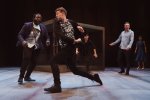
Ah, The Merry Wives of Windsor. The name sounds so innocent doesn’t it? Tea on the lawn at Runnymede. Happy jumble sales at Datchet. Street parties for the Queen down Windsor High Street. Well indeed, it was the Queen who wanted this in the first place, as the first scene of Fiona Laird’s new production at the RSC showed at first hand; a projection of Queen Elizabeth I querulously observing that her favourite Falstaff was being written out of Shakespeare’s next play, so she demands a new offering, showing Sir John in love, to be ready in two weeks. Much to Shakespeare’s chagrin.
 The ever constant challenge to make new productions of Shakespeare plays modern and relevant is just as valid in the frothy comedies as it is in the heavyweights. But Merry Wives is a significant play in many ways and deserves treating seriously. It’s one of the few Shakespeare plays that is completely original. It is the only one to be written entirely in prose. It’s the only one to be concerned with middle-class life in a small English town; to that extent, it’s the most similar in structure to a modern-day sitcom. Not uniquely, but it’s one of the plays where the action is most driven by female characters; and where female characters win the day. It’s also a contender for being Shakespeare’s funniest play. No wonder it keeps coming around, again and again.
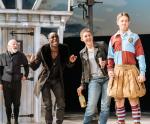 This is the 5th time I’ve seen the play; George Murcell as Falstaff at the now defunct St. George’s theatre in Tufnell Park in 1977; Peter Jeffrey in the RSC’s production at the Barbican in 1986; the Oxford Shakespeare Company’s productions in the grounds of Wadham College in 2005 and 2013; and now David Troughton as the randy big man with the RSC again in Stratford. Each one marvellous in their own way; and this latest production has more entertainment value than you can shake a stick at.
 And that’s down to the engagement of one Mr Toby Park, boss of Spymonkey, as Physical Comedy Director. We’ve seen Spymonkey several times, with their endlessly creative, pomposity-puncturing, ridiculousness-worshipping productions; if you’ve never seen a Spymonkey production, You Haven’t Lived. There are elements of Spymonkey-business running through this show like a stick of rock. But does the double-directorship work, dovetailing the comic business with the rest of it? Or is it an Eton Mess? (See what I did there?)
 I usually agree with the old saying, less is more. Maybe it’s because of my innate conservatism (small C, please note.) Maybe it’s due to my Public School upbringing – you’re not meant to have fun. If it hurts, it’s doing you good. Or maybe it’s because I value quality over quantity, in virtually all matters. However, when it comes to Spymonkey, I change my mind. In this production they throw absolutely everything at it. From the disgusting wheelybin to the pink flamingos by the side of the Fords’ swimming pool, from the stagestruck golf cart to Falstaff’s extravagant codpiece, from Dr Caius’ frenchisisms to Master Brook’s false nose; no visual joke, no audio prompt, no quirky playing with the script goes unmissed. It’s a numbers game. The more funny business you put in, the funnier the end product comes out. I’d say a good 95% of the comic content sticks solidly like… well you provide your own simile. If the main intention of a production of Merry Wives is to make the audience laugh – and why would it be anything else – this is a five-star extravaganza.
 Fiona Laird has picked this production up and moved it from west of the M25 to the east, to create a TOWIE version of the play – The Merry Wives of Billericay. The wise woman of Brentford has become the wise woman of Brentwood, which is somehow strangely funnier; Mistress Ford has her own beautician, which I’m sure isn’t in the original; the refuse guys who come to take away the lurid pink coloured wheelybin (belonging to the Royal Borough of Windsor and Essex) exchange jokes in Polish. Mistress Page hides behind a decadently large electric barbecue; Falstaff hides under a poolside lounger.
 Lez Brotherston’s fantastic costume designs enhance this Estuary Grandeur; Mistress Ford is genuinely stunning in her Versace trousers and tight-fitting top; the Hostess of the Garter is a vision in leopard skin; Pistol’s handbag (you read that right), Dr Caius’ bandana (ditto) and Fenton’s suitcase all reek of expense; and, above all, Master Ford and Master Slender are so trendy that they’ve given up on the socks. And the costumes and padding for Falstaff are genuinely hilarious and incredibly inventive; a quite remarkable achievement.
 I can’t decide whether the creative team encouraged the cast to portray their characters partly as impersonations, or whether it’s some natural, evolutionary by-product of the rehearsal procedure. But in any event it’s a delight to see Sybil Fawlty as Mistress Page, Julia Davis as Mistress Ford, Tracy Emin as the Hostess of the Garter, Ricky Gervais as Shallow, Del Boy Trotter as Master Ford, and my cousin Trevor as Slender. No offence, Trevor, but Tom Padley had you down to a T.
 The performances are gleefully brilliant from first to last. David Troughton is just magnificent (and only barely recognisable) as Falstaff, completely self-obsessed and repulsive, so puffed up in his own affairs that duping him is like taking candy from a baby. Of course, when a character is so set up in a high and mighty fashion, it makes you deliriously happy to see them crash and scarper in shame. Rebecca Lacey’s Mistress Page, outwardly so respectable but in reality a truly tough nut, can’t wait to interfere in Falstaff’s plans and eggs Beth Cordingly’s sassy Mistress Ford into playing the tart for the fat knight. Together they are a perfectly mischievous pair, and make a great comedy duo.
 David Acton almost steals the show with his childishly excitable performance as Evans the Welsh parson, his face lit up with joy as he revels in every prank; encouraging us all to join him in a Cardiff Arms Park (his words) chorus of Cwm Rhondda. He’s also a great partner-in-crime for Jonathan Cullen’s Dr Caius, murdering the French language with fantastic ease, espousing all the Spymonkey tenets of making yourself look as ridiculous as possible. I’ve been an admirer of Mr Cullen since I first saw him perform in the First Year Students’ competition at Oxford, when I was in the second year. We always knew he’d go far.
 Tim Samuels is a beautifully mealy-mouthed (and violent) Shallow and Tom Padley simply hilarious as his gormless nephew Slender, constantly trying to cover up his incessant faux pas. Luke Newberry invests the otherwise worthy but dull Fenton with a string of brilliantly performed pratfalls, Josh Finan is an irrepressible Nym, Katy Brittain a superb lush of a Hostess at the Garter, Vince Leigh a fabulously jealous Ford and Paul Dodds a proper bossy Page. But the whole cast work together to make a really funny and entertaining ensemble show.
 At the end of the day, it’s up to you whether you like the transferred location away from small town Berkshire to somewhere Chez Lakeside. I thought it worked fine. There are numerous liberties taken with the script, but if any Shakespeare play can take messing around with, it’s this one.
 Mrs Chrisparkle pointed out that in previous productions of Merry Wives that we’ve seen, Falstaff has been even more humiliated in that final horns and spirits scene. In this production, his shame is quickly achieved, and quickly over, which actually made a pleasant change – there’s only so far that you can humiliate one fat randy old knight. However, I sense something didn’t go quite right with that scene; there were a few spirits just hanging around doing nothing and blundering into each other. And the whole imagery of the ghosts and ghoulies is much scarier in its original location of a woodland glade than in a town centre piazza. Maybe it needs a little tightening up.
 Still that’s a small quibble with such a great show. We laughed, and laughed, and laughed. I’m sure you would too. Can’t recommend it strongly enough. It’s in the RSC repertoire at Stratford until 22nd September and then it’s on at the Barbican from 7th December until 5th January 2019 – that would be a perfect Christmas treat!
Production photos by Manuel Harlan