Lockdown Armchair Travel – Istanbul, Turkey – 29th March 2012

Continuing with the lockdown armchair travel memories, and T is for Turkey. We’ve been there a couple of times on cruises, and we had a week in Istanbul in the late 90s, but I can’t find any of the photos from that holiday. So these pictures are from a day spent in Istanbul during an Eastern Mediterranean cruise in March 2012, concentrating on The Main Sights. So, what do you think of, when you think of Istanbul? Probably one of two places, depending on whether you’re Team Blue Mosque…

Or Team Aya Sofya

It’s a tough call. From the photos, you’d always say the Blue Mosque, but when you’re inside the Aya Sofya, it takes your breath away. We took a tram from near the port into the centre of the city, and headed straight away for the central complex that houses both these magnificent buildings, plus the ancient hippodrome.

I’m not sure Constantine would remember it looking like this, mind. OK, let’s head straight for the Blue Mosque.

Really the Sultan Ahmed Mosque, built between 1609 – 1616.

One of the five mosques in Turkey that has six minarets, apparently.

It’s a big tourist favourite, but is primarily a working mosque. It has a relatively small courtyard fountain.

Delightful from the outside…

But its beauty really hits you inside!

Look at that amazing decorated ceiling!

It really is the definition of breathtaking.

It’s beautifully lit too

And the calligraphy is stunning

Architecturally fabulous!

The pictures tell their own story.

A brilliant place. After the Blue Mosque, we decided to find the Basilica Cistern, a favourite place of ours from our previous visit.

It’s called the Basilica Cistern, because it was built underneath a basilica in the reign of the Emperor Justinian in the sixth century.

It’s an incredibly dramatic and moody place, enhanced by the lighting

With just a little water in there to make some extra-dramatic reflections.

There are two columns topped with Medusa heads

Or, rather, upside down! It’s a dark and haunting place

But, being Istanbul, you’re never too far from a spot of commercialism…

That’s so out of place! Anyway we left the Cistern and returned to the other end of the main square to see the Aya Sofya.

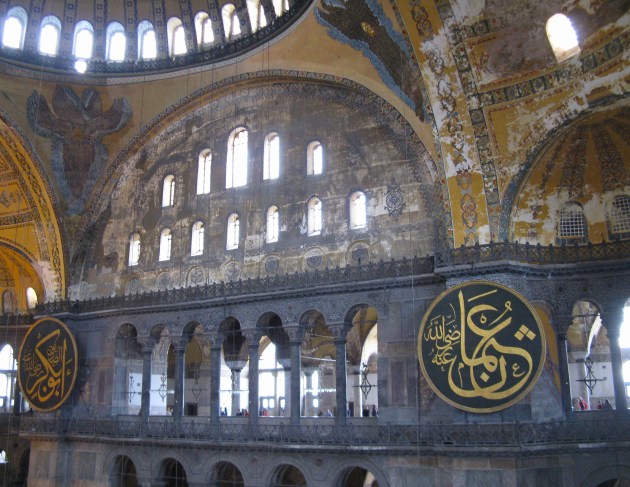
Or Hagia Sophia, if you prefer. It’s been a Roman Catholic cathedral, then it was converted to a mosque, and then in 1935 it was turned into a museum – which is how we saw it. But in 2020 it became a mosque again.

Those colours are extraordinary!

Just take it all in….

The immaculate marbled floor is apparently now covered by carpet

There’s a stunning minbar

Beautiful calligraphy

Marvellous windows

Fabulous tiled walls

Big pillars

Ramps lead up to an upper floor

From where you get this great view!

And you can get a closer look at some of the detail

You’re also closer to the mosaics – this is the Deësis mosaic

The Comnenus mosaic dates from 1122

The Empress Zoe mosaic is even earlier

Southwestern entrance mosaic dates from the reign of Basil II (958-1025)

The Aya Sofya even has nice doors!

And a look out of its upper floor windows reveals a fascinating collection of domes!

Yes, I think I am still Team Aya Sofya. Other interesting sights include the Egyptian Obelisk

With its intricate base

And the Serpentine Column

Shoppers, of course, head for the Grand Bazaar

A massive covered market, probably the best I’ve ever visited

It’s a maze where you can easily get lost

You’ll get invited in by the shopkeepers to share a “no-obligation” cup of apple tea

If you believe “no-obligation”, you’ll believe anything!

Great place for lighting

And ceramics

We had a quick walk past the University

But the other place I really wanted to see before we left was the Suleymaniye Mosque

Commissioned by Suleiman the Magnificent and inaugurated in 1557,

It was the largest mosque in Istanbul until the Çamlıca Mosque superseded it in 2019.

Four minarets, each and every one a stunner.

Again, it’s inside the mosque where the whole place comes alive

with its extraordinary ceilings

superb arches

and just its innate grandeur.

Although, to be fair, it’s pretty grand from the outside too.

Streetlife in Istanbul is pretty hectic, as you would expect

But the views make up for it

And you can easily blend in with the crowds.

And that’s Istanbul – grandeur, magnificence, and the occasional bit of quirkiness.

So we sail away and say farewell to Istanbul!


The Agatha Christie Challenge – The Clocks (1963)

STOP PRESS: The Agatha Christie Challenge is now available as a book in two revised volumes – details at the end of this blog post!

In which young Colin Lamb (not his real surname) is tasked to unearth an espionage hub, at the same time that he accompanies his pal Inspector Hardcastle in solving the mystery of the murder of an unidentified man found in someone else’s house, surrounded by clocks! Colin decides to enlist the help of his old friend Hercule Poirot – as a challenge to the revered (but elderly) detective to solve the crime from afar without meeting the suspects. And without his help, Hardcastle would have been lost. As usual, if you haven’t read the book yet, don’t worry, as always, I promise not to reveal whodunit!

The book is dedicated “to my old friend Mario with happy memories of delicious food at the Caprice”. The Caprice was a much-loved restaurant in St James’s London, opened in 1947 by Mario Gallati, who was formerly a Maitre D’ at the Ivy. A haven for celebrities and superstars, it was one of Diana, Princess of Wales’ favourite restaurants, along with Mick Jagger and Elizabeth Taylor. Mario Gallati ran the restaurant until 1975, and it closed in 2020 due to the Coronavirus pandemic. The Clocks was published in the UK in six abridged instalments in Woman’s Own magazine in November and December 1963, and in the US a condensed version of the novel appeared in the January 1964 issue of Cosmopolitan. The Woman’s Own publication coincided with the full book being first published in the UK by Collins Crime Club on 7th November 1963, and in the US by Dodd, Mead and Company in 1964.

The book had unorthodox origins. In 1949, Christie set a competition where she wrote the start of a short story, and competitors were invited to complete it. Her start involved a typist named Nancy who let herself into the front room of a house, to discover a dead man, a blind woman and a collection of clocks. The competition was to work this up into a tale and a solution. Whilst there are a number of differences between what she wrote for the competition and what appears in The Clocks, clearly she went back to this idea to start her new novel. Maybe the fact that she originally thought of the presence of the clocks in the room as a jumping-board for others to come up with an interesting story accounts for the fact that Christie herself didn’t really know what to make of all those clocks herself, as is revealed in the ending to the book.

This is an unusual read in many respects. I’m sure I’m not alone in that I’ve read this book several times over my life and each time I cannot remember a thing about it apart from its riveting opening scene, one of Christie’s paciest and most rewarding starts. Once the crime has been established, and we understand that Colin is working on two projects side by side, the first part of the book becomes a rather friendly, popping round for tea at the neighbours’ sequence of conversations, as Colin and Hardcastle try to identify what’s gone on. As we slowly realise that we’re being introduced to all the potential suspects in the book, we gain a sense of claustrophobia, as the world of The Clocks is firmly rooted in Wilbraham Crescent and its off-shoot streets.

It’s a tremendously engaging book, and one of her more difficult-to-put-down works, and the excitement and suspense continues to rise as it proceeds, and you feel whatever external powers of evil there are, close in on our detective heroes. Yet at the end it all seems to peter out; the solution is relatively hard to follow and comprehend, there’s a jump of logic/intelligence that I think I understand – but it’s weak, and one of the book’s most intriguing aspects – that of the clocks themselves – at the end comes to absolutely nothing. Thus a crescendo of interest soars as the book progresses, all to become a last minute diminuendo in the final analysis.

The narrative approach to the book is a mix of Colin Lamb’s own account of his activity and Christie’s narrative voice. It’s not obvious why Christie has structured it in this way; indeed, at one point I wondered whether Colin’s involvement was going to have something of the Roger Ackroyd’s about it. Unfortunately, Colin isn’t that well drawn a character to make his narration stand out beside Christie’s; but as the two are telling precisely the same story, within precisely the same timescale, it doesn’t add or detract either way. In Christie’s universe, Colin is one of Superintendent Battle’s children; she confirmed it as such in a 1967 interview. This explains why he conceals his real surname and why such a young man might be such good friends with such an old one – Poirot. Detection running through his veins may also explain why he has such an incredible but fanciful insight into the parentage of Sheila.

But it’s Colin’s friend Inspector Dick Hardcastle, whose job it is, to detect who the dead man is, and by whom he was killed. Hardcastle doesn’t have Colin’s flashes of inspiration; in fact, he comes across as rather cumbersome and slow of mind. Christie describes him as “a tall, poker-faced man with expressive eyebrows”, who appears on the scene “godlike, to see that all he had put in motion was being done, and done properly.” When he realises that Miss Pebmarsh is blind, he is clumsy and unintentionally offensive with his language, challenging her ability “to see those clocks”. “”See?”  Hardcastle was quick to query the word. “Examine would be a better word, “  said Miss Pebmarsh, “but even blind people, Inspector, use conventional modes of speech that do not exactly apply to their own powers.”” Nevertheless, when he realises that if he had reacted differently in another scene then he might have averted another death, he blames no one but himself; “left alone he made an effort to subdue his rising anger and self-condemnation.”

And what of Poirot? It’s been three years since we’ve seen him – four, if you exclude his presence in The Adventure of the Christmas Pudding, where the stories were actually written decades before that publication. His servant George advises Colin that “sometimes he gets a little depressed”, and we first see him seated in front of an electric bar heater, surrounded by books that he reads to keep his little grey cells active. He is desperate to be captivated by an intellectual challenge, and reels off classic whodunit after classic, admiring the methods of their famous detectives. It feels a little as though old age has relegated Poirot to sleuthing from a distance, second-guessing detective fiction, rather than being allowed to become actively involved in any cases – and it’s a rather sad feeling. Christie has Poirot going on at length about these writers, which, although has a relevance later on in the book, comes across as rather obsessive and, frankly, dull.

It is, however, amusing when Poirot criticises the works of his friend and ours, Ariadne Oliver, because, by doing so, we know that it’s actually Christie criticising herself – as Mrs Oliver is how Christie portrayed herself in some of her later novels. Whilst she doesn’t actually appear in this story, she is referred to a number of times. Miss Martindale has her signed photograph on her office wall. Colin likens some of the more fanciful aspects of the case to a typical Oliver book (very tongue in cheek). And Poirot hates the way she over-uses the convention of coincidence, and scorns the fact that she doesn’t know the first thing about the foreign country from whence her detective hails. Sounds familiar! Miss Lemon is still Poirot’s secretary, writing the letters that he instructs; and he also refers to two of his previous cases, the tale of the kidnapped Pekinese dog that was The Nemean Lion from The Labours of Hercules, and “the Girl Guide murder case” that was Dead Man’s Folly.

At the end of the book Poirot loses his temper with Colin, as the latter presses him for a reason why he decides to come to Crowdean and explain his solution to the crime there, rather than staying in London. “Since you are too stupid to guess […] I am human, am I not? I can be the machine if it is necessary. I can lie back and think. I can solve the problems so. But I am human, I tell you. And the problems concern human beings […] I came out of human curiosity.” Poirot misses his old life more than he is prepared to say.

As just mentioned, we’re in Crowdean, a seaside town of moderate size and holiday interest, and the pages of the book are set in a warren of suburban anonymity. Wilbraham Crescent features so much in the book that it’s almost a character of its own. Given Christie’s earlier propensity for adding maps and plans to some of her books, I think she missed an opportunity to provide a helpful street plan of the area in its early chapters, which would explain more clearly why people get lost on that street trying to locate some of the numbers.

I very much enjoyed the way Christie has all the locals talking about the case and inventing wild assumptions about it that have absolutely no grounds in truth – rather like Rumour in an old Greek tragedy. However, the discovery of the child Geraldine, observing everything going on in the neighbourhood from her tower block window, and the easy way that Colin pumps her for information and evidence, feels too convenient for words, and is obviously not one of Christie’s best devices. Nevertheless, despite a few failings in the structure and the logic of its deductions, it’s a cracking read, and, rather like The Pale Horse, you’ve still got no idea whodunit with less than 20 pages to go.

Now for the references, starting with the locations. The book is almost entirely set within the confines of Crowdean, Sussex; a fictional place with fictional roads, but whose names might suggest that Crowdean is an amalgam of Brighton, Newhaven and other small seaside towns. It is ten miles from another fictional town, Portlebury. The only other places mentioned are the fictional Shipton Bois, a one-horse market town in Suffolk, and some obviously real locations in London near Beck’s office. Sheila Webb’s London address – 17 Carrington Grove – is made up. Miss Pebmarsh works at the Aaronberg Institute, which sounds like a splendid organisation, but it’s purely the result of Christie’s fevered brain. With a nod to the writer’s tendency to make up names based on geographical locations, Poirot draws our attention to the fact that the dead man had a card in the name of Mr Curry and the person who identified the body was Mrs Rival – and that Curry Rival is the name of a village in Somerset. Actually he’s wrong – it’s Curry Rivel – but we get the picture.

In other references, Mrs Hemming emerges at her front door wearing a tea gown. I’ve never heard of one of those before, and by 1963 they would have been very out of date. Popular in the mid-19th century, they were designed to be worn whilst entertaining informally (maybe at dinner) indoors. It was wrong to be seen wearing a tea gown outside. According to Wikipedia, they were characterised “by unstructured lines and light fabrics”.

Poirot makes the same reference to Sherlock Holmes’ Adventure of the Six Napoleons, (“the depth at which the parsley has sunk into the butter”) as Dr Haydock in The Mirror Crack’d from Side to Side. He also cites the Charles Bravo and Lizzie Borden cases, both of which Christie referred to in Ordeal by Innocence. Colin refers to Adelaide Bartlett, who may have murdered her husband in the Pimlico Poisoning case of 1886, and Poirot mentions the child murderer Constance Kent, who is also mentioned in Crooked House.

In further literary references, Poirot has a range of books that he is enjoying, some of which are real, and some are fictional. He’s sharpening his little grey cells on The Leavenworth Case, an American detective novel and the first novel by Anna Katharine Green, dated 1878. He loves The Adventures of Arsene Lupin, Maurice Leblanc’s turn of the century French equivalent of Sherlock Holmes. He finds The Mystery of the Yellow Room a classic, Gaston Leroux’s 1908 locked-room mystery. He admires Cyril Quain as the master of the alibi – commentators identify Quain as Freeman Willis Crofts; Florence Elks and Louisa O’Malley are also cited, and various opinions abound as to whom they could refer. Garry Gregson, whose writing plays a slightly more important role in the book than everyone else’s, is pure invention. Dickson Carr, G K Chesterton and Conan Doyle also get the odd look-in.

Few readers wouldn’t recognise Poirot quoting The Walrus and the Carpenter in Chapter XIV, but his quote “dilly dilly dilly – come and be killed” is not so recognisable to a modern readership. This is from Samuel Foote’s two-act farce The Mayor of Garret (1763), and became both a nursery rhyme and a music hall song. The dilly in the quote is a duck, with a Mrs Bond going out into the farmyard to catch herself a duck for dinner. “Dilly, dilly, dilly, dilly, come to be killed, / For you must be stuffed and my customers filled!”

Regular readers will know that I like to consider any significant sums of money in Christie’s books and work out what their value would be today, just to get a feel of the range of sums that we’re looking at. There’s only one in this book – the sum of £7 10/- is found on the dead man’s body. That’s the equivalent of about £110 today. Just about the amount of money you might take out with you to cover you for most needs on a day out.


Now it’s time for my usual at-a-glance summary, for The Clocks:


Publication Details: 1963. My copy is the Crime Club hardback first edition, but lacking the dust jacket. I bought it for 25p at a fete in about 1970 – about £2.50 at today’s rates. Not bad for a Christie first edition. It’s probably held its value!

How many pages until the first death: 5. One of the paciest and most entertaining starts to a Christie novel, and that early death really lets you get on with the important business of solving the crime.

Funny lines out of context: Some funny lines, both in and out of context.

“Its painstaking eroticism left her uninterested – as indeed it did most of Mr Levine’s readers, in spite of his efforts. He was a notable example of the fact that nothing can be duller than dull pornography.” (Not a line one would normally associate with Christie!)

“”Edna sighed and put in a fresh sheet of paper: “Desire had him in its grasp. With frenzied fingers he tore the fragile chiffon from her breasts and forced her down on the soap.” “Damn,” said Edna and reached for the eraser.””

(Imagine you’re at a Julian Clary pantomime) “It was just after two o’clock that I walked into the station and asked for Dick.”

Memorable characters:

The major characters aren’t that memorable, regrettably, with neither Colin nor Hardcastle being particularly interesting. I liked the portrayal of the mad cat woman Mrs Hemming, and Miss Pebmarsh is well drawn, with her crystal clear thought processes and no-nonsense attitude. The dopey Edna and the inebriated Mrs Rival are also entertainingly written. Curiously, one of the most interesting characters is that of Wilbraham Crescent itself, a constant presence in the book and one that takes on human force from time to time, such as when Colin wished the stones of the street could speak. “Wilbraham Crescent remained silently itself. Old-fashioned, aloof, rather shabby, and not given to conversation. Disapproving, I was sure, of itinerant prowlers who didn’t even know that they were looking for.”

Christie the Poison expert:

Knifing and strangling are the favoured methods of murder in this book, but chloral hydrate is also used as part of the story. At the time of writing it was often used as a sedative before minor medical or dental treatment, or to treat insomnia, but is currently unlicensed within either the UK, the EU or the USA.

Class/social issues of the time:

Following on from the in-depth look at modern living that strongly characterised Christie’s previous book, The Mirror Crack’d from Side to Side, it’s perhaps surprising that it isn’t developed more in this book. There are, however, a couple of references to modern housing about which, despite the comfort they bring, Christie still manages to cast aspersions. She describes the quirkiness of Wilbraham Crescent with a kind regard, calling it a Victorian fantasy; “the houses were neat, prim, artistically balconied and eminently respectable. Modernisation has as yet barely touched them – on the outside, that is to say, kitchens and bathrooms were the first to feel the wind of change.”

It’s when Colin is walking through Wilbraham Crescent that he notes “in one or two houses I could see through the uncurtained windows a group of one or two people round a dining table, but even that was exceedingly rare. Either the windows were discreetly screened with nylon netting, as opposed to the once popular Nottingham lace, or – which was far more probable – anyone who was at home was eating in the “modern” kitchen, according to the custom of the 1960s.” Remember Colin is a young man in his early 20s. This is not the kind of observation one would expect him to make. Rather, it’s Christie’s disapproval of abandoning the dining room for the kitchen that is being voiced.

It’s notable that the residents were being pestered by the Press. Hardcastle defends the Press, saying they have their job to do; but Mrs Lawton, who has clearly been pestered already, has no sympathy. “It’s a shame to worry private people as they do […] saying they have to have news for the public. The only thing I’ve ever noticed about the news that they print is that it’s a tissue of lies from beginning to end. They’ll cook up anything so far as I can see.” I don’t know if Christie had an unfortunate relationship with the Press – maybe they pestered her at the time of her disappearance and her divorce. She featured the busybodying journalist Charles Enderby in The Sittaford Mystery. Anyway, it looks like there’s no love lost there – and the concerns she raises about the freedoms of the Press are definitely as valid today as they were then.

That also applies to another political hot potato that rears its ugly head in this book – Europe! The Common Market (aka the EEC) had started in 1957, and by the time of The Clocks was a familiar framework in Europe, if not the UK. Hardcastle’s interview with Miss Pebmarsh’s cleaning lady, Mrs Curtin, reveals her to be very suspicious of it. When he questions her about the cuckoo clock, she leaps to some assumptions: “Must have been foreign […] Me and my old man went on a coach trip to Switzerland and Italy once and it was a whole hour further on there. Must be something to do with the Common Market. I don’t hold with the Common Market and nor does Mr Curtin. England’s good enough for me.” Mrs Curtin there, revealing how a little knowledge can be a dangerous thing.

Apart from Mrs Curtin’s European prejudices, there aren’t too many examples of the usual Christie xenophobia in this book. Mrs Bland avows that she wouldn’t “care at all for a foreign doctor. I wouldn’t have any confidence in him” – and at her husband’s suggestion they go on a Greek island cruise, she worries “there’d be a proper English doctor on board, I suppose”. Similarly, Mrs Ramsay rejects Colin’s idea that “ one of those foreign girls” would help her domestically; “au pair, don’t they call it , come and do chores here in return for learning English”. ““I suppose I might try something of that kind,” said Mrs Ramsay, considering, “though I always feel that foreigners may be difficult.”” Elsewhere there is an example of that occasional Christie theme that the police aren’t really quality people. Mrs Head tells Miss Waterhouse, “a couple of gentlemen want to see you […] leastways […] they aren’t really gentlemen – it’s the police.” She further explains that she didn’t take them to the drawing room, but the dining room. “I’d cleared away breakfast and I thought that that would be more proper a place. I mean, they’re only the police after all.”

Classic denouement:  There are elements of a classic denouement, but it doesn’t quite make it. For one thing, it’s a highly complicated solution – even though Poirot maintains it is simplicity itself. Secondly, the suspects are not there – just Poirot, Colin and Hardcastle. However, Poirot still unveils his solution stage by stage, piece by piece, revelation by revelation, and it’s an incredibly exciting reveal. Some of the drama is lost by there being a further chapter that ties up Colin’s espionage case, and also two letters from Hardcastle to Poirot, informing him of additional discoveries and confessions after the event. Whilst we need that information for completeness, it does detract from the grand denouement.

Happy ending? There is a marriage – so we wish the happy couple well. Apart from that, and the fact that the guilty parties are dealt with, one senses that nothing will change in Wilbraham Crescent, which may, or may not, be a happy outcome.

Did the story ring true? There’s a surprising ordinariness to the environment that makes a strong contrast with the fanciful nature of the crime, and that, for the most part, helps to make the story pretty believable on the whole.

Overall satisfaction rating: It’s an excellent read, and was certainly heading for a 10/10 all the way through, but the final solution is both a little overcomplicated and under-delivering, so it drops to a 9 in the final analysis. But it’s a very enjoyable book.

Thanks for reading my blog of The Clocks, and if you’ve read it too, I’d love to know what you think. Please just add a comment in the space below. Next up in the Agatha Christie Challenge is A Caribbean Mystery, and Miss Marple on holiday in the West Indies – but of course, she’s never far away from crime. I can’t remember anything about it, so I’m looking forward to re-reading it and, as usual, I’ll blog my thoughts about it in a few weeks’ time. In the meantime, please read it too then we can compare notes! Happy sleuthing!


If you enjoy my Agatha Christie Challenge, did you know it is now available as a book? In two revised volumes, it contains all my observations about Christie’s books and short stories, and also includes all her plays! The perfect birthday or Christmas gift, you can buy it from Amazon – the links are here and here!

Lockdown Armchair Travel – Tunis, Tunisia, 19th December 2012

Finally moving off S and on to T, and T is for Tunisia and one day spent in its capital, Tunis, during a Mediterranean cruise shortly before Christmas in 2012. So, when you think of Tunis, what do you think of? Probably not this…

But our cruise was one of the first that called into Tunisia after its 2011 revolution, and there were still plenty of military around, worried about security.

However, it didn’t spoil our day – the country was desperate to revitalise its old tourist industry, and the soldiers simply ignored us. Tunis is a delightful mix of the old and the new. Modern architecture like the City Hall

Sit comfortably side by side with sights such as the Catholic Cathedral of St. Vincent de Paul.

The modernity of the University

And the tradition of the Youssef Dey Mosque

As with many Muslim cities, you get the best feel for real life in the bazaars and the souks. Tunis has a wealth of them.

You can have your hair cut

Buy from a tailor

Have a coffee

Buy food

Buy decorative trinkets

And of course, a magic flying carpet!

And there’ll always be a traditional dancer there to encourage you to buy!

The architecture of the souks and the old town is fascinating too. I love the old doors

And those Moorish arches

And, of course, the tiles

Walking the streets is where you see the real people and the real sights

Outside Tunis, Sidi Bou Said is known for its beautiful blues.

Just one day  in Tunisia is obviously not enough, but you can get just a taste of the life here.

And there’ll always be a traditional welcome for day trippers off a cruise!


The George Orwell Challenge – Common Lodging Houses (1932)

By 1932, Orwell was teaching at a boys’ school in West London but was also writing articles for submission to magazines and journals. With this article, Common Lodging Houses, published in the New Statesman on 3rd September 1932, and signed Eric Blair, Orwell recalls his regular experiences over the previous couple of years when he chose to live as a tramp, to find out what it was like to endure the hardships of life with no money, job, or home, as a form of journalistic research.  Common Lodging Houses is a factual account of what it’s like to rely on such places, “night-shelters specially licensed by the LCC” – that was the old London County Council.

In 1931 his essay The Spike had been published, which told his experience of staying in a casual ward of a workhouse, the slang term for which was a spike. That essay is a grim depiction of filth and squalor, and the indignities suffered by those who slept there. However, in Common Lodging Houses, Orwell finds they’re not much better than spikes, and in some respects, considerably worse, noting “considering that they house so many people and that most of them are in an extraordinarily bad state common lodging houses do not get the attention they deserve.”

To be specific: “the dormitories are horrible fetid dens, packing with anything up to a hundred men, and furnished with beds a good deal inferior to those in a London casual ward.” He points out that the beds are small and hard, with thin, dirty bedclothes, and with access to neither baths nor privacy; but Orwell goes on to emphasise the horror of the filth. “As often as not the beds are verminous, and the kitchens invariably swarm with cockroaches or black beetles.” Casual wards, or spikes were free; in fact, it was a condition of entry that you were forbidden to bring any money in with you. But Orwell reveals that the charges for a night in a common lodging house vary between 7d and 1s 1d per night; and because so many people use them, “the average common lodging house brings in something like £40 net profit a week to its owner.” That’s the equivalent of around £2000 per week today.

This is Orwell’s main source of despair in this essay. By licensing these lodgings, proprietors could profiteer from the men who stay there, whilst offering a service that is in many ways worse than the (unlicensed) spikes. In addition, Orwell describes the rules and regulations for staying in a house as “exceedingly tyrannical”; “gambling, drunkenness, or even the introduction of liquor, swearing, spitting on the floor, keeping tame animals, fighting – in short, the shole social life of these places – are all forbidden.”

He gives an example of how the legislation effectively works against the lodgers, rather than in their favour. When lodging house owners were required to comply with an LCC regulation that the beds in a dormitory had to be at least 3ft apart, thereby reducing the numbers of beds, and therefore the number of paying customers, they simply increased the prices, without providing any further upgrade to the living conditions. With lodging there was no scope for men and women to be in the same house; nor was there any remedy for the lodgers to prevent the constant appearance of slumming parties – 1930s style slum tourism, people “who march into the kitchen uninvited and hold lengthy religious services”. Orwell criticises the reasoning behind what he calls the “interference-legislation” that governs the common lodging houses: “their emphasis is on hygiene and morals, and the question of comfort is left to the lodging house proprietor”.

The essay is not written simply to alert the reader to what life in a lodging house is like, nor is it simply to bemoan the fate of the unfortunate people who have no choice but to live there. He also offers constructive suggestions to improve the houses. “The LCC would be doing an immense service if they compelled lodging house keepers to divide their dormitories into cubicles and, above all, to provide comfortable beds”; even the casual wards had their cells. “The houses should be licensed for both sexes alike […] and the lodgers should be protected by law against various swindles which the proprietors and managers are now able to practice on them.” Orwell also displays a resentment towards this kind of exploitation in his essay on Hop Picking. He asks the question: “Can anyone imagine such things being tolerated in a hotel? And yet a common lodging house is only a hotel at which one pays 8d a night instead of 10s 6d. This kind of petty tyranny can, in fact, only be defended on the theory that a man poor enough to live in a common lodging house thereby forfeits some of his rights as a citizen.” Highlighting this social injustice is the core of this essay.

There is an alternative to the lodging house, which Orwell briefly touches on; the hostels provided by the Salvation Army and the Rowton Houses – a chain of hostels built by the philanthropist Lord Rowton, who had been Disraeli’s private secretary. According to Orwell, these are “clean and decent. Unfortunately, all of these places set off their advantages by a discipline so rigid and tiresome that to stay in them is rather like being in jail.” Orwell calls not only for decent conditions for poor people, but also respect for them to live their own lives, and not to have to comply with lifestyles imposed on them by their “betters”. His final summing up in the article reveals that harsh alternative on offer. “Tens of thousands of unemployed and partially employed men have literally no other place in which they can live. It is absurd that they should be compelled to choose, as they are at present, between an easy-going pigsty and a hygienic prison.”

Like his essay on hop picking, this is a fact-filled piece of journalistic reporting, also serving as an opinion piece on how low cost lodging could be improved. Orwell’s deep understanding and despising of the horrors that these men must endure is clear in every sentence. He rarely needs to spell it out for the reader to know his precise feelings. Describing the dormitories as “horrible fetid dens” and the kitchens as “murky, troglodytic caves” is enough for us to get an insight into the conditions for ourselves; and his inevitable hatred of those who seek to make money out of the misery of others is obvious throughout. If the reader has any sense of socialism in their soul, this is bound to bring it out! I’m expecting much more of these insights and observations in his next published work, the full-length non-fiction Down and Out in Paris and London, which would appear a few months later, and which I’m looking forward to reading for the first time since I was a teenager.

The Paul Berna Challenge – Gaby and the New Money Fraud (1961)

In which we return to the world of Gaby, Marion, Zidore and the other members of the Hundred Million Francs gang, where Gaby and Zidore are now grown up and working, and Gaby can’t see himself in the role of gang leader anymore. But when the gang put pressure on him to stay by chipping in to buy him a car, all looks rosy until counterfeit money follows them wherever they go!

Gaby and the New Money Fraud was first published in 1961 by G. P. Rouge et Or under its original French title Le Bout du Monde, which translates literally as The End of the World, with a jacket illustration by Barry Wilkinson, but, unusually, no further illustrations inside. As “Gaby and the New Money Fraud”, the book was first published in the UK by The Bodley Head in 1971, and translated, as usual, by John Buchanan-Brown. My own copy of the book is the Bodley Head first edition, bearing the price 90p. A quick check online suggests there aren’t any copies of this book available to buy at the moment, sadly. It had been two years since Berna’s last book for children, Le Champion (never translated into English), was published, but he hadn’t been sitting on his laurels; in fact, during that time he’d written at least another four novels under the pseudonym Paul Gerrard, including the award winning thriller, Deuil en rouge. But, two years on, Berna was back in the saddle for this entertaining story of Gaby and his gang acting as unwitting couriers for a counterfeit money scam!

It was at the end of A Hundred Million Francs that Gaby was in tears because, having reached the grand old age of 12, he thought he was too old to be a gang member. Six years later, and Gaby still has the same doubts, although he deals with it in a slightly more adult way. He doesn’t burst into tears, but he’s frustrated by his own lack of maturity, which would allow him to move on with good grace and friendship. As a result, he’s angry and grumpy instead. “”Here’s my bomb! From this moment on you can call yourselves the Eight. You can have my resignation here and now – and Zidore’s too, if you want it.” Deathly silence greeted the news. Marion was still half-grinning, but the others seemed both shocked and upset. Fair-haired Mélie began to snivel. “No, Gaby, you wouldn’t dare do that…” “Oh yes I would!” the leader of the Ten bellowed. I’m telling you, it’s all over and done with now […] Zidore and me are too old for kids’ games now!””

One of the great things about this book is that we observe Gaby growing from a boy to a man. We actually find out Gaby’s date of birth – 29/4/52 – which was presumably brought forward a decade for the English translation and publication, otherwise, he’d only be 9! He seems to have great anger management issues, not only with the others in the gang, but also with the police, which suggests he might get himself into serious problems in the future. But we care about Gaby. When Patrice and Pedro trap Gaby and Zidore in the shed, you really feel the injustice of the action! You’re surprised how much you care about them, and how you resent the fact that they’ve been caught in danger. Gaby has been a hero to us and to his friends for a few years now, so it’s surprisingly alarming and off-putting to discover this internal anger that you sense will haunt him in years to come. This book isn’t the last time we meet Gaby – let’s hope he’s calmed down by the time he makes his final appearance.

We also follow Marion growing from a girl to a woman. She retains a much stronger grasp of common sense and obeying the law, which will stand her in good stead in the future. She deliberately allows Patrice to think she’s stupid, but it’s in order to get her own way. But it’s disappointing to see Gaby and Zidore not treating her with the respect that she deserves. There’s a particularly difficult scene where Zidore manhandles her into the van when she’s making the point that they should not go away until the police have made their enquiries. Berna notes the difficulty she has keeping her public face as part of the gang and her injured private emotions. “Marion laughed with the others to avoid upsetting anyone, but her abduction rankled and she kept a discreet eye on the road.” It’s also regrettable to see Fernand playing so small a part in this book – he doesn’t appear to step in and protect her as you feel he should.

As always, Berna is at his best when conveying what it’s like to be a member of a gang. And, as the gang members get older, there’s an art to maintaining that gang mentality. In this book, Zidore seems to have made a closer friend with Juan, who’s a lot younger and poorer. Maybe this is because Gaby seems to get annoyed at the turn of a hat, finding it difficult to turn off his unease at being the oldest. Everyone still firmly adheres to their gang roles, which makes it easier to stick together. When Gaby allocates the jobs that everyone will do on their holiday trip, the younger girls get given first-aid and all the housework, and Marion isn’t given a role at all: “just watch the countryside go by”. She’s quite angry about this. He’s so sexist!

Once again, Berna depicts a gang concentrating their interest in scheming to make money to achieve a particular aim. As in The Knights of King Midas, where Charloun and his gang raise money for the local homeless, in this book Gaby and his gang put in so much effort, not only to raise the money to buy the van, but also to insure it, maintain it and fill it with petrol. And when the opportunity to earn something comes their way, they never refuse it!

Even though we’re a few years on, Louvigny remains a highly urban yet poor environment. Both Gaby and Zidore have taken a very traditional route into the world of work – Gaby following his father by working on the railways, and Zidore following his natural ability with engines by working at the local garage. It’s interesting, from today’s perspective, that, despite the poverty of their environment, they obviously faced no difficulty in getting jobs; sadly that would be unlikely today.

The English title of the book, which has a very different emphasis from the original French title, maybe doesn’t reflect the content of the book too well. Like the previous book, The Mystery of the Cross Eyed Man, the English title takes one aspect of the story and gives you an expectation that perhaps is not met in the story as a whole. The original French title, The End of the World, is first alluded to when Gaby and the gang are sitting in Marion’s mother’s garden at the beginning of the book, remembering their old adventures. ““Sometimes,” [Gaby] grumbled as he looked round, “you hardly know the place. Remember the old days? The Clos Pecqueux was the end of the world so far as we were concerned.” “Some people still think it is,” Marion said. We’re too old for it now. We’ll have to look somewhere else.”” The Clos Pecqueux was a ruined enclosure, full of bomb craters, which constituted the gang’s playground and which we first came across in A Hundred Million Francs. They thought of it as the end of the world, Le Bout du Monde. That was as far as their imagination and experience could take them in those early, poverty-stricken days. Six years on, the Clos Pecqueux is home to a brand-new estate of bungalows, and, similarly, the youngsters also have their sights set much farther. Itchy feet tell Gaby and Zidore (at least) that it’s time to move on. Marion returns to the idea of the end of the world as their adventure culminates in a night in prison cells – a very ironic reflection of how their dream holiday ended up. So it’s a clever title – something of a double-edged sword.

But the link established between new Franc and the new Penny, with the title Gaby and the New Money Fraud is very tenuous. My memory is that in 1971 people were primarily concerned about not understanding the new currency, and that it would be an opportunity for unscrupulous people to make a lot of money by putting a higher price on an item than it bore before the changeover. I don’t think anyone was that concerned about forgeries, or the coins breaking in two! It seems odd that the publishers took the opportunity to have this otherwise untranslated book available to an English-speaking market just on the strength of that. I don’t understand why it wasn’t translated before – as it follows Berna’s most successful characters on their journey into young adulthood. There is also a later book involving Gaby’s gang – The Mystery of Saint Salgue – which was published in English in 1963, which means that Gaby and the New Money Fraud was published out of sequence. So, indeed, the title does not reflect the story that well, and puts a different emphasis on its content, that of the criminal activity of Patrice and his pals, rather than the growing-up of the gang members.

Like The Mystery of the Cross Eyed Man, this is another book full of real locations, and you can largely track the routes that the gang members take as they travel around Paris and head south towards their holiday destination. Zidore and Juan take the search for a car as far away as the Forest of Senart, a real area to the south east of Orly Airport. The Carrefour de l’Alouette, where Patrice’s garage is situated, doesn’t exist in Montgeron (which does), although there is one in Brebières, in northern France. Patrice says the smelting plants are based at Villejuif, Maisons-Alfort, Brunoy or at Saint-Maur, all of which are real places, south and south-east of central Paris. Apart from those, the only exception is that the Rue des Petits-Pauvres is now renamed the rue Zavatta, but I still can’t see one on a map of Paris!

It’s a matter of the era when this was written that there are a few times when the racial descriptions are outmoded. It’s not remotely racist – in fact, quite the opposite, Gaby’s gang is incredibly inclusive. But when you read it, there’s something not entirely comfortable about Berna often referring to Juan as “the gypsy”, and Criquet Lariqué as the “little coloured boy”.

Despite this, there are, as usual, some tremendously thought-provoking and beautifully created passages. I really liked Berna’s description of Marion sizing up whether she should sell more dogs. “When the argument raged the loudest, she turned her back on the gang and stared at her hounds with the cold calculation of the farmer’s wife coming into the fowl-yard with a carving-knife behind her back. Her four-footed guests seemed to understand and stood still, their heads cocked and their eyes watching her.” Still with the dogs, there’s a wonderful sequence where we follow Marion’s dogs Dick and Bébert as they follow the scent of the boys, the van and the villains. It’s all seen from their point of view, with their names for the characters, and their canine conversations. It’s very inventive and creative, and makes you realise that the dogs are just as important as the humans!

I was very amused by how the gang rearrange the configuration of the van, so that they can create a square seating area in the back, with sofas, chairs, windows, and so on, to create a convivial living space. This could never happen with today’s regulations, and it was clearly written long before the value of seat belts was recognised!

Here’s my chapter by chapter synopsis of the book. If you haven’t read the book yet and don’t want to see any spoilers, here’s where you have to stop reading!


Chapter One – A Marvellous Idea. During a meeting of the gang, they are surprised by a thunderous roar from a vehicle – and are shocked to discover Old Zigon, the rag and bone man from previous books, driving a van bearing the legend “The Junk Palace”. He must have come into some money, they think; and someone says “everybody’s got a car these days: why don’t we get one?” All the gang members go into a reverie of what their dream car would be like, and their ideas reflect their personalities. Gaby and Zidore want flashy sports cars. Tatave relishes the comfort of a Rolls-Royce. Minimalist and practical Fernand hopes for a 2CV. Juan wants a Berliet truck, Bonbon would be satisfied with a toy car, and Criquet Lariqué misunderstands the game and wants a fire engine. Mélie, Babin and Berthe all want an ambulance so they could help people after an accident. Only Marion doesn’t play along; as the gang’s treasurer she knows that a car would be unaffordable. They’ve only got three francs in the kitty, and one of those is a dud – a counterfeit coin that keeps on coming back to them in small change. Tatave agrees to try and palm it off when he buys bread the next day, but Gaby, enraged at their poverty, and the fact that a third of their wealth is a dud, insists he tries now.

Later on, the gang are sitting in Mme Fabert’s front garden – that’s Marion’s mother – remembering old times. The Clos Pecqueux was their old, ruined playground, but the wilderness has now been built on, with brand new bungalows. Gaby and Zidore get the sense that it’s time for them to move on too. Now that Gaby is working on the railways and Zidore is working at the Metropole garage, they don’t have the time to commit to their old friends. Gaby drops his “bomb”, to the effect that he and Zidore are now too old for all of this and want to resign from the gang. Whilst the others are surprised and upset, Marion could see this coming. But she’s still annoyed for the rest of them, calling the boys selfish, and accusing Gaby of saving money to buy a motorbike – money that he would normally have spent on gang activities. Everyone starts mocking the two senior boys, much to their fury and embarrassment. But Marion has a solution: “you’d be safer on four wheels than two, and your mates could join in the fun […] a car, of course. Let’s go and buy one. We’ll move mountains to raise enough money. And we could do it, too. We’ve plenty of ideas.”

The offer stops Gaby and Zidore in their tracks. At that moment Tatave returns empty-handed; the baker spotted the fake franc and sent him away with a flea in his ear and a sore cheek. They decide that Tatave can keep the coin as a present. And as they all decide what kind of car they would like, the meeting descends into knockabout farce. Zigon and his van career back into view; Gaby isn’t impressed, and is determined they won’t have a vehicle like his. Zidore recommends “an old-fashioned saloon car”, and Gaby agrees that Zidore should source the perfect vehicle at the best price. Their resignations from the gang duly withdrawn, all that remains is to tell Gaby’s father about their plan. “First pass your driving-test: then we’ll see.”


Chapter Two – The Poor Man’s Rolls. A week later, Zidore and Juan chance upon M. Patrice’s garage in Montgeron, full of broken-down old wrecks – but they ask their question anyway. “I work at the Metropole Garage in Louvigny”, said Zidore; “I heard a whisper that you’d got a second-hand saloon in good running order… Could we have a look at it?” Patrice shows them his Peugeot 602. In excellent condition, but 25 years old and looks like a tank. It wasn’t what Zidore and Juan had in mind, however… “five hundred francs! And we haven’t a penny of it so far…” Instead, Patrice shows them round the old crocks outside; cheaper, but all of them unsuitable. He has warmed to the boys and makes them a great offer for the 602. Three hundred francs down, and six months to pay the balance. Zidore knows he has to spin a good story to get the agreement of Gaby and Marion.

The gang’s coffers are actually quite healthy. Berthe, Mélie and Fernand are all very generous and chip in 185 francs between the three of them. Tatave gives fifty francs – eventually – and Juan donates a five franc coin every day. Marion’s contribution remains unknown – but she sold two of her dogs to raise the funds. Criquet Lariqué proudly donates ten francs, but he’s wretchedly poor, so this represents a very generous contribution. Still, that all comes to 525 francs – not quite enough to buy the car outright, because they also have to pay for Gaby’s driving lessons.

Enter Zidore and Juan, their cups spilling over with enthusiasm for the car they’d seen. They’re all ready to part with the three hundred francs in an instant, until Fernand reminds them of something they’ve overlooked. “We want our heads tested […] nobody’s thought of the insurance […] the policy’s going to cost almost as much as the car.” His suggestion is to raise more cash and buy a cheaper car. Not a popular idea. Marion suggests a compromise – pay for Gaby’s test, hopefully he passes, and then wait one month longer to buy the car. Gaby’s reaction is one of petulant selfishness. “I’ll get my licence next Saturday, but I won’t get my car. It really makes me weep! In a month’s time, I’ll have lost the knack!”

Now it’s Tatave’s turn to explode. “What about Bonbon and me? For the last week we’ve been scrounging every penny we can lay hands on […] all so that Big-Head can have his driving lessons and complain if he can’t have a car by return of post […] Want to know what I’m going to do? I’m packing it all in and I want my fifty francs back, so just hand over the cash!” As a result, all the money gets returned to their original donors. Nearly all; “the two eldest moved angrily and shamefacedly away. They had not the nerve to ask for their money back.” And one more… “”Do you want your money back, too?” Marion murmured after a minute or two, and looked at her best friend. Fernand shook his head […] “You know them better than I do. They’ll be back in a day or two – every single one of them.””


Chapter Three – A Knight of the Wheel. Zidore sends Juan off to Patrice’s garage to tell him that the deal is off. Patrice is in secret conversation with three other men – and they look annoyed that Juan has disturbed them. The tall man looks strangely familiar to Juan, but he thinks no more about it. Patrice thanks him for the message and promises to keep a lookout for a cheaper car for them. Much to his surprise, Zidore recognises the 602 at his garage that afternoon as its proud new owner pulls up at the Metropole’s petrol pumps. He’s sick with disappointment.

There are no gang meetings for a couple of days, as the members sulk and nurse their mental wounds at home in private. But then things change, and slowly, one by one, they all return to Marion’s mum’s garden, each clutching their donations – plus a bit more. Zidore is the last to put in an appearance. Normally, Gaby would be with him, but there’s no sign of him. That’s because his driving test is tomorrow, and he’s steadying his nerves.

Not exactly bristling with confidence, when Gaby arrives for his test, his driving instructor informs him that the examiners for the day “aren’t examiners, they’re executioners”. Gaby will get M. Jacquot, “a little man with greying ginger hair under his black hat, an unhealthy complexion and a bristling moustache.” He has a vocal tic that confuses his victims, “he makes a himmf when he breathes in and a hunnf when he breathes out.” On his test, Jacquot tricks Gaby into parking in a no-parking zone so that he can fail him. However, Gaby refuses to accept he’s beaten because Jacquot had also told him to pretend he was taking his wife and kids to the hospital urgently – in which case he’d park wherever he liked. And like all bullies, Jacquot ends up giving in, and Gaby is the lucky recipient of one new drivers licence. The gang are all there to greet him like a hero. Marion announces they have six hundred francs – now to find a car!


Chapter Four – The Uphill Struggle. Zidore and Juan continue the hunt for a car, but the problem is finding one that will seat ten. Gaby is pleased as punch, and offers to drive delivery vans just to keep his hand in. Fernand has sourced an insurance policy that should not exceed three hundred francs – leaving not much more than three hundred to buy the car. Marion considers whether she should sell more of her dogs. She restores them to health only to reveal that no one wants to buy a healthy, but ugly, mutt. She considers them all in order, ending up with her favourite, Dick, the kalbican, who would be worth a lot of money due to his rarity; but Marion decides to keep them all.

Shortly before Zidore has finished his day’s work, Patrice rings the garage and says he has the perfect vehicle for him – going for a song. Excited, Zidore contacts Gaby, and together they cycle to Patrice’s garage. Patrice is convinced they are going to “fall for the old bus.” “It’s that lovely Citroen C6 with the van-body. Fit for a king, you take my word for it!” – but it turns out to be Old Zigon’s van, with “The Junk Palace” emblazoned on its side. Zidore and Gaby are horrified, but Patrice continues with his sales patter undeterred. Ugly old hippopotamus of a van it may be, but its engine purrs contentedly and the lads begin to see its benefits. Patrice wants three hundred for it, but during its test drive, the price drops by a hundred.

As they drive back, they notice a yellow truck backing up to a shed, and a mechanic coming out of his workshop to meet it. Patrice says the man is Pedro, his foreman, a genius with the paint spray. Convinced by the test drive, they do the deal. What’s more, Patrice tells them they can garage it for free at his place for the first six months. Delighted, they drive away. And Patrice and Pedro look delighted too.

The rest of the gang are waiting patiently to greet them. When Zigon’s van pulls into sight, Bonbon recognises the driver, but they cannot believe the vehicle. Of course they all laugh scornfully, and Gaby gets annoyed again, but he quickly sees the joke and joins in with the laughter. They all pour into the van, and Gaby sets off on an adventure through the nearby countryside, overtaking trucks and trains as they go. They needed to give the van a name; and it was when Marion said that struggling with their savings had become an uphill struggle, that the vehicle inherited its name – The Uphill Struggle.


Chapter Five – A Ten-Seater Minibus.  Over the next two weeks, Gaby, Zidore, Fernand and Juan set about converting the Uphill Struggle into a ten-seater minibus – including cutting some windows in the side panels – no glass, but to be fitted with hinged shutters. The girls want it to be painted pale blue, but they can’t afford the paint – and the couple of tins that Patrice gives them is red, so red it remains. Inside they put up wallpaper with forget me nots, and create barn doors at the back for safety and a view.

Marion sneaks in to catch up on progress. As they discuss how they’re going to fund the petrol for their next escapade, Patrice arrives and patronises Marion – why would a girl be interested in a vehicle? Unimpressed, she is cold in her response. “He thought the girl somewhat stupid, which was just what she wanted him to think”. After she has left, Patrice asks who she is. “She was a good friend when I was at school” replies Gaby, keen to downplay her importance.

Patrice offers to buy the van back from them for 400 francs, but the gang are too delighted with it to part with it so soon. But they do need some money to keep it on the road. Patrice makes them an offer to use the van to transport some scrap metal for them to a smelting plant, and for each delivery they make, they will earn 20 francs. Bonbon and Tatave note that only Gaby’s name appears on the documentation, whereas in fact the van belongs to all of them. Marion promises to draw up a contract of joint-ownership that evening.

The next night, Gaby and Zidore, with Bonbon and Tatave in tow, do the first delivery of scrap metal, to a man called Popoff in Maisons-Alfort. When they get back, there are another ten boxes for a M. Grosnier in Brunoy. Forty francs for one evening’s work. Sunday’s trip to Fontainebleau proved expensive, but Patrice keeps the jobs coming – and increases the payment. It’s not long before the gang have amassed nine hundred francs.

As luck would have it, Popoff also has some work for them – and in return he gives each gang member who helped a shiny new five-franc piece. Tatave and Bonbon are particularly excited to receive these newly minted coins. But when Tatave goes to pay for some ice-lollies for everyone, the coin breaks in two. Fernand and Tatave are dismayed and confused, and agree that Marion is the best person to sort out what’s going on.

Chapter Six – Something Suspicious.  Marion meets Zigon and asks him why he sold his van. What had been a pleasant early morning conversation turns aggressive. Zigon replies that it was heavy on the petrol, and that it ate up all his profit. But Marion wants to dig deeper. She tells him that Gaby is driving out on evening trips and Zigon instantly guesses “so that means your mates have gone into the scrap-metal business!” He won’t say any more, but has advice for them. “Tell them to make whatever excuse they like, but get out of the business quick. If Monsieur Patrice runs after them, they’ll have to run a lot faster or else they’d better look out!!” Berna nicely points out: “The old man was under the oath of silence which binds the criminal and the poor in the swarming slums outside Paris.”

It’s almost time for the gang to go on holiday but none of them yet knows where they’re going. Tatave prompts Marion into sorting out the deed of joint-ownership, and reserves a window seat for himself. Allocating the roles for the holiday, Gaby appoints himself driver, Zidore engineer, Fernand navigator, and so on. Marion tells Gaby that she believes Patrice’s work is shady, and that the boys are accomplices to the work. Gaby protests, but Juan and Fernand are not so sure. They think Patrice and Pedro’s behaviour is sometimes rather suspicious. Marion is super-cautious and insists that Gaby and Zidore stop working for Patrice. They can keep the Uphill Struggle behind gates at Marion’s mum’s garden.

Then Marion reveals the awful truth that the coins that the gang have been given in payment are counterfeit, and that they break if you drop them. Zidore, in particular, is furious, and wants to confront Popoff over the scandal. Marion has a better idea; they all head off in the direction of M. Patrice’s garage. They fill up with petrol – and then pay Pedro with the coins they know to be dud.

Last minute preparations for the holiday are made, checking the engine, adding some carpet, poring over maps. Excitement and anticipation are at fever-pitch. But where will they go? Fernand has a plan, but it’s a surprise.


Chapter Seven – The Night in the Shed. While Gaby and Zidore check the oil and tyre pressures at a service station, just before the holiday gets underway, Patrice arrives at the same service station and spots the boys. He gently challenges them about why they left him “in a jam” but they dodge his questions. However, he reverses his car in front of their van and insists that he does an urgent job for him now. They find it hard to say no. But it’s while they’re having a quick beer with Patrice that Pedro jumps into the Uphill Struggle saying he’s going to put it in the shade. But what is he really up to?

Patrice announces that he’s selling up and retiring to the Yonne. This will be the last time they meet. The boys are now getting very suspicious. And with good reason. Patrice and Pedro have trapped them. The heavy doors of the shed shut down and they are literally caught in the dark. Patrice explains: “you’re stupid idiots. You be good and stay where you are. I’m keeping you locked up for the night and then well decide what to do with you […] you’re rather in my way, that’s all, and that’s where you shouldn’t be […] don’t try to set fire to it […] the first suspicious sign of smoke and I’ll drown the pair of you like rats in a trap.”

Meanwhile, the rest of the gang are getting worried. Juan goes to find out what’s happened and returns with a story about the boys giving the van one last long check. However, once the younger gang members have gone, he tells Marion and Fernand that he believes the boys are at Patrice’s compound – because Fritz, his dog, had some material in his mouth – the same colour and pattern as Gaby’s cap. But what to do? After dinner Marion, Fernand and Juan go out again to investigate.

Gaby and Zidore, stuck in the shed, hear a frequent coming and going of voices. They get the idea of escaping through the roof, and by pushing a lever between the corrugated iron panels they make a hole that they can jump through. Outside, the gates are shut, but as the boys are carefully working out what to do next Fritz starts to bark, alerting Pedro and Patrice. But they can’t see the boys and assume they’re “snoring in their van.”

Nevertheless Pedro makes a patrol of the yard, and closes in on Gaby and Zidore. Finding a great hiding place, the boys observe Patrice talking to Popoff, Grosnier and Kalowski, three of the men to whom they had made scrap metal deliveries. It appears the police were going to set up an ambush and the boys would have spilled the beans, thereby ruining the men’s nefarious plans. Kalowski suggests Pedro should slit their throats which alarms Gaby and Zidore! They discuss how the counterfeit currency that they have been distributing is of very poor quality – it breaks easily, which – obviously – renders it useless.


Chapter Eight – Dog’s Delight. And now we see what’s going on from the point of view of two of Marion’s dogs, Dick and Bébert. They’re confused by their late-night walk, but Dick is sure the van is nearby – his nose doesn’t lie. They squeeze through a hedge, and meet Fritz, who’s not prepared to give way. Dick lands on Fritz from behind and they have a big three-way fight. Old Fritz is no match for the joint efforts of the others, and eventually confirms that Big Curly and Tall Skinny (their names for Gaby and Zidore) are in the area. The dogs go back for the others, and it’s big Plouc who smashes through the hedge, enabling his canine colleagues to get through – as indeed do Marion, Fernand and Juan.

They realise that Gaby and Zidore have escaped, and follow the dogs to a workshop, where, peering through the grimy windows, they are joined by the two escapees, and together watch Patrice and his accomplices working a cottage industry of creating counterfeit coins. It’s Pedro who is the master engineer when it comes to making the coins, but he’s not happy with the prospect of continuing the business in Marseilles as Patrice favours.

Rather than making an escape, Gaby and Zidore opt to stay and watch what took place. However, after a while, a dull thud hits the front door, and, alarmed, the whole procedure is halted. When Pedro eventually opens the door, in fly all Marion’s dogs on the warpath, attacking, biting, scratching the men, and, when Popoff falls, he knocks over one of the tubs containing the coins that were being dyed silver. All the silver liquid goes everywhere. The boys choose this time to make their escape. Deciding to dump Kalowski’s “scrap metal”, they go back to their original plan of starting their holiday tomorrow. Gaby feels they ought to act on what they have seen, but Marion convinces him that it’s none of their business.

And what of Fritz, “curled up, pretending to be asleep on the steps outside the office”? Rather than be beaten by Patrice for not stopping the canine attack, he bares his teeth and runs off to follow the others. “He would rather take pot luck with Marion, her crazy friends and the dogs who were his brothers.”


Chapter Nine – The World’s End.  Commissioner Sinet is on the case! He is informed that the clues to solving the counterfeit money case all lead to Louvigny – and he is told to look out for a van that looks like a hippopotamus! But when he goes to the Café Parisien for his usual coffee, he discovers the coin he was going to pay for it with had broken in two on the table. Even the police are not immune from the scam!

He learns that some of the coins were given in change at a service station, so demands to speak to the attendant, who turns out to be M. Grosnier. He said he obtained them from “a gang of skinheads in a red van” – and Sinet realises it’s the same van. Mme Macherel, the baker, tells Sinet it’s Gaby who’s in charge of the criminals, and Tatave is palming off the cash. Once he’s pacified the locals who have all suffered from accepting the dud money, Sinet realises he has to talk to Gaby and the gang.

Just as the gang are about to set off on their holiday, Fernand discovers that the police are after them. Gaby insists that they all drive off, but Marion insists they stay and help the police. In the end, Zidore drags her into the van, and, because she hadn’t closed the garden gate, all her dogs follow her in. Marion has a very bad feeling about this.

It’s a slow drive once they’re on the road. There’s traffic everywhere. Gaby is getting more and more angry, so turns off the main road at Melun, even though that’s not the route they planned. Suspecting they might be followed, they pull off in a forest clearing and the green car that had been tailing them sails past. But other vehicles are following too. Juan noticed that all the cars following them had the same slender aerial at the back – but he decides not to mention it. Nevertheless, Gaby, still in a rage, confronts one of the drivers that are following him, and sends him off with a flea in his ear.

They stop to have a meal outside Malesherbes. All is very jolly, until they hear a news announcement on a radio – to the effect that police are following their van and expect to make arrests very soon. Gaby thinks they should run for it, Zidore thinks they should hide. It starts to rain heavily; Gaby accidentally loses his way and drives in a complete circle; and finally the Uphill Struggle starts to drive erratically. All the fun has gone. The van runs out of petrol, and they pitch up for the night.

Then two police officers – who haven’t been alerted to the search for the van – come to their assistance. One points out that the van will have an emergency tank. Despite Zidore’s plea not to open it, they do, and a zinc container the size of a shoe box falls to the ground. And when they open it, “two thousand coins flowed in a glittering silver stream across the pine needles.”

They’re taken to the police station at Ingrannes. The gang bicker amongst themselves about the hidden stash – Gaby blaming Zidore, Juan laughing his head off. The police are rather kindly and can’t see the gang as hardened criminals. But they have to be locked up overnight. Marion was proved right. “”We set out this morning for the world’s end,” she murmured. “Well, we’ve found it tonight, sixty miles from Louvigny and behind prison bars.””


Chapter Ten – A Fine Start.  The gang – and the Uphill Struggle – are slowly driven back to Commissioner Sinet’s office, where he’s waiting for them, full of anger. It’s a shameful journey, with a hostile crowd shouting and pelting rotten tomatoes. Sinet’s office is also full of angry policemen, parents and traders. But Gaby isn’t contrite. And when some of the gang members treat it all as joke, some of the police don’t know how to react. And that’s because the gang members had already written to Sinet revealing their innocence. Unfortunately, Sinet hadn’t read it, as it arrived the day he was promoted from Inspector to Commissioner. When the truth is revealed, the gang are dismissed, and the police have found Patrice’s delivery book which was in the front compartment. All his clients’ details were there.

One last action before they finally get to go on their holiday – Tatave confronts Mme Macherel and buys cakes and bread – with a dud coin. “The fat boy’s victory lasted only a second. As he turned to go he saw his nine friends in a row, staring silently at Madame Macherel through the shop window, on their faces an icy, almost aloof expression which was more frightening than anger.” Finally, they’re ready to go. Marion wonders if Gaby still wants to drive. “But the knight of the wheel just shook his curly head as he gently let in the clutch and the Uphill Struggle pulled smoothly away.”


To sum up; this is a very entertaining and frequently funny story, which develops the well known characters further into their young adulthood. It brings out a number of emotional reactions from the reader – the sense of injustice when the boys are duped and held against their will; the fear that Gaby’s temper gets the better of him and he can’t always exercise good judgment as a result. The book has a rather sudden and easy resolution which feels a little disappointing. But it’s still got plenty to recommend it. If you’ve read the book – or are re-reading it now, I’d love to know what you think about it, so please add a comment below. Paul Berna’s next book was La Piste du Souvenir, translated into English as The Mystery of Saint Salgue. This is the final book that features Gaby and his gang, and I’m looking forward to re-reading it and sharing my thoughts about it in a few weeks.

The Agatha Christie Challenge – The Mirror Crack’d from Side to Side (1962)

STOP PRESS: The Agatha Christie Challenge is now available as a book in two revised volumes – details at the end of this blog post!

In which garrulous busybody Heather Badcock corners movie star Marina Gregg at a reception party, boring her to tears; and the next minute, she’s dead! But did the murderer intend the harmless Heather as the victim, or the wealthy and influential Marina? Fortunately for Miss Marple the murder takes place at Gossington Hall in St Mary Mead, and her friend Chief Inspector Craddock is brought in from Scotland Yard to investigate the crime; so Miss Marple has all the necessary access to the facts to crack the case. As usual, if you haven’t read the book yet, don’t worry, as always, I promise not to reveal whodunit!

The book is dedicated “to Margaret Rutherford in admiration”. Margaret Rutherford was a seasoned actress, known for many great dramatic and comic film appearances following her first big hit as Madame Arcati in the film of Noel Coward’s Blithe Spirit in 1945. By 1962, she had already appeared as Miss Marple in the film Murder She Said, with three more Marple adaptations to follow in the next couple of years. This was Christie’s first book not to have been serialised in advance of its full publication in either the US or the UK, although an abridged version was serialised in two parts in the Toronto Star Weekly Novel in March 1963, with the shortened title The Mirror Crack’d. Otherwise, the full book was first published in the UK by Collins Crime Club on 12th November 1962, and in the US by Dodd, Mead and Company in September 1963, also with the shortened title The Mirror Crack’d. The title is a quotation from Tennyson’s The Lady of Shalott, which is quoted as an epigraph.

This is a thoroughly entertaining read, where the old and the new collide, and sparks fly as a result. The clash of traditional and modern is evidenced not only in Miss Marple’s day-to-day life,  but also with the old ladies of the village being confronted by modern day America, by having a film studio on their doorstep. You can also see it in people like Cherry, who has moved into the Development but doesn’t like the new types of people, preferring the gentility of the traditional village residents. You can sense Christie reaching conclusions as she writes the book, uncertain as to how the old and the new will live together until she actually explores it in the narrative. She writes some pacey conversation scenes – those between the Misses Marple and Knight, Miss Marple and Dr Haydock, Miss Marple and Dolly Bantry, for example, come to mind, plus – if you already know whodunit (as I sadly did – I find the 1980 film adaptation really sticks in the mind) – you can see how adeptly she deliberately leads the innocent reader up the garden path, with a wilful narrative deceit that’s a complete joy to identify!

We’re back in good old St Mary Mead, where Miss Marple seems to have aged considerably since the last time we met her. Although she’s still grumbling about gardeners, she’s not keeping up with the changes that have happened to her beloved village, and it puts her out of sorts. Even worse, she now has to suffer the indignities of what today we would call a live-in carer. Miss Knight fusses around, talks down to Miss Marple as if her brains were slowing down (which they’re undoubtedly not), makes her milky tea, insists on her having an afternoon nap; and, although she does understand the kindness behind the actions, and she appreciates the advice that she does require a certain level of “looking-after”, Miss Marple resents every minute of it. Even though Dr Haydock, whom we first met in The Murder at the Vicarage, encourages her to keep her brain alive, Miss Knight does everything she can to prevent Miss Marple from catching the local gossip or discovering the details of the local murder, because it will tire her out. But Miss Marple is too used to getting her own way, and detection is oxygen to her, so she does, of course, work alongside the police to discover who killed Heather Badcock.

Although she doesn’t want to be cared for, she does still value a decent housekeeper and cook – so, enter Cherry who becomes Miss Marple’s long-term companion. Cherry and her husband Jim have a house on the New Development, where modern living starts to encroach on the traditionalism of the village. But Cherry doesn’t fit in with the new estates; yes, she likes the gadgets and the convenience, but she doesn’t feel at home there. So when she suggests to Miss Marple that she and Jim could occupy part of the house that never gets used, it’s the perfect solution to Miss Marple’s needs. Miss Knight will be out the door without a moment’s thought!

Other characters from previous novels appear in the book, including Mrs Dolly Bantry, now widowed as her husband Arthur died some time before; they used to live in Gossington Hall, and would host some of the Tuesday Night Club meetings as retold in The Thirteen Problems, and it was on their library floor that The Body in the Library would be found. Miss Hartnell, whom we also first met in The Murder at the Vicarage, is still alive, “fighting progress to the last gasp”. But progress always wins, as evidenced by the Development. And it’s while going for a sneaky walk in the new estate (taking advantage of Miss Knight’s shopping trip) that Miss Marple not only ends up having an unexpected argument with some new residents, but she also trips on the footpath, which is how she meets Heather Badcock, who takes her indoors and looks after her injury. Miss Marple is now definitely of the age where she doesn’t fall, she has a fall.

The other significant person we meet again is Craddock. He’s come a long way since he led the investigation in A Murder is Announced, he’s now a Chief Inspector, but to Miss Marple, and indeed Christie, he’s usually just plain Dermot. I don’t think Christie is ever this familiar with any of her other detectives. Maybe it’s that informality that makes Craddock come across as more of a family friend than a law enforcer. He is brought in to help when it appears that local man, Detective Inspector Frank Cornish, is out of his depth. To be fair, Cornish isn’t given much opportunity to tackle the case before Craddock is called in, and we’re not given much insight into the kind of guy he is.

It’s an enjoyable, brisk read, with some nice observations and conversations, and a clever solution. It does, unfortunately, employ the device of having at least one whopping great coincidence, which is a little disappointing when you consider the book dispassionately. But it’s very well written, and with a remarkably memorable storyline.

Looking at the references, there are, unusually, few locations for us to consider – by far the majority of the story takes place in and around St Mary Mead, which could be a village in Kent or Hampshire, depending on your own interpretation of distance and direction from real places! Apart from that, there is just the occasional London-based conversation. As for the other references, Christie likens the gardener Laycock’s excuses to those of Captain George in Three Men in a Boat, one of the daring chaps who takes the two week river cruise in Jerome K Jerome’s hilarious and still fresh 1889 novel. Marina Gregg is said to have been great in the films, Carmenella, The Price of Love and Mary of Scotland; the first two of these are fancies of Christie’s imagination – unlike Charlie Chaplin, who was said to be coming to the local Hellingforth studios. But Mary of Scotland was a real film, starring Katherine Hepburn, from 1936 – and a flop. I wonder if Christie simply didn’t do her research or wanted to tantalise us with the possibility that Marina Gregg took a leading part in it?

Dr Haydock, encouraging Miss Marple to keep her brain active, suggests she could “always make do with the depth the parsley sank into the butter on a summer’s day […] Good old Holmes. A period piece, nowadays, I suppose. But he’ll never be forgotten.” This is a reference to a vital clue in the Sherlock Holmes story, The Adventure of the Six Napoleons. Interestingly, Christie would use this quote again, in her next book, The Clocks, and in her 1972 novel Elephants Can Remember. It’s also interesting that Haydock, and/or Christie, speculated that the Sherlock Holmes stories might go out of fashion. I don’t think there’s any evidence of that, Holmes remains probably equally as famous in the annals of fictional detectives as Poirot!

In further literary references, Hailey Preston is likened to Dr Pangloss, for his belief “that all was for the best in the best of all possible worlds”. Britannica describes him as “the pedantic and unfailingly optimistic tutor of Candide,” from Voltaire’s novel of 1759. Cherry suspects that Arthur Badcock must have murdered his wife Heather, even though he is a very meek chap: “still, the worm will turn or so they say. I’ve always heard that Crippen was ever so nice a man and that man, Haigh, who pickled them all in acid – they say he couldn’t have been more charming”. Crippen, of course, was hanged for the murder of his wife in 1910, and Haigh, the Acid Bath Murderer, killed somewhere between six and nine people for their money. A nice man, indeed.

“Othello’s occupation’s gone”, says Mrs Bantry to herself after her conversation with Ella Zielinsky. This is from Act 3 Scene 3 of the play, where Othello is in conversation with Iago and he has fed him the lie about Desdemona’s disloyalty. Later Ella herself quotes, “fly, all is discovered” which, it is alleged, Conan Doyle sent in a telegram for no apparent reason, and the recipient did indeed fly. She also remembers the phrase, “the pitcher goes to the well once too often”, which is a variation on a 14th century proverb which means you can push your luck once too far, or that you shouldn’t repeat a risky action too often. And continuing the literary vein, Miss Marple recalls a book “written by that brilliant writer Mr Richard Hughes […] about some children who had been through a hurricane”. She’s referring to A High Wind in Jamaica, dated 1929, and considered one of the best English language novels of the 20th century.

Regular readers will know that I like to consider any significant sums of money in Christie’s books and work out what their value would be today, just to get a feel of the range of sums that we’re looking at. There aren’t many in this book – the chief sum mentioned is that of £500 which was deposited into Giuseppe’s bank account, which today would be around £7500. Almost more interesting, although much smaller, is the admission fee to the Gossington Hall fete, which was a shilling. That’s 75p at today’s rate. Pretty cheap, really.


Now it’s time for my usual at-a-glance summary, for The Mirror Crack’d from Side to Side:


Publication Details: 1962. My copy is a Harper Collins paperback, the twelfth impression of the 2002 Agatha Christie Signature Edition, nineteenth impression, dated 2007, bearing the price of £7.99 on the back cover. The cover illustration merely shows a cracked mirror. That’s not very inventive. I could have done that.

How many pages until the first death: 76, but that’s misleading as this edition has 351 pages, which is a little under twice the normal page count in the Fontana paperbacks. So it’s not a long time to wait before things start getting bloody.

Funny lines out of context: Disappointingly none.

Memorable characters: Most of the characters aren’t particularly memorable with the exception of Marina Gregg, the Hollywood star, who brings glamour and exoticism to the otherwise staid confines of an English village.

Christie the Poison expert:

Heather Badcock is killed by the administration of what Christie, in a rare comic aside moment, describes as “hy-ethyl-dexyl-barbo-quinde-lorytate, or, let us be frank, some such name”. It’s a piece of marketing irony that it’s better known as Calmo. Christie is obviously taking the mickey out of some overly complicated chemical terminology – basically, Heather died of an overdose.

There is also some talk of the effects of poison by arsenic; and another person is killed by cyanide spray. When the deaths eventually come in this book, they come thick and fast!

Class/social issues of the time:

We return to the charming world of St Mary Mead to discover that it’s perhaps not as charming as it used to be. Christie uses this book to explore the effect of “the new development” as a blot on the English landscape, inhabited by some decent people of course, but also those that don’t really deserve to live in a village. At least, that’s the sense you get from this book. Perhaps the most interesting characterisation here is Cherry, who has moved in to the Development, where she has a modern home with modern conveniences, all of which she appreciates, but she identifies much more with the old-style village – to the extent of giving up her own modern home to live in an annex at Miss Marple’s. The divisions between the two levels of living are emphasised much more strongly than any similarities between the two.

Christie and Miss Marple both make a play about the phrase, “coming in Inch”, by which they mean taking the local taxi service. Mr Inch hasn’t run the business for years now, but convention requires that they still call it and the driver by the old name. This highlights the desire of the older members of the community – and those who serve them – to keep with the old practices and terminology. Nothing new would really work for them.

But progress is enforced on St Mary Mead, not only by The Development, but also by the appearance of the Hellingforth Film Studios, dragging the community into the twentieth century to a mixture of curiosity and distaste. The likes of Dolly Bantry and Miss Marple rubbing shoulders with Marina Gregg and Jason Rudd is one of the amusing sideshows of this book, and which help give it a little extra flavour.

Christie uses a few words that we wouldn’t use today, and you sense they were used deliberately to push the envelope of acceptable language to see what would be considered funny, or telling, or, indeed offensive. In a fit of xenophobia more than racism, Cherry refers to Giuseppe dismissively as “you know what these wops are like”. Frank Cornish refers to Margot Bence’s assistant as her “pansy partner” with all its pejorative force. And Dr Haydock and Miss Marple talk in terms of people who aren’t overly intelligent as morons. This use of language really stands out today.

It’s left to Craddock to satisfy Christie’s occasional need to knock feminism, in a conversation he has with Miss Marple about the Good Old Days. He remarks that in Miss Marple’s time, women would have been what he calls, “wonderful wives”.  “I’m sure, my dear boy, [she replies] you would find the young lady of the type you refer to as a very inadequate helpmeet nowadays. Young ladies were not encouraged to be intellectual and very few of them had university degrees or any kind of academic distinction.” “There are things that are preferable to academic distinctions,” said Dermot. “One of them is knowing when a man wants whisky and soda and giving it to him.” You can sense the crackle of old and new values clashing uncomfortably as they speak.

Classic denouement:  Not at all. In fact, it’s not until Miss Marple finally appears at the scene of the crime that she is completely convinced of all aspects of the case, and its solution. There’s no confrontation of the murderer, as that person isn’t present; just a clarification and final understanding of all the details between the investigating team and one of the suspects. There’s no real alternative for Christie than to stage it this way, but you do sense a little potential drama is lost as a result.

Happy ending? The only glint of happiness at the end is that Miss Marple will be rid of Miss Knight and that Cherry will take her place. Apart from that, only sadness remains.

Did the story ring true? There’s one sucker punch of a coincidence, and you get the feeling that if only Miss Marple had visited the scene of the crime earlier, it could have been solved much more quickly. But both the modus operandi of the murder, and the motive struck me as extremely believable.

Overall satisfaction rating: A very enjoyable book, with a good story, and I really like the way Christie uses it to reassess the character of Miss Marple with her passing years, and how old and new lifestyles can (or cannot) co-exist. It’s probably worth more than an 8/10, so I’ll give it the benefit of a 9. Just.

Thanks for reading my blog of The Mirror Crack’d from Side to Side, and if you’ve read it too, I’d love to know what you think. Please just add a comment in the space below. Next up in the Agatha Christie Challenge is The Clocks, one of the first Christies I ever read, and I remember as a child being thoroughly confused by it – I remember my mother asking me if I understood whodunit and I also remember lying to her that I did! As a result I’ve never quite come to terms with this book and certainly can’t remember anything about it. Therefore I’m very much looking forward to re-reading it and, as usual, I’ll blog my thoughts about it as soon as I can. In the meantime, please read it too then we can compare notes! Happy sleuthing!

If you enjoy my Agatha Christie Challenge, did you know it is now available as a book? In two revised volumes, it contains all my observations about Christie’s books and short stories, and also includes all her plays! The perfect birthday or Christmas gift, you can buy it from Amazon – the links are here and here!

Lockdown Armchair Travel – Syria, November 2008

More lockdown armchair travel and the last country on my list to begin with S is Syria – perhaps not one’s first thought for a holiday destination, but back in 2008 when we were there, it was an exciting, exotic and stunningly historical country, which we visited as the second part of a tour which also went to to Jordan (you can check out my Jordan pictures here if you like!) So when you think of Syria, what do you think of? Perhaps I should rephrase that and ask what did you think of?

The face of President Al-Assad appeared on many buildings – I always think he bears a curiously unemotional expression. This was on a back street behind our hotel in Bosra, the border town with Jordan where we first entered Syria. The town has one major sight – and it’s extraordinary.

Its amazing Roman theatre that dates from the 2nd century AD. BosraThe theatre is 102 metres across and has seating for about 15,000 people. BosraIt’s built so that speeches made from this stage reach the farthest spectators with the greatest of ease and no amplification.BosraSadly the site has been damaged in the Syrian Civil War. But I’m sure the amazing sunsets are still there.BosraThe next day we drove north, towards Aleppo. We first stopped at Maaloula, where some people still speak Aramaic, the language of Christ. MaaloulaAmong its extraordinary sights is the Greek Orthodox Convent of Saint Thecia, hidden in the rocks. MaaloulaIt’s not just a convent and monastery town though. We saw the fascinating local habit of people buying their freshly baked bread, and then spreading it out and waving it around in an attempt to cool it down for eating! MaaloulaAnd, whilst I’m always up for trying local food, I though I’d give the sacrifice a miss. MaaloulaWe journeyed on to discover the famous castle of Krak des Chevaliers. Krak des ChevaliersSteeped in history, this Crusader Castle was first inhabited in the 11th century. Krak des ChevaliersFull of atmospheric corridors and alleyways, doors and courtyards. Richard the Lionheart was there… Krak des ChevaliersYou can tell it from his own lion decorations. Krak des ChevaliersNew frescoes continued to be discovered there right up until the 1970s. Krak des ChevaliersSadly this too has suffered damage during the Syrian Civil War. I’m so glad we got to see it before it was damaged. Krak des ChevaliersDominating the surrounding countryside, it’s not difficult to see its strategic location! What was useful in those days, today we would say was a stunning view.Krak des ChevaliersFrom Krak we went on to Hama, famous for its waterwheels, or norias. Hama is the fourth largest city in Syria, but its appeal was all about the norias! HamaHistorically used for irrigation, today they are purely kept for the decorative appearance. HamaIn the early 1980s, Hama had emerged as a major source of opposition to the Ba’ath government during the Sunni armed Islamist uprising, which had begun in 1976. HamaThe city suffered some damage during its 2011 siege. HamaThe next day we carried on north, reaching the ruins of the Church of St Simeon Stylites. St Simeon Stylites19 miles outside Aleppo, this is where the ascetic saint St Simeon Stylites lived for 37 years on a pillar. This is all that remains of the pillar.St Simeon StylitesIt’s a beautiful ruin, with some exquisite carvings. St Simeon StylitesThis beautiful site hasn’t survived the recent conflict well. Much of it is now in ruin. St Simeon StylitesIt didn’t help that pilgrims and visitors kept helping themselves to stones to take home as relics. St Simeon StylitesBut it seems that an air strike by the Russian Air Force in May 2016 has destroyed most of the site. St Simeon StylitesIrreplaceable history lost for ever. St Simeon StylitesFrom the Church of St Simeon Stylites we retraced our steps back to the fascinating city of Aleppo. AleppoAt the heart of its city, the citadel. AleppoA popular destination for school trips too! AleppoOne of the oldest and largest castles in the world, the citadel is a medieval fortified palace. AleppoHere’s the relief on the main door! AleppoAnd who can resist this decorative cat gargoyle?! AleppoAs you’d expect, the view from the top is (or rather, was) commanding! AleppoThis is the entrance to the Throne Hall Aleppowith its extraordinary ceiling AleppoBut the throne isn’t there! AleppoYou could get lost for hours in there AleppoI think this external gate has been damaged in the 2012 Battle of Aleppo, sadly. AleppoOne of my main memories of Aleppo was of its remarkable Grand Souk. AleppoThis, too, sadly, is largely destroyed. AleppoJust ordinary people, like you and me, going about their business, trying to make a living. AleppoAlthough we didn’t buy it in the souk, one of the things we did take home from Aleppo was a good quantity of their remarkable olive soap. But shopping was great in Aleppo. AleppoAnd the fruit drinks were simply wonderful.AleppoThe next day we made our way from Aleppo to the desert jewel that is Palmyra. I could just blitz you with endless photographs… ok perhaps I will. Palmyra

Palmyra

Palmyra

Palmyra

Palmyra

Palmyra

Palmyra

Palmyra

Palmyra

Palmyra

PalmyraPossibly the most remarkable place I’ve ever been. This is our favourite photograph, combining ancient and modern:

PalmyraLeaving Palmyra, you get to see exciting road signs like these: Palmyra

PalmyraAnd we even stopped off here! PalmyraWhich was actually a wonderful little place, but I don’t think it’s there any more. Like the Apostle Paul, we were now on the road to Damascus. DamascusIn the way that Jordan felt remarkably British in its vibe and personality, Damascus feels remarkably French. DamascusThe traffic is chaotic, the people very demonstrative, the cafe culture was alive and bright. DamascusAnd, just like Aleppo, it was thronging with children! DamascusNot sure where this is, but the red domes are very striking!

DamascusHere’s the statue of Saladin Salah Al Din StatueIt’s a very lively place DamascusBut the traffic is something else Damascus

DamascusIt too has its fair share of amazing souks

DamascusDamascusIncluding M. Stephan’s shop Damascuswith these amazing old pattern machinesDamascusThe world famous Umayyad Mosque is a sight to behold DamascusDamascusDamascusDamascusLook at the gold DamascusDamascusAnd inside is majestic too DamascusDamascusDamascusDamascusBut if you thought Damascus was only about Islam, think again. DamascusIt’s a very important Christian centre too. St Ananias’ House is a popular place for Christian pilgrims. DamascusDamascusSo many memories of so many extraordinary places in this amazing country. DamascusDamascusDamascusDamascusNot forgetting the bread. DamascusI’m so glad we had the opportunity to visit. I expect tourism will never be the same again there. Palmyra