Review – As You Like It, RSC, Royal Shakespeare Company at the Royal Shakespeare Theatre, Stratford-upon-Avon, 21st February 2019

The prospect of seeing another production of As You Like It always fills me with excitement because it’s one of Shakespeare’s true crowd-pleasers. The cheeky, jokey relationship between Rosalind and Celia; the challenge of how to characterise the melancholy Jaques; the knowing sniggering of Orlando chatting up Ganymede when we all know it’s Rosalind; the rustic tomfoolery of Touchstone, Audrey, Silvius and Phoebe. Then there are also those little heart-warming moments, like Adam pledging allegiance to Orlando, and Orlando’s subsequent care for Adam when his life is almost at an end; and Celia facing up to her vicious father and refusing to leave Rosalind’s side. There’s a lot of kind friendship going on here.

Celia and RosalindI confess; I struggled to identify director Kimberley Sykes’ vision for this production. My only clue came from an article in the programme about how plays such as these would have been very much performed to and for the audience in Shakespeare’s time. As a result, there’s quite a bit of fourth-wall breaking. It’s as though they’ve taken Rosalind’s final speech, an epilogue delivered directly to the audience, and worked backward from there.

Orlando wrestlingTo be fair, some of this works extremely well. Whilst Orlando and “Ganymede” are wooing each other and pretending to get married, Celia joins us at the edge of the stage and casts tutting glances at individual audience members as if to share the thought, jeez how much longer is this going on? She grabs a programme off someone and tries to identify who’s on stage – and then she finds a funny photo in the programme and cackles with inappropriate laughter whilst pointing at it and others, just like an ill-behaved audience member might. Personally, I found that “irreverent audience member-act” hilarious. In another scene, Touchstone’s camera lens disintegrated so he gave it to an audience member to hold. On yet another occasion, Rosalind and Celia tried to outstare a gentleman in the front row. All these little incidents really helped to build a relationship between cast and crowd. Less so the moment shortly before the interval when Orlando got four people out of the audience to hold up pieces of paper that, when put together, read “Rosalind”. Rarely has so much audience disruption been caused for so little dramatic or comic gain.

Duke FrederickOther effects bludgeon us into some form of reaction. Touchstone is dressed throughout in homage to Scottish/American magician/comedian Jerry Sadowitz. Don’t ask me why. The arrival by the banished characters at the Forest of Arden is marked by the stage lights glowing bright, removal of the backdrop so we can see all the backstage gubbins, members of the cast walking round chatting willy-nilly, and a disembodied voice requiring Miss Stanton to appear on stage to perform her All The World’s a Stage routine (even though we hadn’t got that far into the play yet). Again, don’t ask me why. Many productions do away with the appearance of Hymen, the god of marriage, in the final scene, because it heavily detracts from any sense of realism. Not so with this production, where the stage is dominated by the biggest Hymen (if you’ll pardon the expression) you’re ever likely to see. Out of all proportion, it’s grotesque and ungainly and looks like an accident in a papier-mâché factory.

Forest of ArdenThis is a very strange evening at the theatre. On the one hand, you have some superb performances and a few laugh out loud moments that really take your breath away. On the other hand, the production has a strange energy-sapping effect, and by the time Rosalind/Ganymede has engineered the four-way marriage celebrations, you really just want to get out for some fresh air. Although the production aims to bring the audience and play closer together, it’s only Rosalind, Orlando and Celia who sustain your interest. The plights and intrigues of the other characters can go hang for all you care. Mrs Chrisparkle wore her bored look for much of the evening – OK I realise, that might have been because of me, but I sense (and hope) it was the Arden brigade.

JaquesOn a lighter note, the love triangle of Touchstone, Audrey and William is enhanced by having Tom Dawze’s William act as a sign-language interpreter between the other two characters; Charlotte Arrowsmith delivers all Audrey’s lines by sign language and this excellent element of inclusivity lends an extra dimension and weight to their relationship. Recently we’ve seen quite a lot of gender-bending in productions of the classics, and this production features female portrayals of Jaques, Le Beau, Amiens and Martext, all of which help you to see the familiar characters from a different perspective.

TouchstoneAnd there’s also a female Silvius – now portrayed as Silvia. This means Phoebe is now being pestered by a lovelorn young shepherdess; fair enough. However, the appropriateness of this change all unravels at the final scene. Ganymede promises to marry Phoebe if ever he marries woman. But when it’s revealed that he is a she, Phoebe’s reaction is if sight and shape be true, why then my love adieu – in other words, “oh no, you’re a girl, I only fancy boys”. Nevertheless she’s still instantly married off to a girl! I appreciate that the words of Hymen could imply that he has no problem with equal marriage – which, of course, is great – but it’s being imposed on Phoebe and for me, it didn’t make sense and it didn’t sit comfortably.

RosalindLet’s concentrate on the good things. Lucy Phelps as Rosalind – what a tremendous performance! A perfect blend of mischief and nobility, of girlish goofiness and authoritative courtier. Whether she be sharing a joke with her friend or trying to extricate herself from very serious situations, she constantly reveals little insights about her character and she is so completely believable. Very funny, very dignified; Ms Phelps absolutely nails it.

Rosalind SubmergedSophie Khan Levy, too, is perfect as Celia; long-suffering, easily giving in to temptation, and wickedly sarcastic. I loved how she transformed herself into a rock; and how her cynical side just melted away when she encounters the dreamy Jacques de Bois. She and Ms Phelps form a terrific double-act, both comic and dramatic. David Ajao’s Orlando is a simple, good-hearted soul, exuding enthusiasm in everything he does, and a great match for Ms Phelps as neither can contain their giggly romantic interest in each other.

CeliaSophie Stanton’s Jaques is a very intelligent reading of the role, full of wistful thought and interrupted emotion; calmly and unhysterically delivered. She doesn’t recite All the World’s a Stage like some powerful, previously well thought-out party piece, but as though the idea is coming to her as she says it; a concept developing in her brain as she works her way through the journey of An Average Life. The staging of What shall he have that kill’d the deer is less successful; the combination of Ms Stanton’s eerie vocal delivery and Graeme Brookes’ First Lord’s cervine scampering around the stage makes the audience uncertain whether to laugh or be concerned for their mental wellbeing.
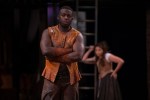
OrlandoAntony Byrne excels at the dual roles of the two Dukes, one nice, one nasty; and I enjoyed the way the one became the other at that otherwise strange border crossing into the Forest of Arden. Sandy Grierson’s eccentric and perceptive Touchstone is a lot to take on board, and treads a fine line between annoyingly comic and comically annoying – which is perfectly reasonable for that character. Richard Clews’ Adam is a noble and moving performance – with a delightful singing voice too, and there’s a nicely bumbling characterisation of Corin by Patrick Brennan. Emily Johnstone’s Madame Le Beau steals every scene in the first act as she teeters into the sinking grass with her stilettos and speaks her servilities with wonderful emptiness.

Rosalind and SilviaThere’s no doubt that the fantastic cast carry this rather underwhelming production. It could do with a few more cuts and a little tightening up; at just over three hours including the interval it is a little trying at times. However, it’s worth paying the ticket price to see Lucy Phelps alone! In repertoire at the Royal Shakespeare Theatre until 31st August and then across the country between September and April 2020.

Production photos by Topher McGrillis

Review – Timon of Athens, Royal Shakespeare Company at the Swan Theatre, Stratford-upon-Avon, 13th December 2018

Excitement stirred in my Shakespearean breast as I realised I’ve never seen a production of Timon of Athens before; and, indeed, apart from having read it as part of my degree, me and Timon have never crossed paths since. This new production by the RSC would be the perfect way to rectify this omission.

It's a partyAs far as Shakespearean tragedies go, plot-wise it’s fairly straightforward. Timon, a nobleman of Athens, gives generously to his friends, who in turn fawn on him with flattery in order to be bestowed with even more goodies. When we first meet him, he pays the debt of an unnamed, imprisoned man, so that he may go free. He makes up a dowry so his servant can marry the girl of his dreams. He buys a ghastly painting so as not to upset the talentless artist. This is Timon’s version of a happy state of order. But when the truth emerges that his money has run out, he assumes he can rely on those friends to whom he has shown such generosity, to give some of it back. One good turn deserves another, right? He sends his servants out on a mission of mercy for some cash; but all to no avail. Timon’s orderliness becomes a state of disorder. The moral of the tale? Friendships bought with gold aren’t worth a penny.

Timon is the hostess with the mostestFaced with mounting debt and no way of paying it back, he finally realises how everything he has taken for granted, and on which he has based his existence, was all a lie. With a Sweeney Todd-like Epiphany, he invites his “friends” back for one more meal where he suddenly bursts into revengeful violence, and throws scalding water over them all (they used the more visceral and easily recognised blood in this production – we don’t know whose blood it is). Turning his back on mankind, and wishing death and destruction on anyone who gets in his way, he flees for the forest. Lear-like, he camps out and survives on a more vegan lifestyle, whilst continuing his war with his fellow man. Unlike Lear, though, who allows himself to be sheltered and returned to “civilisation”, Timon remains Misanthropos and resists all opportunity to return to Athens.

Digging a holeTimon’s an odd chap in the Shakespearean universe. Hamlet, for example, is liked by his family and friends, but, in return, is rotten to almost all of them. Othello is liked by everyone except Iago, and pays them back by being rotten to everyone except Iago. Lear is liked by most of his followers and family – so he banishes them. Macbeth is universally liked and universally evil. However, Timon is basically disliked. His so-called friends have no time for him in his hour of need, even though he has always treated them with overwhelming generosity, both in gold and in spirit. So when he finds buried gold in the forest (as you do), he sees no value in it for himself; and, after using it to taunt and trick both thieves and followers, ends up giving it to his steward. After that, there’s nothing left for him to do. Perhaps it’s no surprise he’s the only Shakespearean character (I think?) to announce his own, premeditated, suicide.

Darlings!It’s definitely a game of two halves; the programme discusses that the reason might be because the play is thought to have been written in collaboration with Thomas Middleton, who may have been responsible for the Athenian scenes of wealth and society. The final acts, set in the forest, have Shakespeare written all over them. It was probably written about the same time as Macbeth, but lacks that play’s dramatic intensity, basically taking one theme and doing it to death. Still, it’s fascinating to have the opportunity to see the play, and Simon Godwin’s vision for this enjoyable production dwells on the contrasts between lavish Athens and brutal forest survival.

Do you have it in gold?On arrival in the auditorium you are met with servants laying out a gracious banquet, and there’s gold as far as the eyes can see. Gold chairs, gold table, gold wall-hangings; when guests start to arrive, they are wearing gold suits, gold pyjamas, gold coats. A gold sheet is draped across the front of the painting; the jeweller teases us with some magnificent gold bling. When Kathryn Hunter’s Timon (yes, Timon is female in this production) makes an entrance in a stunning gold evening dress, you expect her to burst into a Shirley Bassey rendition of Goldfinger. Gorgeous Greek-style orchestrations from the musicians up above drift down and give you a vision of golden sunshine and golden beaches. We’re talking serious gold here. The later arrival of the creditors, all dressed in harsh, comfortless black, announces an end to the golden lifestyle, and, indeed, when Timon next appears, her golden dress has been muted to a (nevertheless still stunning) darker creation with only some little highlights of gold flashing in it. Very nice work from designer Soutra Gilmour there.

Looks like troubleThe Royal Shakespeare Company are never ones to shy away from a theatrical challenge – which is one of the things I most love about them – so this Timon has a number of roles which would traditionally be played by men, performed by women . Not only Timon herself, but the revolutionary Alcibiades, whose forces discover Timon in the forest, and Apemantus the philosopher. Flattering Lord Lucius becomes Lucia, and servant Flaminius is Flaminia. In its original version, Timon of Athens is incredibly male-oriented, so these changes create a much more realistic environment of both rich and poor lifestyles today. Another fiddle with the original text that works brilliantly well is having the three scenes where Timon’s servants chase up money from the “friends”, cut together so that they all appear on stage at once – an Alan Ayckbourn, How The Other Half Loves moment. Not only does it save time, it triples the impact.

Kathryn HunterA question I must ask myself: why have I never seen Kathryn Hunter on stage before? She’s superb. A pocket-sized dynamo who lends herself so convincingly to the opulence of those early acts and the wretchedness of the later scenes. She has an extraordinarily expressive voice, like a mix of yogurt and honey, that flows mellifluously until she peppers it with some staccato delivery that stops the audience in their tracks. She got a huge laugh for her one word: “oh!” when she first sets eyes on the ghastly painting. She had to briefly stop the show when one audience member laughed so much at her “would thou wert clean enough to spit upon” because Ms Hunter gave the line such unexpected power. A physically demanding performance, full of emotion and a fine balance between comedy and tragedy; you couldn’t take your eyes off her.

Patrick DruryThere’s great support from the fully committed cast; I particularly enjoyed Debbie Korley’s warrior-like Alcibiades and Nia Gwynne’s sarcastic Apemantus, who both put the pressure on Timon to examine herself and mend her ways. Patrick Drury’s steward Flavius hit the perfect note between obsequiousness and genuine warmth for his mistress, and there were some terrific characterisations from Anton Cross’ hapless thief, James Clyde’s self-centred Sempronius, Sagar I M Arya’s chancer of a painter and Ralph Davis’ wannabe Machiavellian poet.

Fun fun funIf you’re thinking that Timon of Athens is probably some minor work and you should save your Shakespearean pennies for better known plays, think again. This production is a feast for the eyes and the ears, and features a stand-out lead performance. It’s on at Stratford until 22nd February and I wholeheartedly recommend it!

Production photos by Simon Annand

Review – Troilus and Cressida, Royal Shakespeare Company at the Royal Shakespeare Theatre, Stratford-upon-Avon, 18th October 2018

It’s hard to imagine, but it’s been 42 years (!) since I last saw a production of Troilus and Cressida. Back in 1976, young Master Chrisparkle got on a train to London to see the National Theatre production at the Young Vic, directed by Elijah Moshinsky, starring Denis Quilley, Roland Culver, Robert Eddison, Mark McManus and Simon Ward. Good grief, all those actors are dead now!

Gavin Fowler as TroilusThis is one of Shakespeare’s hard-to-categorise plays. Traditionally it was always lumped into the comedies, because it’s not a tragedy and it doesn’t fit the usual definition of a history, as it doesn’t concern a British king. But it doesn’t sit comfortably as a comedy either, and the temptation has always been to pretend that it doesn’t exist. According to Wikipedia, so it must be true, there were no recorded performances of this play between 1734 and 1898; that’s pretty extraordinary, considering it’s by our Immortal Bard. Along with Measure for Measure and All’s Well That Ends Well, it’s now considered a “problem play”, which makes it sound like it’s going to be hard work to appreciate.

Amber James as CressidaBut that’s not the case at all. The excellent programme notes (the RSC always do great programmes but this one is outstanding) include extracts from the late John Barton’s old directorial notes from previous productions, and he points out that the strength of this play is in its sheer bloody-mindedness not to fall into any categories. The characters contradict themselves; the relationships between them change unexpectedly, with neither rhyme nor reason; it doesn’t succumb to any set pattern; in fact, it’s just like real life. So rather than trying to make it a one size fits all kind of play, celebrate the fact that it just goes its own way.

Andrew Langtree as Menelaus, Adjoa Andoh as Ulysses, Suzanne Bertish as Agamemnon, Jim Hooper as Nestor and Theo Ogundipe as AjaxGregory Doran’s new production does precisely that, although he has made one imposition on the play – to cast it 50:50 between men and women. As a result, we have a female Agamemnon, Ulysses, Aeneas, Calchas and Thersites, as well as women playing traditionally male servant roles. In one respect, it makes hardly any difference at all; a military woman is pretty much the same as a military man when uniformed and concentrating on strategies and tactics. In another respect, it does shed different light upon the play; it makes you see something familiar with new eyes, creating an excitement and a freshness that you might not otherwise have expected. This is one of many innovations in this production that works really well.

James Cooney as Patroclus, Andy Apollo as Achilles and Adjoa Andoh as UlyssesIt’s a rewarding, surprising play. It deals with themes of honour and betrayal, order and disorder, even celebrity versus mundanity. Achilles, the celebrity warrior, is sick of fighting and just wants to lounge about with his “masculine whore” Patroclus; his reputation sullied, not so much by his debatable sexuality as by what Agamemnon describes him, “in self-assumption greater than in the note of judgement”. It’s only when his Greek warrior colleagues play a trick on him, pretending not to notice him, that his vanity is offended; and not till Patroclus is killed that he is spurred into action.

Andy Apollo as Achilles and Daniel Hawksford as HectorThe Greeks and the Trojans are locked in a military and political impasse, causing them to bicker between themselves, but showing amity between the two parties. “This is the most despiteful-gentle greeting, the noblest-hateful love that e’er I heard of” says Paris, as Aeneas and Diomed confer amicably. Before Hector and Ajax can fight, they choose peace. “The obligation of our bloods forbids a gory emulation ‘twixt us twain”, says Hector; thus honour prevents him from surely killing Ajax. Yet, Achilles, with gross dishonour, sees Hector killed, not by his own hand in glorious war, but, ironically, outsourced to the Myrmidons while Hector is unarmed.

Amber James as Cressida and Gavin Fowler as TroilusPlonked in the middle of all this is the growing love between Trojan prince Troilus and Cressida, niece to Lord Pandarus, who serves as something of a Courtly Fool. He moves heaven and earth to get the two together, but after one night of connubial bliss, fate separates them; they both, unhappily, accept the fact that the politics of the state are bigger than both of them. They vow to stay true to each other, but that doesn’t last long; another excellent example of how the characters of this play don’t perform as you’d expect. The misleading title suggests that the love affair between the two will be the most important element of this play; but that’s simply not so.

Adjoa Andoh as Ulysses and Suzanne Bertish as AgamemnonThis is a lively, funny, and extremely watchable production with some very creative and entertaining highlights. Oliver Ford Davies’ Pandarus’ hilarious running commentary, explaining to Amber James’ Cressida the benefits (or otherwise) of each of the warriors who parade past them like some military Mr Universe pageant, works brilliantly well. His fussing around Troilus and Cressida’s morning after arrangements, checking for signs of consummation on the sheets, is also superbly done. Pitching Sheila Reid’s diminutive and wretched Thersites side by side with the tall and fit Achilles or Ajax also gives some great physical comedy moments. And I loved the play on words with “The Trojans’ trumpet”.

Sheila Reid as ThersitesAnd then there is the innovative involvement of having Dame Evelyn Glennie as the production composer. If you know Dame Evelyn’s work, it’ll come as no surprise that you can expect percussion – and a lot of it. That’s great for the war scenes, as the drums suggest marching armies and the metallic clashes represent sword on shield or armour against armour. Softer motifs also provide incidental music for some of the characters; again the programme notes tell us how she has orchestrated the two central lovers differently. And no opportunity is missed to fill in any details suggested by the text; when Pandarus is irritated by the sound of music, he’s not the only one. But it’s true, sometimes the excitement and creativity of the background music can overwhelm what’s happening on stage, and we found it difficult to make out some of Ms Reid’s bon mots as she observes the vanities of the warrior classes. That’s a shame, because she clearly gives it some suitably savage characterisation. As the other Fool in this play, the crude and visceral Thersites provides a lot of important context; but it’s no good if you can’t hear it.

Suzanne Bertish as AgamemnonThere are long sequences between the Greek warlords that are very wordy, particularly in the first half of the play. To make them more palatable, Gregory Doran has pantomimed-up the characters into a larger-than-life presence. Thus we have Suzanne Bertish’s Agamemnon, all swirling hair and fighting talk, rather like Anna Soubry MP on acid; Andrew Langtree’s Neanderthal Menelaus, constantly interrupted by Agamemnon to stop him from saying something foolish; Adjoa Andoh’s super-intelligent and manipulative Ulysses; Theo Ogundipe’s estuary Ajax, just about stringing a sentence together; Andy Apollo’s languid, too cool for school Achilles; and Jim Hooper’s dirty-old-man Nestor, taking a peck on the cheek with Cressida too far, to the disgusted, retching reaction of the audience. This outrageous, tongue-in-cheek approach to the characters oughtn’t to work; but it does, tremendously. These are all fantastic performances.

Theo Ogundipe as AjaxGavin Fowler gives his Troilus a nice mix of nobility and naivete; hopelessly hapless with his chat-up lines but dignified in his deference to the instructions of King Priam and valorous in battle. Amber James also invests Cressida with some gutsy personality, not backward in coming forward when Troilus is too tongue-tied to step up to the mark, and suitably flexible when she has to hold her own in the Greek camp.

Oliver Ford Davies as Pandarus, Daisy Badger as Helen and Geoffrey Lumb as ParisA couple of things puzzled me; I didn’t understand the significance of the weird collection of pots and pans and old bits of car that suspended from the ceiling, and shook clankingly every so often; and I wasn’t sure why Helen and Paris made their appearances from inside a pod that dangled down to earth, like a celestial conservatory. But John Barton’s notes had already guided me into not expecting to understand everything.

Andy Apollo as AchillesIt’s a thoroughly entertaining production, and if you haven’t seen Troilus and Cressida before, this is a delightfully accessible and stimulating experience, that I’d totally recommend. Terrific performances from Oliver Ford Davies, Suzanne Bertish, Theo Ogundipe and Adjoa Andoh make 3 hours 15 minutes go by remarkably quickly. At the Royal Shakespeare Theatre until 17th November – don’t miss it!

Production photos by Helen Maybanks

Review – Tartuffe, RSC Royal Shakespeare Company, Swan Theatre, Stratford-upon-Avon, 18th September 2018

Here’s a recipe for an innovative night at the theatre: first take your Molière, one of the all-time comic geniuses. He knew precisely how to structure a comedy, create larger than life but recognisable characters and put them into a ghastly but hilarious situation where they have to sink or swim. Then take two modern masters of comedy, the writers Anil Gupta and Richard Pinto, responsible for such landmark TV programmes like Goodness Gracious Me and The Kumars at Number 42, not to mention Citizen Khan (I won’t mention Citizen Khan because it’s awful). Blend delicately and what do you get? A Tartuffe for the 21st century, set within a British Pakistani Muslim family in Birmingham. The big question is, does that soufflé rise to the occasion of translating 17th century lampooning of religious hypocrisy successfully to the here and now?

Asif KhanMon Dieu, you cannot believe how beautifully the one fits into the other! Molière’s Tartuffe (a sufficiently piercing satire to warrant the King censoring it) is a religious directeur de conscience; a kind of domestic guru who wangles his way into a well-to-do family, and convinces the Master of the Household, Orgon, that his are the words of the angels, on a direct line from God. Therefore he must be obeyed, even if that means turning a blind eye to his having it away with the lady of the household, marrying their unwilling daughter and virtually stealing the house and business from under their nose. Observing and commenting on the madness is Dorine, the maid who is the confidante of all and sundry and is more intelligent than the rest of them put together. Only when the unwitting idiot of a Master finally gets the ocular proof that his noble houseguest is a roué and a vagabond does he finally tumble to his own vain stupidity. But Tartuffe has something else up his sleeve, and tries to get Orgon arrested for possession of incriminating letters.

Michelle BonnardMessrs Gupta and Pinto have transported Orgon and his family to Small Heath, where they have become the Pervaiz family; he a wealthy businessman, on to his glamorous second wife Amira, living with his vacuous son Damee, progressively-educated daughter Mariam and his old mother Dadimaa (who is straight out of The Kumars – Meera Syal should sue). Imran Pervaiz has been transfixed by one Tahir Taufiq Arsuf (Tartuffe), whom he has brought into his house, given him as much food and drink as he wants, allowed him take control of the fabulous Home Cinema system and has become thoroughly brainwashed by his charisma. He insists that Tartuffe marries Mariam despite her already being engaged to the drippy but well-meaning Waqaas; in a misplaced religious fervour he liberates his own mind and spirit by giving all his worldly possessions to Tartuffe so that he can use it for charitable purposes (err, I don’t think so.) When Pervaiz is eventually satisfied that Tartuffe is a sham, he too realises that an incriminating document is no longer where it should be… but has Tartuffe stolen it for blackmail purposes?

Simon Nagra and Asif KhanCliché time, but Molière’s timeless creation fits into this modern setting like a hand in a glove. The idea of a charismatic zealot, whether it be religious or political, a true celebrity who takes the usual brain settings of an otherwise sensible person, and puts them through the wash, is as relevant today as it was in the 17th century. Trump, Putin, Kim on the international stage; Farage, Rees-Mogg, Corbyn on the domestic. Plus ça change, as they say. It’s no surprise that at one stage Pervaiz puts his head in his hands and wishes he hadn’t voted Leave.

Salman Akhtar and Simon NagraGupta and Pinto litter the script with countless modern references which both delight and illuminate. During two-and-a-half hours, they cover (in no particular order) female emancipation, familial tensions between generations, politics, Windrush, marital trust, faith, sexual harassment, illegal immigration, Brexit, religious hypocrisy, Islamist fundamentalism, and much more. It’s never offensive, and, certainly, it never pokes fun at Islam; its target is simply the relationship between the manipulative trickster and the idiot who believes him. Never has the phrase “a fool and his money are soon parted” been more appropriate.

Raj BajajThis adaptation gets its point across by using terrifically humorous characters and a sparky, al dente text. There are a few passages where, in more than a nod to its original writer, the speech diverts into rhyming alexandrine couplets; there’s even a passing reference to Shakespeare and some other contemporary garçon (and I think we know who that is.) I liked the very clever use of accents to help create the characters; the Brummie voices of Damee, Khalil and Usman all help to suggest that they’re (sorry to say it, Midlanders) a bit thick; whereas Mariam’s Brummie accent strangely makes her sound more intelligent – but then she is always talking about protecting the interests of women in the sub-Saharan continent and complaining about heteronormative patriarchy.

Simon NagraBretta Gerecke’s design is a nice contrast between the plush surroundings of the Pervaiz family home and stark modernistic lighting tubes that fall into place to demarcate the indoors from outdoors. Iqbal Khan’s production brings in quite a few musical moments, some of which work better than others. Raj Bajaj’s Damee clearly sees himself as some kind of rap star and he is given a couple of chances to show off his style; even more proficient is the excellent (if you like that sort of thing) beatboxing from Riad Richie as Tartuffe’s assistant, Usman. The play begins with a very loud onslaught of musical mush coming through the headphones of Darina, the Bosnian cleaner; Black Sabbath, she confides in the audience, she’s a fan. Not entirely sure I am; it’s a bit of a brutal start. Sarah Sayeed’s traditional Punjabi music has been composed to reflect particular characters in particular moods; although these leitmotifs may work on paper, I found much of the incidental music throughout the play really distracting, and frequently too loud so that it drowns out the dialogue, which is exasperating as you know you’re missing out on gems but you just can’t hear them.

Riad Richie and Asif KhanMolière knows to keep his audience waiting and it’s a full fifty minutes before we meet our eponymous anti-hero. Asif Khan (who was superb in the Royal and Derngate’s A Passage to India last January) gives us a very larger-than-life portrayal of a man appearing to be conservative and clean but in fact a mere conman. He’s dressed in the most formal Muslim clerical clothing: traditional beard as low as you dare, and a pure white abaya robe to reflect the purity of his heart (as he would like you to think). He adopts a very lilting tone of speech, as though he were part speaking, part intoning the Qu’ran. This makes him sound like a truly holy man; which only makes the sham feel worse when you see how he’s manipulating everyone around him.

Zainab HasanThe whole cast put in tremendous performances. Simon Nagra is great as Imran Pervaiz; there’s an element of Omid Djalili in his delivery, but it’s none the worse for that. His wonderment at Tartuffe’s general gloriousness is a delightfully comic turn, and it makes a painful contrast with his fury at his family’s determination to cross him, insisting his daughter marry the wretch and banishing his son from the family home. Sasha Behar makes for a glamorous and fiery Amira, well able to take care of herself, and she brings out all the comic potential from the scene where she’s trying to trap Tartuffe so that her husband can see the deceit for himself. Raj Bajaj is excellent as the well-intentioned but essentially useless son Damee, either grinning inanely at life or trying to solve problems by fisticuffs; and Zainab Hasan is superb as daughter Mariam, proudly independent but fully knowing that she should obey her father, even though he is condemning her to a life of misery.

James ClydeAmong the supporting cast there are some great performances from James Clyde, as family friend Khalil, wont to pontificate ad nauseam much to everyone’s exhaustion, and from Salman Akhtar as the hapless Waqaas, firing up with anger at the prospect of losing his Mariam but essentially unable to fight his way out of a paper bag. And the whole show is held together by a star performance from Michelle Bonnard as Darina, keeping up lengthy conversations with the audience (even hoovering under their seats after the interval), taking the mickey out of her employer’s bromance, seeing right through Tartuffe’s pretence, and generally getting away with murder – but also looking after their interests, as is seen in the very last second of the play.

Amina ZiaAn immensely refreshing night out at the theatre – and you’re in awe of how neatly Molière’s original fits so neatly into the totally different environment. Hats off to everyone involved for a tremendous achievement. Tartuffe remains in rep at the Swan Theatre until 23rd February. Don’t miss it!

Production photos by Topher McGrillis

Review – Tamburlaine, Royal Shakespeare Company at the Swan Theatre, Stratford-upon-Avon, 1st September 2018

I often recall one of raconteur and director the late Ned Sherrin’s favourite quotes, where he overheard two elderly female American tourists emerge at the end of the full two-parter of Tamburlaine the Great at the National Theatre in 1976. After a considerable silence between each other, one turned to the other and simply said “more of a play than a show, really…” I’m sure Marlowe would have been thrilled with that description.

TamburlaineThe overpowering character (in more ways than one) of the great Amir Timur, born in present-day Uzbekistan in 1336, continues today in his home country with statues and palaces in his name; in his birthplace of Shakhrizabz, newlyweds still like to have their photos taken underneath his statue, in the hope that some of his success rubs off. Over 35 years of active warring, treachery, theft and mass-murder, he expanded his empire throughout Persia, Afghanistan, and into modern day Pakistan, India, Syria, and Turkey. Marlowe’s account of his exploits set London Society into a riot of Tamburlaine-mania. He even influenced London fashion, with the exotic colours and styles of the Middle East that were being seen for the first time in England.

Don't trust these guysFull of grandiloquent speeches, political intrigue, deception and savagery, Marlowe’s play grips you by the throat and doesn’t let up until he’s wrung every inch of passion and fear out of his warrior-in-chief, his entourage, and his victims. You can’t call Tamburlaine a “tragic hero” in the same way that you can a Macbeth or a Hamlet. Amazingly, considering all the people he exploited and defeated, Tamburlaine isn’t murdered. He suffers and grows weak from an unspecified illness during a winter campaign and returns to Persia to die in the comfort of his own palace. If there is a moral to his tale then it would be that courage, might and ruthlessness are everything you need to succeed; anyone who doesn’t aspire to or achieve these virtues is a wimp. The programme draws interesting comparisons between the lawlessness of Tamburlaine’s regime and the Putins, Tumps, and Orbans of today. Tamburlaine’s brash audacity of power is as relevant in 2018 as it ever has been. And that doesn’t really bode well for any of our futures.

MycetesMichael Boyd has created a magnificent production that keeps you transfixed throughout. Powerful and emotional performances keep the story moving forward at a vital pace – remember these are two full five-act plays compactly abridged into three-and-a-half hours. Sometimes it can be a little hard to keep up, actually, and you’re grateful for the few comedic moments when actors explain that they’ve changed roles so that you know where you are! The occasional non-Marlovian addition, like the brief impersonation that accompanies the appearance of the King of Fez, really helps to break the tension. On a similar note, I also loved how the excellent James Tucker, playing a series of different retinue-lords, each swearing allegiance to his man on the one hand and supporting a rival on the other, ended up jumping over the dead bodies of his former lieges as he rushes off to stay alive by following the next successful leader. It very nicely highlights the brittle nature of allegiance.

Welcome everyoneJames Jones’ incidental music plays perfectly alongside the action – heavy drumming when something dangerous and portentous is happening; a wistful curious motif when someone gets the idea that the best way out is suicide. Colin Grenfell’s lighting is atmospheric and enticing; and the use of a bucket of blood, applied on a victim with a paintbrush or generously tipped over them, to signify the moment and barbarism of their death, works chillingly well. It’s a graphic depiction of blood but it lets your own imagination fill in the details of precisely how each individual died. There’s a lot of blood about; but nothing like as much as in The Duchess of Malfi, where they were positively swimming in it.

Tamburlaine in controlJude Owusu’s central performance as Tamburlaine is superb. A perfect portrayal of someone so confident in their own abilities, so fearless in their ruthlessness, so determined in their purpose, that anything that stands in his way is eradicated. You’re either on his side – and demonstrate that you are, by deeds and emotions – or you’re toast. Within a few minutes of his first appearance on stage, he emotionlessly twists the neck of Magnetes in response for the latter’s slight note of sarcasm in his voice. There’s no question that you’re in the presence of true danger. But he’s charismatic too, shown by how Edmund Wiseman’s grippingly performed Theridamus is instantly taken in by his spell and forsakes his allegiance to the drippy Mycetes. And there’s no mistaking Tamburlaine’s love for Zenocrate, both in the wooing and in the mourning. It’s such a demanding role, with so many long speeches and physical scenes, but Mr Owusu takes it all in his stride in his amazingly impressive performance. I hadn’t seen Mr Owusu on stage before; I sincerely hope it’s not too long till the next time.

ZenocrateRosy McEwen is also truly impressive in the dual roles of Zenocrate and Callapine. As Tamburlaine’s queen she explores all the divisive emotions of being in love with him yet also holding her father and her homeland in high esteem. Tamburlaine will ransack and conquer Egypt, but spare the life of her father the Soldan by making him a tributary king. As Callapine she reveals the character’s essential nobility, sweet-talking the jailer to let him go free, and avowing revenge on Tamburlaine for the death of his father. In both roles Ms McEwan is crystal clear in her enunciation, has magnificent stage presence, and both moves us and makes us admire her characters. Ms McEwan only graduated from the Bristol Old Vic School last year and is definitely a Name To Watch Out For.

ZabinaMark Hadfield brings a comedic touch with his delightfully ridiculous portrayal of the petulant Mycetes, as well as the Soldan and Almeda. David Sturzaker is excellent as the double-crossing but quickly defeated Cosroe (amongst other roles); David Rubin and Riad Richie make a terrific partnership as Tamburlaine’s ever-present warrior followers Techelles and Usumcasane; Sagar I M Arya invests Bajazeth with the most beautifully spoken pride and contempt for Tamburlaine, and there are smart supporting performances from Anton Cross as Tamburlaine’s enthusiastic son Celebinus, Debbie Korley as the devastated Zabina, wife to Bajazeth, and Ross Green in more roles than you can shake a stick at. But the whole ensemble put in a terrific performance and there is not one weak performance anywhere.

BajazethIf I’m honest I wasn’t that impressed with the solution of what to do with the dead bodies. Anyone killed by Tamburlaine or his retinue is left on the stage at the end of the scene, then slowly stands up, looks around them quietly and vengefully, and then slopes off. I can see that this gives the sense that the characters’ ghosts are still there, observing what’s happening, although I don’t think that sense exists in Marlowe’s original; once they’re dead, they’re dead. I felt it looked clumsy, and a bit desperate for a practical idea of how to clear the stage. At least when Olympia receives her dying husband and murders her son for his own good (#yeahright) she tips them both down into the cellar tout de suite.

Theridamas and OlympiaA minor quibble in an otherwise fascinating and magnificent production. I’m guessing this might be something of a hard sell for the RSC – at last Saturday’s matinee there were loads of available seats, but I can assure you it’s most definitely worth spending your theatre pounds on a ticket. It’s on at the Swan Theatre until 1st December and it would be a crime to miss it; and you definitely wouldn’t want to incur Tamburlaine’s displeasure….

Production photos by Ellie Kurttz

Review – The Merry Wives of Windsor, Royal Shakespeare Company at the Royal Shakespeare Theatre, Stratford-upon-Avon, 14th August 2018

Ah, The Merry Wives of Windsor. The name sounds so innocent doesn’t it? Tea on the lawn at Runnymede. Happy jumble sales at Datchet. Street parties for the Queen down Windsor High Street. Well indeed, it was the Queen who wanted this in the first place, as the first scene of Fiona Laird’s new production at the RSC showed at first hand; a projection of Queen Elizabeth I querulously observing that her favourite Falstaff was being written out of Shakespeare’s next play, so she demands a new offering, showing Sir John in love, to be ready in two weeks. Much to Shakespeare’s chagrin.

FalstaffThe ever constant challenge to make new productions of Shakespeare plays modern and relevant is just as valid in the frothy comedies as it is in the heavyweights. But Merry Wives is a significant play in many ways and deserves treating seriously. It’s one of the few Shakespeare plays that is completely original. It is the only one to be written entirely in prose. It’s the only one to be concerned with middle-class life in a small English town; to that extent, it’s the most similar in structure to a modern-day sitcom. Not uniquely, but it’s one of the plays where the action is most driven by female characters; and where female characters win the day. It’s also a contender for being Shakespeare’s funniest play. No wonder it keeps coming around, again and again.

Evans, Pistol, Bardolph, NymThis is the 5th time I’ve seen the play; George Murcell as Falstaff at the now defunct St. George’s theatre in Tufnell Park in 1977; Peter Jeffrey in the RSC’s production at the Barbican in 1986; the Oxford Shakespeare Company’s productions in the grounds of Wadham College in 2005 and 2013; and now David Troughton as the randy big man with the RSC again in Stratford. Each one marvellous in their own way; and this latest production has more entertainment value than you can shake a stick at.

CaiusAnd that’s down to the engagement of one Mr Toby Park, boss of Spymonkey, as Physical Comedy Director. We’ve seen Spymonkey several times, with their endlessly creative, pomposity-puncturing, ridiculousness-worshipping productions; if you’ve never seen a Spymonkey production, You Haven’t Lived. There are elements of Spymonkey-business running through this show like a stick of rock. But does the double-directorship work, dovetailing the comic business with the rest of it? Or is it an Eton Mess? (See what I did there?)

Mistresses Ford and PageI usually agree with the old saying, less is more. Maybe it’s because of my innate conservatism (small C, please note.) Maybe it’s due to my Public School upbringing – you’re not meant to have fun. If it hurts, it’s doing you good. Or maybe it’s because I value quality over quantity, in virtually all matters. However, when it comes to Spymonkey, I change my mind. In this production they throw absolutely everything at it. From the disgusting wheelybin to the pink flamingos by the side of the Fords’ swimming pool, from the stagestruck golf cart to Falstaff’s extravagant codpiece, from Dr Caius’ frenchisisms to Master Brook’s false nose; no visual joke, no audio prompt, no quirky playing with the script goes unmissed. It’s a numbers game. The more funny business you put in, the funnier the end product comes out. I’d say a good 95% of the comic content sticks solidly like… well you provide your own simile. If the main intention of a production of Merry Wives is to make the audience laugh – and why would it be anything else – this is a five-star extravaganza.

Falstaff, QuicklyFiona Laird has picked this production up and moved it from west of the M25 to the east, to create a TOWIE version of the play – The Merry Wives of Billericay. The wise woman of Brentford has become the wise woman of Brentwood, which is somehow strangely funnier; Mistress Ford has her own beautician, which I’m sure isn’t in the original; the refuse guys who come to take away the lurid pink coloured wheelybin (belonging to the Royal Borough of Windsor and Essex) exchange jokes in Polish. Mistress Page hides behind a decadently large electric barbecue; Falstaff hides under a poolside lounger.

Caius, Shallow, Slender, Hostess, PageLez Brotherston’s fantastic costume designs enhance this Estuary Grandeur; Mistress Ford is genuinely stunning in her Versace trousers and tight-fitting top; the Hostess of the Garter is a vision in leopard skin; Pistol’s handbag (you read that right), Dr Caius’ bandana (ditto) and Fenton’s suitcase all reek of expense; and, above all, Master Ford and Master Slender are so trendy that they’ve given up on the socks. And the costumes and padding for Falstaff are genuinely hilarious and incredibly inventive; a quite remarkable achievement.

HostessI can’t decide whether the creative team encouraged the cast to portray their characters partly as impersonations, or whether it’s some natural, evolutionary by-product of the rehearsal procedure. But in any event it’s a delight to see Sybil Fawlty as Mistress Page, Julia Davis as Mistress Ford, Tracy Emin as the Hostess of the Garter, Ricky Gervais as Shallow, Del Boy Trotter as Master Ford, and my cousin Trevor as Slender. No offence, Trevor, but Tom Padley had you down to a T.

Mistresses Ford, Page and QuicklyThe performances are gleefully brilliant from first to last. David Troughton is just magnificent (and only barely recognisable) as Falstaff, completely self-obsessed and repulsive, so puffed up in his own affairs that duping him is like taking candy from a baby. Of course, when a character is so set up in a high and mighty fashion, it makes you deliriously happy to see them crash and scarper in shame. Rebecca Lacey’s Mistress Page, outwardly so respectable but in reality a truly tough nut, can’t wait to interfere in Falstaff’s plans and eggs Beth Cordingly’s sassy Mistress Ford into playing the tart for the fat knight. Together they are a perfectly mischievous pair, and make a great comedy duo.

EvansDavid Acton almost steals the show with his childishly excitable performance as Evans the Welsh parson, his face lit up with joy as he revels in every prank; encouraging us all to join him in a Cardiff Arms Park (his words) chorus of Cwm Rhondda. He’s also a great partner-in-crime for Jonathan Cullen’s Dr Caius, murdering the French language with fantastic ease, espousing all the Spymonkey tenets of making yourself look as ridiculous as possible. I’ve been an admirer of Mr Cullen since I first saw him perform in the First Year Students’ competition at Oxford, when I was in the second year. We always knew he’d go far.

Caius, RugbyTim Samuels is a beautifully mealy-mouthed (and violent) Shallow and Tom Padley simply hilarious as his gormless nephew Slender, constantly trying to cover up his incessant faux pas. Luke Newberry invests the otherwise worthy but dull Fenton with a string of brilliantly performed pratfalls, Josh Finan is an irrepressible Nym, Katy Brittain a superb lush of a Hostess at the Garter, Vince Leigh a fabulously jealous Ford and Paul Dodds a proper bossy Page. But the whole cast work together to make a really funny and entertaining ensemble show.

Anne PageAt the end of the day, it’s up to you whether you like the transferred location away from small town Berkshire to somewhere Chez Lakeside. I thought it worked fine. There are numerous liberties taken with the script, but if any Shakespeare play can take messing around with, it’s this one.

FordMrs Chrisparkle pointed out that in previous productions of Merry Wives that we’ve seen, Falstaff has been even more humiliated in that final horns and spirits scene. In this production, his shame is quickly achieved, and quickly over, which actually made a pleasant change – there’s only so far that you can humiliate one fat randy old knight. However, I sense something didn’t go quite right with that scene; there were a few spirits just hanging around doing nothing and blundering into each other. And the whole imagery of the ghosts and ghoulies is much scarier in its original location of a woodland glade than in a town centre piazza. Maybe it needs a little tightening up.

SimpleStill that’s a small quibble with such a great show. We laughed, and laughed, and laughed. I’m sure you would too. Can’t recommend it strongly enough. It’s in the RSC repertoire at Stratford until 22nd September and then it’s on at the Barbican from 7th December until 5th January 2019 – that would be a perfect Christmas treat!

Production photos by Manuel Harlan

Review – Romeo and Juliet, RSC at the Royal Shakespeare Theatre, Stratford upon Avon, 1st May 2018

There’s an argument for believing that Romeo and Juliet is the greatest love story of all time; although maybe they’re too young, and in love too briefly, to lay claim to that accolade in full. Of course, today, to be termed a Romeo is more of an insult than a compliment. It implies all show and no commitment; possibly a roving eye and a love ‘em and leave ‘em attitude. True, Shakespeare’s Romeo starts off in love with Rosaline (Juliet’s cousin, so he was always attracted by those damned Capulets) but all it takes is just one glimpse of Juliet, and Rosaline’s toast. Funnily enough, no one ever gets called a Juliet, by comparison.

R&J9Erica Whyman’s new production at the Royal Shakespeare Theatre has a few stand-out and inventive aspects. It toys with sex and sexuality to an extent that I’ve not really seen done seriously in a Shakespeare play before. For example, both recent productions of Julius Caesar that we’ve seen over the last year or so have featured a female Cassius, which was interesting inasmuch that it shows that a woman can be just as good a lead conspirator as a man – no real surprise there. But in this production, we go one (or possibly several) steps beyond.

R&J5Escalus, Prince of Verona, is played by a woman, Beth Cordingly. She’s a no-nonsense, strict ruler who has to act decisively to keep the peace between those pesky Montagues and Capulets; but she’s always referred to as a Prince, and it’s a strong, authoritative performance from Ms Cordingly. Mercutio, Romeo’s friend and cousin of Escalus, is also played by a woman, Charlotte Josephine. The character is always referred to as “she”, so she’s definitely female, although they haven’t gone down the line of feminising the name into Mercutia. This Mercutio has all the blokey belligerence you’d normally expect from the role, and I guess you’d see her as something of a tomboy. I wasn’t expecting this characterisation, and at first I confess it irritated me a little, but as I got used to her, I appreciated that she had as much right to be part of the gang as anyone else. It was a challenge to me, and one that caught me out at first – and that’s definitely my bad.

R&J12Benvolio, on the other hand, is still played by a man, Josh Finan, but with a mancrush on Romeo as a big as a rainbow coloured unicorn. Bally Gill’s Romeo comes across as 100% straight, and doesn’t remotely notice how Benvolio has to catch his breath and fan himself after he plants a big excited smacker on Benvolio’s lips. Mr Finan gives an excellent performance as Benvolio and really highlights the difficulties of being gay in a very straight group. These modern interpretations certainly bring the play bang up to date and help our understanding of these characters and the issues they face.

R&J4But a play like Romeo and Juliet is nothing if it doesn’t speak clearly to its audience. No degree of directorial embellishment, no manipulation of the text to support weird clever-clever theories, or re-imagination of the play in another time or place simply because we’ve got some great props can make the slightest bit of difference if the story isn’t told simply, from the heart, and true to the original. I’m so glad to be able to report that this Romeo and Juliet is about as clear as you can get.

R&J1At least, that’s true after the first fifteen minutes or so. For the first scene we are bombarded with a cacophony of lines from a bunch of people whom we know nothing about and I was instantly lost. To be fair I think this was the Chorus’ speech that begins Act Two of the play; but the alert amongst us realised we were only at Act One. I felt harangued and deliberately confused, and feared the worst for the rest of the night. Warring factions started to form; Montagues and Capulets, no doubt, literally thumbing their nose at each other and then running away like naughty schoolkids. I blame the parents. Romeo’s caught up in this bunch of idiots; a lot of street-fighting, anger, teasing and generally bad behaviour. I thought we’d skipped Romeo and Juliet and gone straight to the gang violence of West Side Story but without the songs.

R&J2However, once it had all settled down, and we’d been introduced to the youthfully ebullient Juliet (Karen Fishwick), her gossipy, fussy and slightly coarse Nurse (Ishia Bennison) and her hands-off, hesitant and generally inadequate mother (Mariam Haque), the production just took on its own life force and thrilled, delighted and horrified its way through the next two and a half hours, never taking a wrong turn. Tom Piper’s design consists of a box. That’s all there is. You can move it around so that it becomes a cave, or Juliet’s balcony, or the Capulet Family Tomb, but, at the end of the day, it’s just a box. And the simplicity of that reflects the simplicity of the story-telling, enabling the audience’s imagination to fill in all the blanks, which is just how I like it.

R&J7But it’s all about R & J, isn’t it? Two incredible, first rate performances that make you laugh and (almost) cry; certainly that remind you of your younger days when you used to make a fool of yourself over someone you fancied, and how you were horrified when your new-found love didn’t go down well with the rest of the family. Bally Gill’s Romeo is the embodiment of that chap that all the girls want to be with and all the guys want to be like; bright, great company, funny and hideously good looking to boot. As he sidles up to the Capulet garden party only to veer away at the last minute through embarrassment you know this is someone you can identify with. Montague or Capulet, he’s our Romeo. We’re completely on his side. And for Shakespeare purists, when it comes to his delivering the classic lines of poetical love, he’s as eloquent and passionate as you could wish.

R&J6And he’s matched by a sensational Juliet in the form of Karen Fishwick; if you think Juliets should be all pure and demure, think again. Ms Fishwick plays her as a spirited wild child, full of adventure, a giggling provocatrice who can’t wait to start living and loving – provided it’s with the man she chooses. When her domineering father sets her up with Paris – to be wed a few days after her cousin Tybalt has been killed (and awkwardly having already married his murderer) – you won’t believe the fit of fury that overtakes Juliet, pounding the cushions with flailing fists, shrieking her refusal to comply. You can see where she gets this hot-headedness from; her father Lord Capulet disciplines her with a substantial roughing-up that takes you by uncomfortable surprise – a very good physical performance there by Michael Hodgson.

R&J3I loved Ishia Bennison’s kind-hearted, meddlesome but very knowing Nurse, who created a good deal of comedy out of her characterisation. Andrew French gave a perfect portrayal of Friar Laurence, just the kind of cleric you would want as your own family priest; understanding, non-judgmental and with a sense of humour – the kind of person you could confide in. Raphael Sowole’s Tybalt is a figure of intimidating power, although no match for Romeo’s fancy footwork with a knife; and I really liked Afolabi Alli as Paris, a refined, polite characterisation but showing just that flash of sleaziness as he relishes the prospect of getting Juliet between the sheets.

R&J11An intelligent yet accessible production of what may be considered the ultimate tragedy, yet retaining a brilliant lightness of touch to reflect the youthful aspirations of its characters. Hugely entertaining, and you leave with a much deeper insight into the characters than you had before. It’s in the Stratford repertoire until 21st September then in the Barbican repertoire from November to January 2019. Highly recommended!

Production photos by Topher McGrillis

Review – The Duchess of Malfi, Royal Shakespeare Company at the Swan Theatre, Stratford upon Avon, 8th March 2018

“Webster was much possessed by death and saw the skull beneath the skin” says T. S. Eliot. Wasn’t he just? But maybe not quite as much as Maria Aberg, whose visceral and highly stylised Duchess of Malfi opened last night at the Swan Theatre. I don’t think I’ve ever seen such a bloody stage in 52 years of theatregoing. If you sit in the front row you will be issued with regulation grey blankets to cover yourselves when you return from the interval. The lady seated next to me told me that she’d heard that on its first performance, blood spurts reached as far as Row H. Fortunately I can advise that the gore has been sufficiently turned down so that it no longer has such a far-reaching trajectory.

There’s not a lot of plot. The Duchess (young, widowed) has been forbidden to take on a second husband by her villainous brothers The Cardinal (not a Mafia nickname even though we are set in Italy) and her twin Ferdinand, who employs Bosola, a knavish and complicitous gentleman, to spy on her. The Duchess knows her own mind and secretly weds Antonio, her steward, with whom she has three children. When the Cardinal and Ferdinand eventually twig that she has gone against their wishes, they have her murdered. And her children. And her husband is killed. And the spy. And themselves. And anyone else within a hundred kilometres of Malfi.

I jest. If you haven’t seen it before, The Duchess of Malfi is a superbly exciting and suspenseful tragedy in the Jacobean tradition, first performed around 1613, written by John Webster from source material by William Painter (his “Palace of Pleasure” from 1567) and loosely based on the true story of Giovanna d’Aragona, Duchess of Amalfi, who died in 1511. The Duchess is a feisty, independent, free-thinking spirit, a bright spark of warmth attacked by the cold rays of her enemies from all angles. Diamonds are of most value, they say, that have pass’d through most jewellers’ hands, she avers; and like diamonds, the Duchess is one tough cookie. Even when there is no hope of her survival she remains dignified and defiant to the end – I am Duchess of Malfi still is her simple self-proclamation that no one can take away from her. The Cardinal, Ferdinand and Bosola, however, show exactly the opposite traits; controlling, manipulative, double-crossing and, in the case of Ferdinand, ultimately weak-willed. The evil characters are all men; the women are all good.

I think that’s why the production so strongly centres on the struggle between masculine cruelty and feminine virtue. There is a chorus of officers, gentlemen and other assorted guys who weave in and out of the production; gym bunnies working out and pumping iron, or a rabble of enemies to the Duchess, or a group of madmen whose only purpose is to distress and derange her. It’s as though they arrive on stage, perform a set piece, and then disperse.

It’s very unsubtle; but then again, is it a subtle play? Cuts from the original text have certainly made it less subtle, downgrading the influence of Antonio, and removing insights into the motivation of the characters. For me, the regular appearance of the brutal male chorus doesn’t grow organically from everything else we see on stage; indeed, in a rather excellent put-down, Mrs Chrisparkle thought of them as the RSC Haka, limbering up for the next scene. After all, it isn’t as though the portrayals of the Cardinal, Ferdinand, or Antonio are excessively masculine. But there is a balance between the forces of good and evil in this play, and Maria Aberg’s vision seems to me to address the evil too strongly and not concentrate enough on the good. In its attempts to prove certain theoretical points about the nature of masculine cruelty, the actual truth of the play has got lost in places. Rather than illuminating the text, I felt it obscured it at times.

There are articles in the programme about how the music was written trying to explore masculine and feminine rhythms, and how Naomi Dawson’s set was created from ideas of masculine environments – a gym, a sports stadium and an abattoir. I’m not trying to be obtuse, but can’t women use these places too? At the time it wasn’t clear to me that the design was in part meant to reflect an abattoir setting, but in retrospect it makes so much sense. My copy of the play has as its opening scene a conversation between Antonio and Delio, explaining that Antonio has been in France, and setting the character up as the common thread that links the whole play. In something of a surprise change, the opening scene in this production shows the Duchess single-handedly dragging an oversized animal carcass across the stage; slowly, laboriously, exhaustedly. It’s then plonked upstage left, until the Duchess next appears, when she trusses up its legs and suspends them in the air from a chain.

And then, for the rest of the play, no one mentions the carcass. It’s like the elephant in the room – although apparently it’s meant to be a bull, but actually, it looks much more like an oversized rubber chicken. Now we know what caused the KFC shortage. I tried to give it the benefit of the doubt and wondered what it might represent, symbolically. The Duchess’s own private burden, perhaps? Her vulnerability? Now I understand the abattoir setting, I suppose it presages her slaughter (although not her being sliced up and served on dinner tables, that’s much more Titus Andronicus.) After the interval, Ferdinand comes on and sticks his dagger into the carcass’s belly. And it starts to bleed. And it doesn’t stop. Which is where I refer you to my first paragraph, gentle reader.

As the actors squelch around on stage, variously murdering each other, the blood just seeps everywhere. Not just the floor but all over the costumes, on their faces, in their hair; I can only assume that the water pressure throughout Stratford drops after the show comes down as about 20 actors all huddle under the dressing room showers. Ferdinand and the Cardinal writhe on the floor together in an exhibition of what I can only describe as Blood Wrestling. Pity the Wardrobe Department; I hope they have lots of one-pound coins for the laundrette.

So gruesome is the final twenty minutes or so that the audience starts to laugh nervously, almost hysterically, at a few choice moments that you wouldn’t think of as funny – I guess that’s just a natural, human release of the tension. One poor man in the front row buried his head in his regulation blanket so firmly and refused to look at the stage for about 45 minutes, until his friend told him it was safe to come out again. Oh, I forgot to mention the first act contains a superb performance by Aretha Ayeh of I Put a Spell on you, written by Screamin’ Jay Hawkins – approximately 343 years after the first performance of The Duchess of Malfi.

Nevertheless, despite the heavy-handed symbolism, the savage cuts to the text, the anachronistic add-ons and the excessive blood, it’s still a strong and powerful production. There are some striking mental images that will stick with you for ages – whether or not you want them to. Orlando Gough’s incidental music resounds with tension and fear, immaculately played by the five musicians up in the sky, and Francis Gush’s superb counter tenor performance unsettles with its eeriness accompanying the madmen scene. The Duchess’s sophisticated dresses, Antonio’s classic clerical grey, Ferdinand’s lightweight pink suit and white shirt combination and the menacing black terrorist outfits of the mob are all perfect for the roles.

Joan Iyiola is a magnificent Duchess, entertainingly conveying her playful aspect, strong in her dignity, and heart-rending in her tragedy. I also enjoyed Alexander Cobb’s jittery Ferdinand; villainous through and through, but thoroughly convincing as the conspirator who denies ever having had anything to do with the plots, and very discomfiting in his descent into madness. Paul Woodson is a splendidly clean-cut Antonio, his gentle Geordie accent serving to distance himself further from the murkiness of the Calabrian court. Amanda Hadingue gives great support as Cariola, and there is decent villainy from Chris New as the Cardinal. I wasn’t quite so comfortable with Nicolas Tennant’s performance in the multi-faceted role of Bosola; to my ear he garbled quite a few of his lines and I didn’t really get a feel of quite how sinned against or sinning he was, although he does snatch the horoscope from Antonio’s back pocket rather than having Antonio accidentally drop it, as in Webster’s original, which is clearly the act of a bounder.

In the final analysis, this production is all about the visuals; Grand Guignol goes Jacobean. A feast for the senses in many respects; but you may find you need spiritual indigestion tablets to get over it. Love it or hate it, you can’t forget it. Worth going just to see how squeamish you are! It’s on in repertory until 3rd August.

Review – Hamlet, Royal Shakespeare Company on tour at the Royal and Derngate, Northampton, 3rd March 2018

This was a close call! The snow meant the Royal and Derngate cancelled all performances on Friday 2nd March, including the comedy night with Adam Hess and Glenn Moore, for which we had tickets and about which I was expecting to be writing today! Big shame. Fortunately, all shows for Saturday went ahead – and I would estimate about 70% of the almost fully booked audience managed to struggle in to see the play. If they had cancelled Hamlet on the Saturday we would have had no chance of seeing it… which would have been very regrettable as this is one of those rare shows that has 5 stars written all over it within five minutes of the start. But let me not get ahead of myself…

This is the first time (or the first time for ages, not entirely sure) that the Royal Shakespeare Company have taken one of their touring productions to Northampton, and I for one welcome them with open arms; with any luck this will be the start of a very fruitful co-operation between the two theatres. I also realised this is only the fourth time I’ve seen Hamlet on stage – pretty poor showing for what I always consider to be my Favourite Play Of All Time. The first time was at the National Theatre in 1976 for a four hour, uncut performance with Albert Finney as the Great Dane, Denis Quilley as Claudius, Simon Ward as Laertes and Barbara Jefford as Gertrude. I remember it mesmerised me. Then I saw an Oxford University production at the Oxford Playhouse in 1979, where, low down among the castlist, a young Tim McInnerney was a fabulously foppish Osric – definitely a forerunner to his Lord Percy in Blackadder II. In 2008 we saw the RSC production starring David Tennant – but we had tickets for when he was off sick, so we saw Edward Bennett instead and he was superb.

And now this! This production was first seen in Stratford in 2016 and is now settled in its brief tour of the UK and USA. It’s a production that takes everything you would expect from a standard production of Hamlet and throws it out of the nearest window, whilst remaining delightfully true to the original characterisations and the powerful story. The only addition to the original text that I could make out was the short opening scene where we see Hamlet awarded his degree from the University of Wittenburg – so appropriate on the Derngate stage, which is where the University of Northampton graduation ceremonies take place.

Something is rotten in the state of Denmark – we know this, as Marcellus tells us so. Shakespeare’s text confirms that there are invasions from Norway, and that England and France are within relatively easy reach. But where are we really? The pounding drums that permeate the production suggest Africa, as do the appearance and accents of many of the cast – all but a few of the actors are black. The Ghost of Hamlet’s father appears in grand traditional West African robes, and Gertrude is bedecked in the splendid colourful dresses one might associate with Nigeria. However, the gravediggers sing a calypso, which suggests (to me) the West Indies; and Guildenstern, with her (yes, her) pale skin and fair hair could be taken for pure Danish through and through. So what’s all that about? No need for alarm. All we really need to know is that this is a different universe for Hamlet; the story has been taken up and replaced in a new geographical and racial setting, helping its accessibility to a whole new young, vibrant audience. However, rest assured that its age-old themes are as relevant and dynamic as ever.

I don’t think I’m a purist (whatever that means) when it comes to Shakespeare, because he’s big and clever enough to survive any re-imagination of his plays, no matter what a gifted director might throw at him. But he’s also incredibly versatile at lending himself to a variety of new interpretations and, if done well, each one illuminates his plays in a different way. Simon Godwin’s extraordinary production reveals so much more about Hamlet the man than most other productions. The sight of Hamlet in his first scene, his face runny with crying and nasal mucus (sorry if you’re having lunch) said so much more about his very real and solitary grief for his late father than any smart words or sarcastic glances. His interaction with the characters who are his friends is one of true joy; you can tell he and Horatio have that kind of friendship where they could tell each other anything with the absolute trust; Horatio’s grief at his friend’s death in the final scene (oops, spoilers) was truly moving. Hamlet has a roister-doister type of friendship with the guard Marcellus; a slightly more ambivalent friendship with Rosencrantz and Guildenstern who prove themselves to be lousy liars when admitting that they were “sent for”. Everyone else he either distrusts or keeps up a wary distance from; seen beautifully in his brief hello to the guard Barnardo.

One of those unanswerable questions that always crops up with Hamlet is – is he mad or not? There’s no question in my mind that this particular Hamlet is 100% sane all the way through. His explanation that he will only be mad north-north-west is very definite and convincing, and every scene clearly shows his manipulations and detailed planning, to bring about the downfall of Claudius and thus take revenge on the death of his father, as his father’s Ghost so clearly insisted. Paapa Essiedu, as Hamlet, is simply stunning. His ability to get to the heart of the character is so rewarding and fulfilling to the audience. His clarity of speech, the way he juxtaposes nobility with wretchedness, his lightness of humour, his depth of tragedy… it’s a blistering performance. He’s one of those actors you just can’t take your eyes off. The clarity with which Mr Essiedu takes on all those intricate soliloquies, the deliberate way in which his Hamlet picks a fight with Ophelia, the precision of his dealings with the Players, even his paint-spattered appearance in his studio, all convinced me this was a portrayal of an intelligent and witty brain, knowing exactly what he was trying to achieve, by an equally intelligent and witty actor. Hamlet’s fore-runner, Kyd’s Hieronimo in The Spanish Tragedy may well be mad againe but I’m pretty sure Hamlet isn’t.

This production is also much funnier than any production of Hamlet has any right to be, but without taking liberties; it’s all legitimate humour, stemming from the text. Hamlet dragging out the dead Polonius with all the mundanity of helping with the shopping is hilarious. Talking of whom, this production actually made all those bumbling pomposities of Polonius genuinely funny; Laertes’ constant attempts to take his leave, but returning because his father hasn’t quite finished yet, surprised the audience with its modern irreverence. The Yorick scene is light, creative and almost bubbly in its freshness. By contrast, when this production gets dark, it gets really dark. Ophelia’s madness is performed with such deep sadness, with the observing characters visibly shrinking with embarrassment and confusion, that it really disconcerts the audience that you feel horrified – in a simple way of looking at it – that this lovely girl has come to this.

Paul Wills’ magnificent design is arresting from the start. The panelled halls of Elsinore, the King and Queen’s thrones (I loved how cheekily they were redesignated as the Ladies and Gents toilets for the play within a play scene), the artistic designs of Hamlet’s hanging tapestries, are all lively and ingenious. By comparison, I loved the simplicity of depicting the offstage Ghost as simply a bright light in the distance. The costumes are superb: Gertrude’s fine large-print gowns, the Ghost’s dignified formal dress, Hamlet’s colourful painter’s suit, the military garb of the soldiers, the sharp business suits of the envoys, the fancy dress of the Players, even Rosencrantz’s office geeky look (was he meant to look like the guy from the IT Crowd?) all stand out and just make the visual presentation of the play so much more enjoyable.

Clarence Smith, as Claudius, gives an excellent performance as someone who can’t quite believe his luck that his evil plan to become King was so successful, so easily. He has just the right amount of smugness for someone who’s got the power, got the girl and now wants to enjoy the fruits of his achievements. But his fright at the false fire of the murder scene performed by the Players felt genuinely horrific and from then he cuts a suitably weak figure. Hamlet almost kills him whilst praying – but such a fate is too good for him, so worthless is he. Even when presiding over the fight between Hamlet and Laertes, no one listens to him any more.

Lorna Brown is a very regal queen Gertrude, full of her high office and revelling in the stimulation of a fresh husband, until Hamlet devastates her with the truth of what she has done, when her remorse is genuine. Ewart James Walters has a strong presence as the Ghost of Hamlet’s father, cutting a truly noble and furious figure; and he’s also a wily and humorous gravedigger, riposting Hamlet’s questions with his unlearned wit. I enjoyed Patrick Elue’s hearty Marcellus and his statesmanlike Fortinbras; I liked how Kevin N Golding underplayed the Player King and didn’t make him out to be a pantomime character, although his portrayal of the King in the play within the play was delightfully cruel. Buom Tihngang gives an entertaining performance as Laertes, telling Ophelia how to behave whilst not anticipating doing the same himself (hence the condoms in his case) and returning as a noble, avenging foe.

The play benefits from a magnificent ensemble who don’t put a foot wrong, but there are also three simply superb performances in supporting roles that I must mention. James Cooney is brilliant as Horatio; honest, supportive, constructive, Hamlet’s right-hand man always there to help, moving me (almost) to tears as he mourns at the end. Mimi Ndiweni is wonderful as Ophelia; full of schoolgirl cheek, hope, kindness as well as duty when we first encounter her; destroyed though grief later in the play when her mad transformation is truly painful to watch. But maybe best of all Joseph Mydell, a dignified Egeon in the National Theatre’s Comedy of Errors six years ago, who creates a real character our of Polonius’ nonsensical ditherings, genuinely funny as the well-meaning bighead. Mrs Chrisparkle announced at the end of the show that she “finally got Polonius” as a character. But, when all’s said and done, it’s Mr Essiedu whom you can’t get out of your mind for days.

This production has almost finished its tour, with a month at the Hackney Empire coming up and then a week at the Kennedy Center in Washington DC in May. I don’t do star ratings; but in this instance I’ll make an exception. This is as five star a production as you can get. Scintillating, riveting, yet so true to the classic original. Can’t recommend it too strongly.

Review – Twelfth Night, RSC at the Royal Shakespeare Theatre, Stratford upon Avon, 9th November 2017

Twelfth Night is one of those true, perennial crowd pleasers. It lends itself so well to modern reinvention, in new settings and new eras, and when you’ve got a central comedic role like Malvolio it’s a gift for a grumpy comic actor to breathe new life into it. It has songs – so you can make as much or as little of them as you want; it has a girl dressed as a boy making up to another girl on behalf of another boy (that’s bound to lead to trouble); it has drunks and idiots; it has separated twins who dress alike even though they haven’t seen each other for ages; it even has a Fool. If you were to cut up little pieces of all the Shakespeare plays throw them up in the air and then try to put all the most typical aspects back together into one play, you’d come up with Twelfth Night.

Orsino and CesarioChristopher Luscombe’s new production draws inspiration from the late Victorian era. Orsino’s Illyria is a Wildean, Swinburnean palace of decadence, where the Duke paints pictures of pretty young men with few clothes on and despite his protestations of love for his countess seems naturally more attracted to fellas. As a result, the whole Viola/Cesario setup takes on a greater significance. When Viola as Cesario is telling the entranced Duke about how she/he plans to return to Olivia to woo her even more, the Duke gets closer and closer to Cesario until he can’t resist but plant a big sloppy kiss on his/her lips, much to Cesario’s (and ours) dumbstruck surprise. Oh those Illyrians.

Sebastian and ViolaIn more Victorian design, the garden at Olivia’s country estate backs on to a beautifully realised minor extension to the Temperate House at Kew Gardens; and Feste, her jester, here is cast as her munshi ( Victoria and Abdul has a lot to answer for). That reassessment of the role of Feste absolutely makes sense in this setting. Shipwrecked foreigners Viola and Sebastian have clearly travelled from the East Indies or thereabout, with their stunning Maharajan robes looking strangely none the worse for their experience. Britain in the late 19th century was fascinated by all things oriental; it affected their costumes, their designs, their artefacts, even their drugs. Simon Higlett’s magnificent sets and costumes capture both the spirit of that fascination and the general sense of Victorian England, with the train station, garden statuary, Orsino’s studio and so on. I loved the use of the old-fashioned Polyphon player to provide Feste his backing tracks – a really nice touch.

MalvolioAs seems to be on trend at the moment, we opened with Viola’s arrival, off the shipwreck, for the first scene and then went to Orsino’s studio for his music be the food of love scene, rather than the other way around, as Shakespeare had it. Which among us is going to tell Shakespeare he got it wrong? This way round is much better; it somehow allows for a greater understanding of the characters and the opening scenario if we meet the earnest Viola first and then move on to the louche Orsino.

Malvolio crossgarteredAs in virtually every Shakespearean production nowadays there are a few tinkerings with the script or characterisations; and they are all successful and constructive – apart from just one aspect, in my humble opinion. There’s a lot of incidental music; and nine times out of ten it’s either too loud, or the actors’ amplification is too soft. Many speeches are drowned out by the music – Feste seemed to me to be the biggest casualty – and it’s simply too intrusive. On occasion it’s almost as though they’re trying to make it into a musical; that doesn’t work as there simply isn’t enough music to achieve that. Musically, it’s neither one thing nor the other and I was a little irritated at that imbalance. As usual, as Malvolio’s plight develops, we see him as more sinned against the sinning (yes, I know, different play), and Olivia’s final assessment that he has been most notoriously abus’d is quite right. However, this Twelfth Night is totally played for laughs, and the finale involves the whole cast singing all the songs again (really?) so any lingering sadness for Malvolio gets kicked into touch straight away. Maybe the production sacrifices a little of the play’s darker side so that it can end with one foot in the air going oi, oi, which isn’t necessarily for the best.

Sir TobyWhere this production really does come into its own is with some superb performances and truly entertaining characterisations. Let’s start with Malvolio – Adrian Edmondson in that role sounds like a dream come true and will rightly encourage plenty of bums on seats. He’s wonderfully dour as the strict puritan steward, dishing out death stares to reprobates, straightening out the angle of a stationary teapot with pernickety accuracy; and his transformation into a yellow stocking’d, cross garter’d, grinning ninny is very funny and not remotely over the top.

OliviaI absolutely loved Kara Tointon as Olivia. Her girlish relish at her constant meetings with Cesario is a sheer joy; her facial expressions really share that sense of physical enjoyment! John Hodgkinson puts his height and his vocal power into a strong performance as Sir Toby Belch, making what can be a somewhat tedious character genuinely funny; farting noisily and uncontrollably as he leaves the stage. Michael Cochrane’s Sir Andrew Aguecheek is another genuinely funny characterisation, collapsing through drink whenever it’s necessary, teetering across the stage in a discreet attempt to escape, mangling his words as he juggles dignity with debauchery. There’s a lovely scene where Sir Toby, Sir Andrew and Sarah Twomey’s gutsy scullery maid Fabia have to blend in with the broken statues in Olivia’s garden in order to hide from Malvolio. Simple physical comedy in many respects, but beautifully done.

MariaVivien Parry, last seen as the hilariously over-ambitious Mrs Walsingham in Half a Sixpence, brings a huge dollop of Welsh intrigue to the role of Maria; she couldn’t have been more dramatic (and indeed hilarious) in her account of how Malvolio has fallen for her trick – and it’s a really lovely reading of the part. Beruce Khan’s Feste is suitably mystic and exotic, combining the tradition Fool elements with a little touch of munshi magic. Dinita Gohil brings a natural dignity and nobility to the role of Viola; I really admired her clarity of diction with just that hint of Indian refinement that’s particularly pleasing to my ear. Esh Alladi’s Sebastian is a delightfully straightforward chap who can’t believe his luck with Olivia, and he exudes thorough decency whenever he’s on stage. Hats off to the casting department for uniting Mr Alladi and Ms Gohil in these two roles; with their similar heights and frames you really could believe they were twins. And there’s an excellent performance from Nicholas Bishop as Orsino, overflowing with artiness, always confusing the girl for the boy; a perfectly underplayed Victorian version of a Restoration fop.

Sir AndrewThe press night audience absolutely loved it, and it does fill the theatre with genuine contented vibes and a wonderful sense of good humour. I’d just like them to hold back on the musical intrusions a little; apart from that, what’s not to love?

P. S. Interesting to note from the programme how many of the cast of this show will also be appearing in the RSC’s A Christmas Carol, which opens next month; the two productions being played in repertoire until February. I’ll look forward to seeing that!

Production photos by Manual Harlan