I often recall one of raconteur and director the late Ned Sherrin’s favourite quotes, where he overheard two elderly female American tourists emerge at the end of the full two-parter of Tamburlaine the Great at the National Theatre in 1976. After a considerable silence between each other, one turned to the other and simply said “more of a play than a show, really…” I’m sure Marlowe would have been thrilled with that description.
 The overpowering character (in more ways than one) of the great Amir Timur, born in present-day Uzbekistan in 1336, continues today in his home country with statues and palaces in his name; in his birthplace of Shakhrizabz, newlyweds still like to have their photos taken underneath his statue, in the hope that some of his success rubs off. Over 35 years of active warring, treachery, theft and mass-murder, he expanded his empire throughout Persia, Afghanistan, and into modern day Pakistan, India, Syria, and Turkey. Marlowe’s account of his exploits set London Society into a riot of Tamburlaine-mania. He even influenced London fashion, with the exotic colours and styles of the Middle East that were being seen for the first time in England.
 Full of grandiloquent speeches, political intrigue, deception and savagery, Marlowe’s play grips you by the throat and doesn’t let up until he’s wrung every inch of passion and fear out of his warrior-in-chief, his entourage, and his victims. You can’t call Tamburlaine a “tragic hero” in the same way that you can a Macbeth or a Hamlet. Amazingly, considering all the people he exploited and defeated, Tamburlaine isn’t murdered. He suffers and grows weak from an unspecified illness during a winter campaign and returns to Persia to die in the comfort of his own palace. If there is a moral to his tale then it would be that courage, might and ruthlessness are everything you need to succeed; anyone who doesn’t aspire to or achieve these virtues is a wimp. The programme draws interesting comparisons between the lawlessness of Tamburlaine’s regime and the Putins, Tumps, and Orbans of today. Tamburlaine’s brash audacity of power is as relevant in 2018 as it ever has been. And that doesn’t really bode well for any of our futures.
 Michael Boyd has created a magnificent production that keeps you transfixed throughout. Powerful and emotional performances keep the story moving forward at a vital pace – remember these are two full five-act plays compactly abridged into three-and-a-half hours. Sometimes it can be a little hard to keep up, actually, and you’re grateful for the few comedic moments when actors explain that they’ve changed roles so that you know where you are! The occasional non-Marlovian addition, like the brief impersonation that accompanies the appearance of the King of Fez, really helps to break the tension. On a similar note, I also loved how the excellent James Tucker, playing a series of different retinue-lords, each swearing allegiance to his man on the one hand and supporting a rival on the other, ended up jumping over the dead bodies of his former lieges as he rushes off to stay alive by following the next successful leader. It very nicely highlights the brittle nature of allegiance.
 James Jones’ incidental music plays perfectly alongside the action – heavy drumming when something dangerous and portentous is happening; a wistful curious motif when someone gets the idea that the best way out is suicide. Colin Grenfell’s lighting is atmospheric and enticing; and the use of a bucket of blood, applied on a victim with a paintbrush or generously tipped over them, to signify the moment and barbarism of their death, works chillingly well. It’s a graphic depiction of blood but it lets your own imagination fill in the details of precisely how each individual died. There’s a lot of blood about; but nothing like as much as in The Duchess of Malfi, where they were positively swimming in it.
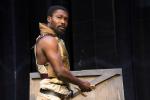
 Jude Owusu’s central performance as Tamburlaine is superb. A perfect portrayal of someone so confident in their own abilities, so fearless in their ruthlessness, so determined in their purpose, that anything that stands in his way is eradicated. You’re either on his side – and demonstrate that you are, by deeds and emotions – or you’re toast. Within a few minutes of his first appearance on stage, he emotionlessly twists the neck of Magnetes in response for the latter’s slight note of sarcasm in his voice. There’s no question that you’re in the presence of true danger. But he’s charismatic too, shown by how Edmund Wiseman’s grippingly performed Theridamus is instantly taken in by his spell and forsakes his allegiance to the drippy Mycetes. And there’s no mistaking Tamburlaine’s love for Zenocrate, both in the wooing and in the mourning. It’s such a demanding role, with so many long speeches and physical scenes, but Mr Owusu takes it all in his stride in his amazingly impressive performance. I hadn’t seen Mr Owusu on stage before; I sincerely hope it’s not too long till the next time.
 Rosy McEwen is also truly impressive in the dual roles of Zenocrate and Callapine. As Tamburlaine’s queen she explores all the divisive emotions of being in love with him yet also holding her father and her homeland in high esteem. Tamburlaine will ransack and conquer Egypt, but spare the life of her father the Soldan by making him a tributary king. As Callapine she reveals the character’s essential nobility, sweet-talking the jailer to let him go free, and avowing revenge on Tamburlaine for the death of his father. In both roles Ms McEwan is crystal clear in her enunciation, has magnificent stage presence, and both moves us and makes us admire her characters. Ms McEwan only graduated from the Bristol Old Vic School last year and is definitely a Name To Watch Out For.
 Mark Hadfield brings a comedic touch with his delightfully ridiculous portrayal of the petulant Mycetes, as well as the Soldan and Almeda. David Sturzaker is excellent as the double-crossing but quickly defeated Cosroe (amongst other roles); David Rubin and Riad Richie make a terrific partnership as Tamburlaine’s ever-present warrior followers Techelles and Usumcasane; Sagar I M Arya invests Bajazeth with the most beautifully spoken pride and contempt for Tamburlaine, and there are smart supporting performances from Anton Cross as Tamburlaine’s enthusiastic son Celebinus, Debbie Korley as the devastated Zabina, wife to Bajazeth, and Ross Green in more roles than you can shake a stick at. But the whole ensemble put in a terrific performance and there is not one weak performance anywhere.
 If I’m honest I wasn’t that impressed with the solution of what to do with the dead bodies. Anyone killed by Tamburlaine or his retinue is left on the stage at the end of the scene, then slowly stands up, looks around them quietly and vengefully, and then slopes off. I can see that this gives the sense that the characters’ ghosts are still there, observing what’s happening, although I don’t think that sense exists in Marlowe’s original; once they’re dead, they’re dead. I felt it looked clumsy, and a bit desperate for a practical idea of how to clear the stage. At least when Olympia receives her dying husband and murders her son for his own good (#yeahright) she tips them both down into the cellar tout de suite.
 A minor quibble in an otherwise fascinating and magnificent production. I’m guessing this might be something of a hard sell for the RSC – at last Saturday’s matinee there were loads of available seats, but I can assure you it’s most definitely worth spending your theatre pounds on a ticket. It’s on at the Swan Theatre until 1st December and it would be a crime to miss it; and you definitely wouldn’t want to incur Tamburlaine’s displeasure….
Production photos by Ellie Kurttz