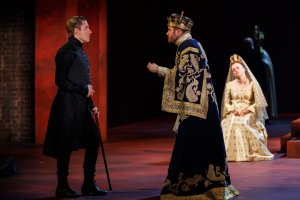
Review – Macbeth, RSC at the Royal Shakespeare Theatre, Stratford-upon-Avon, 11th September 2023

When I saw that the Royal Shakespeare Company’s new production of Macbeth was scheduled to run for over three hours, my heart sank. This is Shakespeare’s second shortest play after Comedy of Errors; so how on earth are they going to make it last three hours? I’m sure when I saw Judi Dench and Ian McKellen at the Young Vic in 1978 they did it in little over two hours. Mind you, that was the production where Dame Judi rattled through Lady Macbeth’s letter scene so rapidly that they dubbed it the telegram scene.

MacbethMy heart sank further when I discovered that the porter scene was to be rewritten by Stewart Lee “because it’s not funny anymore and no one gets the jokes”. I don’t consider myself that much of a Shakespeare purist but there are limits. I was reminded of Julie Walters in the Victoria Wood sketch where the Piecrust Players are staging Hamlet. She pulls Ophelia up on her words: “That lovely line, there’s Rosemary, that’s for remembrance – it’s no good bunging a few herbs about saying don’t mind me I’m a loony. This is our marvellous bard – you cannot paraphrase.” The porter’s scene does indeed pose problems and frequently doesn’t work – but occasionally it does, if you do it really, really well. And that’s one of the challenges of staging this play.

WitchesHowever, having seen the show I happily confess both my reasons for heart-sinking were unfounded. Yes, this is quite a slow Macbeth, but not in a dull, laborious way. It takes the opportunity to dwell upon the silent moments in the play; the actions of the witches, the atmospheric eerie portents of the castle and the ghostly visions, not to mention the drawn-out personal battle to the death between Macbeth and Macduff. The densely packed speeches are delivered thoughtfully and respectfully, at a measured pace, allowing us all to appreciate the language and its meaning. It’s so easy to get lost in a Shakespeare production when the actors race through the words so quickly that you don’t know what’s going on. But that doesn’t happen here; the production’s careful tempo keeps the audience sticking with it all the way through.

PorterAnd as for the rewritten porter’s scene; if you’re going to do something differently you might as well go the whole hog. I thought I was either going to hate it or love it; in fact, I did neither. The porter is now re-imagined as a stand-up comedian, with the obligatory microphone stand and compere introduction, addressing today’s audience with a 100% wall-breaking routine that comments on the news, politicians, and on the students watching the play for GCSE research. In a striking moment of disrespecting the audience, she mischievously gives the game away by telling us that Macbeth dies in the end. When she starts to engage Macduff and Lennox in conversation (as in Shakespeare’s original) it’s their turn to go off-piste and complain about things like woke productions and having a black actor play Othello – whatever next?

Duncan and MacbethFor the most part, the new sequence is pretty funny, and the audience hooted all the way through it. Apparently, there are explicit performances and non-explicit performances, depending on the date, which relate to the content of the porter’s script. We saw a non-explicit performance; but, to be honest, I don’t see the point of pussyfooting here. If you’re going to make a big splash with an innovative and offensive scene, don’t hold back. Personally, I thought it could have gone even more outrageous. However, the rewritten scene does weaken the motif of knocking in the play. It’s a relentless buzzer that disturbs the porter rather than the usual knock knock knocking, and it recurs on a few other occasions, which removes that sense of fate knocking at Macbeth’s door, or knocking at his conscience. I’m not sure a buzzing quite does the same trick.

BanquoWils Wilson’s production truly excels in conveying a classic, eerie, dark atmosphere. Dead birds fall from the sky, discordant clangs reverberate from the on-stage musicians, rain pours down. The witches first appear as almost half-formed pupae oozing out of a hole on the stage. There’s also an artificiality that also lends a discomforting air. It’s an almost entirely bloodless production; Banquo’s ghost is a vision of pallor, Lady Macduff’s babies are puppets that get tossed between murderers until you hear an audible crack of their necks and they’re dispatched into binbags. The unwashable blood on Lady Macbeth’s hands is suggested by a red light up her sleeve. Dead bodies are calmly coaxed up and walk off the stage at the invitation of the witches. On the whole, the production doesn’t do histrionics; Macbeth’s speeches are frequently fragile, Lady M’s criticisms of her husband’s perceived weakness are quietly underplayed, and Macduff’s shock at the loss of his pretty chickens renders him almost speechless.

Macbeth and Lady MAs you might expect, there is some trademark Royal Shakespeare Company gender-shifting amongst some of the roles, usually an opportunity to question your traditional understanding of those characters. Having the porter as a woman and one of the witches as a man works nicely. However, in other areas the concept doesn’t fully flow quite so easily for a couple of reasons. Duncan is now Queen of Scotland – even though Duncan is clearly a male name, she is definitely a woman. Banquo is also a woman, as is the unseen Thane of Cawdor, until she is executed. However, Malcolm is still a male character, even though he is played by a woman, so there’s a lack of consistency there. Perhaps even more of a problem, this production sites women in positions of power with Duncan at the top and Banquo and Cawdor as solid supporting officers; so there’s absolutely no need for Lady Macbeth to bend over backwards to encourage her husband to take the Scottish throne – she could just as easily do it herself.

MacduffReuben Joseph is a rather reserved and controlled Macbeth, prone to flashes of petulance revealing a deep-down fragility and a tendency towards mental disorder that becomes more quickly apparent than in most productions. It’s an intelligent and calm reading of the part. For our performance, Lady Macbeth was played by Eilidh Loan, with another restrained and unhysterical characterisation, quietly dominating her husband, but primarily allowing the text to do the hard work – all whilst still retaining her usual role as a witch too, which is some feat! Anna Russell-Martin’s Banquo is a hearty soul, and Therese Bradley plays Duncan with a sunny and beneficent disposition. Amber Sylvia Edwards and Dylan Read are the other two intriguing and spooky witches, and there’s a terrific supporting performance from George Anton as Macduff – noble, respected, and thoroughly persistent. And Alison Peebles makes the role of the porter very much her own, full of cantankerous glaring and sarcasm. At our show there were a number of roles performed by understudies, and the quality of some of the performances was perhaps a little patchy as a result – but you can’t fault that level of commitment.

Lady MacduffBut it’s not the performances that linger in the mind with this production, it’s with the ominous sense of fear and eeriness where it truly succeeds. It’s a cunning blend of the traditional and the innovative, and although it may lack a little in drive and authenticity, it conjures a very powerful atmosphere.


Production photos by Marc Brenner.

3-starsThree-sy Does It!

Review – Falkland Sound, Royal Shakespeare Company at the Swan Theatre, Stratford-upon-Avon, 5th September 2023

The Falkland conflict; I remember it so well. I turned 22 during those alarming 74 days in 1982, and if it had escalated to full-scale extended war, I would have been ripe for conscription. Everyone watched and waited; hanging on every word reported by the Ministry of Defence’s Ian McDonald’s daily TV updates, gripped by Brian Hanrahan’s journalism:  I counted them all out and I counted them all back. The nation was divided when the Belgrano was sunk as it was sailing away from the exclusion zone – your attitude towards it basically depended on whether you were a fan of Thatcher. It was the era of Gotcha! and Stick it up your Junta! And of course, the conflict was Thatcher’s golden key to No. 10 for the next eight years.

the islandersRather than concentrating on the conflict’s effects on Thatcher and her government, Brad Birch’s new play tells the story of the Falkland Islanders themselves; their way of life, their environment, their national attachments (to Britain, and by nature of location, to Argentina), their relationships, their work, their leisure. 8,000 miles is a long way away, and few Brits ever get to visit the Falklands, so any extra insight into this loyal community is always welcome. Although they still had access to the pop music of the time, it still seems a world apart; letters take ages to arrive, and the prospect of coming to Britain to study is just a pipe dream for most. Still, if your boss is kindly disposed, he might allow you to let off steam with the occasional two-nighter, which sounds like the maddest hangover experience ever.

GabrielThis is a bold attempt to remind ourselves of the conflict and also that the Falklands are still there, still part of Britain, and still loyal. The characterisations of the islanders are both creative and powerful, with much of the narrative coming from two outsiders – John, who has arrived from England as a teacher, and Gabriel who works at a scientific research establishment and is Argentinian. The experiences they share with us, both concerning their day-to-day lives before the invasion and how they survived both the occupation and the liberation, are told with moving realism and sensitivity.

John and the islandersHowever, these scenes are also juxtaposed with life back in Britain, where the Conservative government was very unpopular and Tory grandees were looking for a way to make Mrs Thatcher look good again – and the Falklands invasion was the perfect opportunity. However, these scenes are depicted in a completely different way; unlike the realism of the Falklanders, the government figures are caricatures. They don’t even have names, just numbers, and there’s an almost pantomime-like ridiculousness to the way they behave. As a result, for me, the UK scenes are much less successful than the Falklands scenes.

Joe UsherThere’s also the problem that, with a lot to say, Brad Birch’s play gets very wordy and rather heavy going at times; to the extent that I found some of the narratives rather difficult to follow, with so many characters involved, including those who are not actually portrayed on stage, so there’s a lot of reported activity and conversation. As the play progresses, the writing improves as Mr Birch can concentrate on the immediate issue at hand – the arrival of the British troops and the recapture of the islands. But overall, the play does feel a bit chewy and long.

IslandersI wasn’t sure about the music; not so much the local playing at the drinking get-togethers, but more why the characters would break into the occasional rendition of, for example, Supertramp’s Goodbye Stranger or Spandau Ballet’s Gold. And it didn’t really aid our understanding of the play to have the islanders regularly picking up their buildings – houses, church, shop, etc – and moving them around the stage. I think the idea was to indicate whereabouts in Port Stanley each scene was set; but in reality it’s just a distraction.

Mrs HargreavesThere are some very good performances – Tom Milligan’s John and Eduardo Arcelus’ Gabriel stand out, as does Joanne Howarth’s Mrs Hargreaves and her impressive Mrs Thatcher impersonation. Joe Usher is excellent as Robbie, the British soldier who basically represents the entire British army. At our performance Oliver Hembrough who plays Geoff/Dad was indisposed and assistant director Mariana Aristizabal Pardo stood in, presumably at very short notice, and enabled the performance to go ahead – so three cheers to her!

RosieA fine attempt to tell this important and still relevant story, and it’s a fascinating insight into the lives of the islanders themselves. It’s a little heavy, a little slow, and a little inconsistent. But there’s much more that’s good about it than isn’t.

Production photos by Ellie Kurttz

3-starsThree-sy does it!

Review – The Empress, Royal Shakespeare Company at the Swan Theatre, Stratford-upon-Avon, 18th July 2023

Tanika Gupta’s The Empress first arrived at the Royal Shakespeare Company ten years ago directed by Emma Rice, but here we have a brand new production, now with Pooja Ghai steering the directorial helm. It’s also the first show at the Swan Theatre under the new leadership team of Daniel Evans, Tamara Harvey and Catherine Mallyon. Welcome all!

RaniThe Empress traces the varying fortunes of a handful of characters who emigrated to Britain from India in 1887. 16 year old Rani Das is an ayah – that’s a children’s nursemaid – to a well-to-do English family. Another is a young man named Abdul Karim; there’s also the politician Dadabhai Naoroji, and a wannabe lawyer named M. K. Gandhi (yes, that Gandhi). They all travel on the same ship – and one of the lascars (sailors) on board, named Hari, notices young Rani and pretty much falls in love with her on the spot. On arrival in England, Rani is instantly dismissed by her employers – no employment protection in those days – thus becoming homeless. However, Hari takes her to a boarding house (or should that be bawdy) run by the rough-exterior but kind-hearted Lascar Sally. But this environment is no place for Rani and she quickly absents herself – Hari tries to find her but with no success.

Karim, Victoria, SarahMeanwhile Karim has surfaced as a new young waiter for none other than Her Majesty Queen Victoria. The play then follows the adventures of Rani and Karim; for her the only way is down until she can start climbing back up, and for him the only way is up until the establishment start getting their revenge on him. If you’re familiar with the film Victoria and Abdul then you’re well acquainted with the story of their unusual friendship, and how she elevated him to being her munshi (teacher) – and to be honest, the film gives you much more detail and insight into their relationship than you’ll find in The Empress.

VictoriaHowever, what’s very entertaining is the way that Victoria is reinvented in this play as a rather mischievous person with a keener sense of humour than you might otherwise imagine. It’s that characterisation that makes the Victoria/Karim thread of the story more interesting than the Rani/Hari aspect. One ought to respond emotionally to Rani’s plight and share in her despairs and later joys – but, strangely, somehow, one doesn’t. I found her story in the first act, where she veers from disaster to disaster, oddly cold and unemotional, passive and detached. Her story becomes more interesting in the second act when she starts making a life for herself, re-introduced to Naoroji, building a place for herself in the world. There is a happy ending for Rani – but I confess I found it rather far-fetched.

On board shipBlending fact and fiction, there is a strong narrative here – in fact two separate strong narratives – but they’re crowded out by the production’s obsessive use of music. Background music appears almost everywhere. Yes, it’s beautifully played under the direction of Hinal Pattani, but it has the effect of mollycoddling the hard-hitting aspects of the story with an overwhelming wave of slushy sentimentality. The scene, for example, where Rani is deciding whether her future lies with the man of her dreams or forging her own political career is muted by this blanket of superfluous romantic music – it’s as though the conversation took place in a hotel lift in Mumbai.

Abdul KarimThe Empress is a slightly odd blend of straight drama, interrupted by a few musical numbers – I accept it’s just possible that an early version of Bless Em All could have been sung by sailors at the time but it just feels anachronistic – and a spot of dance fantasy too. Most of the time these musical moments feel very out of place. However, there is a scene towards the end, where Karim promises to bring India to Victoria as she could never get there herself; and it reminded me of one of those strange – but also strangely effective – dream ballet sequences in the likes of South Pacific and Oklahoma. Bharatanatyam dance – beautifully executed by Tanya Katyal, exotic sweetmeats, lavish silks, all the sights and sounds of India are visited upon Victoria who laps it up like an excited child. A vivid dream shortly before her death? Some kind of medically induced hallucination? Or just a stage device for a bit of music and movement? I’m not sure – but, bizarrely, it works.

StagingOtherwise, the production looks good; simple, unobtrusive but authentic stage design from Rosa Maggiora and excellent costumes reflecting both the British and the Indian traditions at play. And the show benefits from having uniformly first-rate performances all round. Alexandra Gilbreath stands out as the surprisingly impish Queen Victoria, her grumpy frown (when used) belying her usually hidden inner charm. You really feel the anger and resentment when the officials, led by her unseen son Bertie, demand that she retracts the privileges she has granted to Karim – stressed and annoyed, she even mixes up her own pronouns of “we/our” and reverts to “I/my” in a very nice touch of 19th century misgendering. Francesca Faridany makes for a good sparring partner in the form of her lady in waiting, Lady Sarah, protecting Victoria from the inappropriate advances of her munshi and frequently getting into trouble for it.

NaorojiRaj Bajaj cuts a commanding and dignified figure as Karim and subtly shows us how he started to lord it over more minor characters as his fortunes rose – for example by politely patronising the artist whom Victoria has engaged to paint his portrait. Tanya Katyal is also excellent as Rani, a wide-eyed innocent youth who develops into a self-assured and perceptive woman. Aaron Gill gives a good performance as the rather reckless Hari, Avita Jay is a delightfully feisty Firoza and Simon Rivers is a strong, benign presence as the first British Indian MP Naoroji. There’s also excellent support from Nicola Stephenson as Lascar Sally, Miriam Grace Edwards as Georgina, Sarah Moyle in a number of roles including Rani’s unkind employer, and Oliver Hembrough as the lascivious Lord John Oakham.

HariRather like India herself, The Empress is a melting pot of narrative, style and imagination. Sometimes the story suffers from excess sentiment, sometimes it’s powerful and telling. But even when it’s at its weakest, it’s still rescued by excellent performances. Enjoyable, but somehow you feel it could just be a bit better than it is.  The Empress continues in rep at the Swan Theatre until 18 November 2023, and also plays at London’s Lyric Hammersmith between 4 – 28 October.

Production photos by Ellie Kurttz

3-starsThree-sy Does It!

Review – As You Like It, RSC at the Royal Shakespeare Theatre, Stratford-upon-Avon, 11th July 2023

There’s currently a curious interest in theatre where the production is designed to draw the attention of the audience to rehearsal proceedings and backstage insights. A prime example is The Motive and the Cue at the National – and from December at the Noel Coward – which details the creative process that led to the Burton/Gielgud Hamlet on Broadway in 1964. Omar Elerian’s new production of As You Like It that opened at the Royal Shakespeare Theatre last month puts yet another perspective on a backstage approach to a production. Here we have a group of (they won’t mind me saying it) veteran actors, many of whom were in a production of the same play in 1978; and they have come together (with a few thrusting younger performers) to re-enact for us their 45-year-old performances.

Celia Touchstone and RosalindThey weren’t the only veterans at last night’s performance. Not only does this show clearly attract an older demographic, but I also clearly remember the 18-year-old me going to see this production when it moved to London’s Aldwych Theatre in September 1978.

Interestingly, none of the actors on stage in Stratford was in that Aldwych show – although I did notice one leading actor from the 1978 production in our audience! I recall how I was bowled over by the production, and for many years it was probably in the top ten shows I’d seen. I have a feeling  that some of the music in the current production – the arrangement of Under the Greenwood Tree for example – is either the same as, or extremely similar to, the musical arrangements in the 1978 production. So for me, I also had a lot of opportunity to wallow in the nostalgia of the evening.

PhoebeAna Inés Jabares-Pita’s design primarily concerns itself with a rehearsal room, where the actors present the play, although with all the pictures and written sheets on the back wall it reminded me more of a police murder hunt case room. Of course, it’s a totally artificial presentation in many ways. As the cast gradually arrive on stage at the beginning, they natter with the audience until a stage manager gives the nod that the show is due to start. Then Michael Bertenshaw, who plays Oliver, addresses the audience to explain what’s about to take place. On more than one occasion, James Hayes (Touchstone) turns to the audience to remind them that he is a classical actor, implying that he’s scraping the barrel by appearing in this show – indeed, on one exit, he adds to Shakespeare’s text, “I’m wasted here”. You get the drift. For reasons known to others but not to me, a rock band slowly descends on the stage like a deus ex machina at the end of the first act – giving the cast a chance to have a bop and a boogie. The modern cage contraption that forms this piece of rigging is totally at odds with the bucolic charm we’re straining to imagine and it gets in the way. Admittedly it lifts early in the second act, taking Orlando with it – heaven knows why.

SilviusThere are some nice moments where the older age of the actors is deliberately at odds with the younger age of the characters – David Fielder and Celia Bannerman as Silvius and Phoebe, for example, put an interesting slant on young romantic love. And Rosalind’s reworked epilogue, which reflects the autumn of everyone’s years, is a neat piece of writing – although, I’m not sure it was completely necessary, the epilogue as written by Shakespeare contains ageless pieces of advice! However, I couldn’t help asking myself, beyond entertainment for entertainment’s sake – and of course, there’s absolutely nothing wrong with that, what actually is the point of this production? And I don’t mean that negatively – it’s great to get a new perspective, and for the most part it works. But I  got the impression that they were doing this production this way simply because they could; to be honest, it’s more “filler” than “killer”.

RosalindThere are some lulls in the proceedings too; the second act suffers from a lack of scenery and a lack of costume, and whereas it’s easy to imagine the Duke’s Court in the Rehearsal Room it’s far harder to envisage woodland glades. At the end of the show, the back wall gives way to reveal a beautiful tableau of the Forest of Arden – it’s as idyllic a presentation as you could possibly imagine. And it’s at that point that you realise that that – the Forest – is the main thing that has been lacking in the show. The episodic nature of the later courtship scenes, with Silvius, Phoebe, Audrey and so on, are normally fun as they dart playfully all over the stage forest, but in this production this all feels very static – and I confess, I did get a little bored, which is the cardinal sin of the theatre. It’s also when the forest is revealed, and the actors move towards it that the sense of nostalgia is at its most acute; when their voices start to merge with the recorded voices of the past, it feels like they are genuinely going back in time.

Rosalind and CeliaThere are some splendid performances that really keep the show lifted. Geraldine James as Rosalind and Maureen Beattie as Celia are a perfect pairing, and the evening revolves around them completely. James Hayes brings tons of comedy to Touchstone, and Malcolm Sinclair proves himself to be a remarkably youthful Orlando. Robin Soans does a terrific good cop bad cop routine as the two Dukes – Senior and Frederick; and amongst the younger members of the cast, I particularly enjoyed Rose Wardlaw, especially as Le Beau, realising after a while that he was meant to be French, and Tyreke Leslie whose calm quiet voicing of the role of Adam was very touching.

OrlandoIt’s very quirky, at times it’s very funny, occasionally it’s rather moving, but most of all it’s very charming. Perhaps it’s fair to say this is more of an experiment than an actual production per se, but it succeeds on those grounds. Despite its faults it’s still very entertaining and I’ve never seen a Shakespeare play performed this way before, so that’s a first!

TouchstoneP. S. I did like the fact that, unusually (but like the 1978 production) they didn’t cut Touchstone’s speech about rhetoric, which culminates in his insightful observation, “Your If is your only peacemaker – much virtue in If”. Remembering this production when I was writing an essay about this play at university back in 1980, I pounced upon this line as the key to the whole play, which I determined was all about the art of compromise. I read my essay as my tutor listened in stony silence. His verdict at the end was the brief but damning comment: “Possible interpretation”. In other words, I got it wrong.

Production photos by Ellie Kurttz

4-starsFour They’re Jolly Good Fellows!

Review – Hamnet, Royal Shakespeare Company at the Swan Theatre, Stratford-upon-Avon, 17th May 2023

Re-opening the Swan Theatre after its pandemic closure is Lolita Chakrabarti’s adaptation of Maggie O’Farrell’s 2020 novel Hamnet, a fictionalised account of the Shakespeare family, based on their son who died aged 11. Like nearly all influential novels of the 21st century, I haven’t read it, but I daresay you have, gentle reader. And so have many other thousands, otherwise the production wouldn’t have more or less sold out at the Swan even before its opening, gaining at West End transfer at the Garrick at the end of September.

Will and AgnesBut first things first; let’s have a quick word about the refurbished Swan Theatre. Plunged into darkness by Covid, it’s sprung back refreshed three years later and looks a proper treat. Super-comfortable fold out chairs make it easier to get to your seat and give you a great view of the stage. The upper floors create the impression of luxury teak bannisters and give the whole venue a classy feel. This isn’t the Royal Shakespeare Theatre’s little brother anymore, it’s a fully-fledged grown-up theatre all of its own. Fantastic job!

John and NedMaggie O’Farrell’s book transfers smartly to the stage, with a first act that depicts the early days of Will and Agnes’ courtship, her pregnancy with Susanna, their marriage (in that order), the later arrival of the twins Hamnet and Judith, and Will’s ascent in the playwrighting business, requiring him to move to London, keeping the family at home. The second act shows his rise to fame set against the backdrop of family activities and health problems back in Warwickshire. Judith is a sickly kid but Hamnet is a robust, precocious young cove with bags of energy and even more cheek.

Will and JohnSPOILER ALERT! When the Plague hits the village, it makes straight for Judith much to the devoted Hamnet’s horror. Agnes relies on her herbaceous remedies as usual, but the word goes out to Will that he must come home. Terrified that Judith will die, Will rushes home, only to be relieved to find a healthy Judith; but the Plague has taken Hamnet. The subsequent grief and ways in which the family members cope with it form the rest of the play. It’s a strong story, strongly told. Perhaps the first act is a little slow in part, but the second act races through with a growing sense of urgency as we reach the inevitable conclusion.

AgnesWhat’s in a name? asks Shakespeare in Romeo and Juliet and it’s a question that gets a lot of attention in this play. Everyone knows who William Shakespeare is, but who’s this Agnes? Wasn’t he married to Anne Hathaway? Maggie O’Farrell discovered that in her father Richard’s will he names her as “my daughter Agnes”. So maybe Anne was just a shortened form or a pet-name for her; and it’s clearly the goal of both writer and adaptor to put her at the heart of the play, so she’s reinstated in her full Agnes glory. Neither the book nor the play mentions either the names Shakespeare or Hathaway in an attempt to leave their reputations behind and just portray them as an ordinary rural couple; thus they’re both only ever Agnes and Will.

HamnetAnd as for Hamnet; apparently it was a local variant on the name Hamlet, so when Will’s renowned tragedy of the same name appeared a few years after his son’s death, it was quickly assumed that the choice of name was clearly influenced by the lad. And it may well have been simply that obvious; or, it may be that Shakespeare took the name from the Scandinavian legend of Amleth, whose fortunes and adventures are clearly the source for Will’s eponymous tragic hero. Taking his son’s name in vain, without clearing it with Agnes first? Honouring the memory of his son in what would probably be thought of as his finest piece of writing? Or pure coincidence? Audience: you decide.

Burbage and WillThere is a little imbalance between the two acts; they almost feel like they’re telling two different stories. To help connect the two, Hamnet and Judith appear in spirit form in the first act, which adds to a sense of dramatic irony; we know the boy’s going to die soon and they don’t even know he’s going to be born yet. I thoroughly enjoyed the overlay of Will’s London theatricals on top of the crises happening back home; rehearsing the death of Tybalt whilst the Plague has hit the family, unable to control his temper during the final scenes of Comedy of Errors – and I thought it was a very nice trick to have the same actor play both Hamnet and Thomas, the boy actor who is struggling with the girls’ roles, emphasising how the two halves of Will’s life interweave.

Will and AgnesIt’s extremely well-acted throughout, but particularly by the main two actors, Madeleine Mantock as Agnes, and Tom Varey as Will. Ms Mantock plays Agnes full of spark as a girl and a young woman, which turns into strong, courageous resilience as the horrors of losing a child completely shape the rest of her life. Tom Varey’s Will also has a cheeky spark as a young man, that develops into a kind of maturity as he gets older, although of course he’s not averse to going out drinking with his theatrical buddies.

Joan and WillPeter Wight is excellent as John, Will’s gruff and impatient father, disapproving of everything his wayward son gets up to – and by association, with the rest of his family. He also entertains as the larger-than-life actor Will Kempe, all wind and ad-lib; very nice. There’s great support from Elizabeth Rider as Will’s hardworking mother Mary, Harmony Rose-Bremner as the grumpy Susanna, and Sarah Belcher’s vindictive Joan, Agnes’s stepmother.

Hamnet and JudithI really enjoyed Alex Jarrett’s performance as Judith; her brief speech about what do you call a twin whose other twin has died was possibly the most poignant moment of the whole production. What’s in a name? again. And it’s a very believable and winning performance from Ajani Cabey as Hamnet/Thomas, both sprightly and spritely, running rings around his mother and sisters, and hopelessly devoted to Judith.

Girls will be girlsA very enjoyable sideways glance at a family you think you know a little bit about but who in fact are largely anonymous to us today. Plenty of relevance to the present time, and an ultimately very rewarding evening at the theatre. Catch it at the Garrick from September 30th to January 6th if you’re too late to see it in Stratford!

Production photos by Manuel Harlan

4-starsFour They’re Jolly Good Fellows!

Review – Cymbeline, RSC at the Royal Shakespeare Theatre, Stratford-upon-Avon, 3rd May 2023

In a fortuitous combination of celebrations, not only is this the 50th production directed for the Royal Shakespeare Company by its Artistic Director Emeritus, Gregory Doran, it’s also 400 years since the publication of Shakespeare’s First Folio, without which we might not have had several of the great man’s plays, including Cymbeline. Tucked away near the bottom of the list of plays in most collected editions of Shakespeare’s plays, poor old Cymbeline has been overlooked for a century or more. Relatively rarely performed or studied, I managed an entire summer term reading Shakespeare at University and not once did it come into my orbit.

Cymbeline and young PosthumusWhen I was about thirteen, gentle reader, one day I decided I would count the lines in each of Shakespeare’s plays and create a list of how long they all were, to see which was the shortest and which was the longest. What an insufferable little prig I must have been. However, fifty or so years later it remains one of the most useful pieces of research I ever did. Whilst Comedy of Errors heads the list as his shortest play, Cymbeline weighs in at a hefty 3,286 lines, beaten only in the length department by Coriolanus, Troilus and Cressida, Richard III and Hamlet.

Cloten and PisanioI mention this because there is something of an elephant in the room with this production, or rather in the Royal Shakespeare Theatre; it’s a long play. Including an interval and a five minute pause (which doesn’t really feel long enough to achieve the double whammy of the Gents and the Gin and Tonic), the show lasts for the best part of three and a half hours. Surely, it could be cut back a bit? No. Shakespeare has packed this play with so many fascinating characters and so many plot elements, that’s it’s hard to see how you could pare it back at all, without depriving it of a vital part.

Royal householdThe initial set-up of the play is a little complicated. Cymbeline is King of Britain; he is married to the Queen – she seems to be just called Queen. However, previously he was married to another queen, who gave birth to Imogen. Imogen has given her heart to Posthumus Leonatus, an orphan whom the King brought up but has no royal lineage, and so is considered an unsuitable match for Imogen. Meanwhile, the Queen was also married once before, and that marriage bore a son, Cloten, a foolish braggart, who has been earmarked to marry Imogen. The Queen is not to be trusted, by the way; she asks her doctor Cornelius to supply a bottle of poison because she plans to murder both Cymbeline and Imogen, However, Cornelius hands her a bottle of harmless sleeping potion instead because he can see right through her little game. Oh, and Cymbeline also had two other sons, Guiderius and Arviragus, and they were stolen away as babies, apparently by the banished Lord Belarius, but you needn’t worry about them yet. I hope you’re taking notes, there will be questions later.

Iachimo and his gangPosthumus is also banished, to Italy, where he meets a nobleman, Iachimo, who wagers that he could seduce Imogen with ease. Riled, Posthumus accepts the bet, always convinced that Imogen would remain faithful. And so she is, as Iachimo is disappointed to discover. This leads him to some subterfuge, hiding in her bedroom so that he can report back on the artwork on the walls, and, more tellingly, the mole on her left breast, of which he sneaks a peek. Then follows a sequence of events, including Posthumus instructing Pisanio, his servant, to murder Imogen (he doesn’t), and Imogen having to go rogue and disguise herself as a boy, Fidele, who by chance pals up with Belarius and the two boys (remember them?) living rough outside Milford Haven. I’ve been to Milford Haven; this part of the story is entirely believable.

By JupiterI’m going to stop there; but there’s so much more plot to follow. Shakespeare must have had a field day incorporating all his favourite plot twists and characterisations that had proved successful in the past. A girl dressed as a boy, a wicked Queen, a beheaded villain, a chaste woman tested, a sleeping potion that makes people think you’re dead, a banished Lord, even a Deus ex Machina (if you’re going to have one, it might as well be Jupiter, voiced by Patrick Stewart). There are themes of honesty and betrayal, forgiveness and redemption, noblemen foraging in the wild, and foolish fops at court. It shows beautifully how if a common man commits a murder he will die for it, but if a Royal figure does it, that’s ok. There’s a stunning scene – spellbindingly clear and simple – when Posthumus holds Iachimo’s life in the palm of his hand, but rather than choose a path of revenge, responds: “the pow’r that I have on you is to spare you; the malice towards you to forgive you. Live, and deal with others better.” For me, the most telling moment in the entire play. It even asks questions about Britain’s identity; is it part of the Roman Empire or a solo state, refusing to pay the tribute to Rome, because Britain can thumb its nose at Europe? Where have we heard that before? I can just imagine that tribute sum written along the side of a bus.

Final sceneBut what makes this play unique in all of Shakespeare’s works – I think – is the way all these tiny elements and themes become convincingly but hilariously resolved in a riotous final scene that makes your toes curl with pleasure. The play is famously considered uncategorisable. Is it a tragedy? Certainly not in the classical sense. Is it a history? Although the character of Cymbeline is based on Cuneboline, King of Britain from AD 9 to 40, the play owes far more to Holinshed’s Chronicles than any history book. I always think of it as a comedy, but with most of the laughs kept back for that final scene.

Imogen in bedThe Royal Shakespeare Company has developed something of a reputation for pushing the boundaries as far as experimental productions of Shakespeare’s Classics is concerned. Setting them in different times; gender-swapping on major roles; using the powers of the audience’s imagination rather than simply conveying plot and character as they were written. As always, this sometimes works brilliantly, and sometimes fails; experimental ideas can go wrong, and you’ll never know unless you try them. But Gregory Doran’s production is – for the most part – tradition and simplicity itself, unadulterated by unnecessary directorial distractions or clever-clever interpretations. And it feels as fresh as a daisy and as clear as daylight as a result. No need for any stage furniture, other than Imogen’s bed and the chest in which Iachimo hides; no need for a complicated sound plot, other than Ben McQuigg’s band’s simple musical accompaniments and a little rainfall. Matt Daw’s lighting design is effective without being intrusive; there is some occasional use of puppetry which works extremely well.

Cloten and his lordsThe performances are first-rate throughout; some are outstanding. Peter de Jersey makes for a gruff and blustering Cymbeline, physically imposing if with some weakness of health (which becomes clear in that all important final scene), quick to ire but essentially generous of spirit. There’s an element of the pantomime villain in Alexandra Gilbreath’s Queen, but none the worse for that, as she shares her devious plans quite openly with us. Amber James is superb as Imogen; stoic, gracious, and full of pluck. Conor Glean’s Cloten is thuggishly foppish, bombastically arrogant; an excellent portrayal of someone who is all façade and no substance.

Imogen and her two new brothersThe always reliable Mark Hadfield puts in a tremendous performance as Pisanio; the character’s thoughts and feelings being conveyed not only by Mr H’s superbly clear delivery but he also has that enviable ability to express a whole range of emotions with the simplest of facial gestures. Jamie Wilkes chillingly captures all Iachimo’s Lothario-like wretchedness, including how deflated he is when the truth comes out – like all bullies, he is pathetic. There are a couple of terrific double acts, in Scott Gutteridge and Daf Thomas’ Guiderius and Arviragus, and Barnaby Tobias and Tom Chapman as the two lords who attend on Cloten. Jake Mann makes the most of Cornelius’ two scene-stealing appearances, and Theo Ogundipe’s incredible enunciation invests the character of Caius Lucius with huge authority. Perhaps best of all, Ed Sayer’s Posthumus Posthumuscommands the stage with every appearance; lowly-born though his character may be, he truly makes you understand what nobility really means.

The Press Night audience gave it a rapturous reception – quite rightly so. Gregory Doran leaves the RSC with a magnificent legacy of work, and Cymbeline is right up there with the best. It’s on at the Royal Shakespeare Theatre until 27th May, and if you’ve never seen this hidden gem of a Shakespeare play before, I couldn’t recommend it more strongly.

Production photos by Ellie Kurttz

Five Alive, Let Theatre Thrive!

Review – Julius Caesar, RSC at the Royal Shakespeare Theatre, Stratford-upon-Avon, 28th March 2023

Without making it sound like an end of the pier revue, the Royal Shakespeare Company’s summer season kicks off with Atri Banerjee’s production of Julius Caesar. Having started with The Tempest, it’s the second in a series of plays grouped under the theme of Power Shifts, and there’s no doubt that’s highly relevant in these tortuous political times that we’re all facing. I’ve no statistical proof of this, but I think if you got a bunch of Shakespeare devotees in a room together they’d agree that Julius Caesar is one of their favourite offerings from the Great Bard. It’s packed with exciting characters, memorable speeches, impactful incident and more deaths than you can shake a stick at. And it couldn’t be more suited to an examination of power shifting. So it’s a great shame to come away from a production regretting many of its directorial decisions and opportunities lost.

Community ChorusThe production is so heavily stylised that it alienates you from the start. Six members of the Community Chorus come on stage, and you think they’re going to sing something passionate and portentous. Instead they give us some heavy breathing like they’re expelling the bad energy at the end of a Vinyasa Yoga session. The rest of the cast come on stage and start running around; after a while they form into a pack and give what I can only describe as an homage to the Michael Jackson Thriller routine. This leads into some chanting (naturally) and Mark Antony starts to howl like a wolf. It’s at this stage that you realise this production is not for purists. The trouble is, if you’ve already lost the goodwill of the crowd by this stage – and Mrs Chrisparkle had already decided that this wasn’t going to be for her – then you’ve got a big uphill struggle trying to get it back.

ThriillerAs you might expect from the Royal Shakespeare Company, there’s an abundance of female actors taking on the traditionally male roles and, despite the odd misplacement of a pronoun here or there, it never seems forced or inappropriate; in fact, it helps gain a new insight into some of the characters. The acting is also first-rate throughout, which really gives purpose to the production. The text is spoken clearly and with conviction; in fact there’s very little that you hear* in this production that doesn’t satisfy even the most pernickety Shakespeare fan. (*One exception, that I’ll return to later.)

ClockNo, the problem with the production is with what you see. A blank stage, with a distracting back projection that does little to set the scene. A mishmash of costumes that neither inform us of the status of the characters nor the era in which the play is set. There’s the return of what I think of as the RSC Clock – a ticking countdown that creates a two-minute pause after the death of Caesar – for no discernible reason whatsoever, other than to minimise its impact – and a twenty-minute countdown during the interval. It was the RSC Clock that contributed to the mess that was their Macbeth in 2018, and whilst it’s less damaging here, it’s still a pointless complication. Nothing looks sillier than when a clock ticks down to zero and nothing happens – as at the end of the interval, when at zero hour some people were still queueing for the loo, and it was probably another two minutes of staring at a stopped clock before the play resumed.

CaesarDespite a number of deaths, there are no dead bodies – think about that – nor are there are any weapons. Killings are mimed, and there’s lots of semi-balletic prancing around which certainly takes away from death’s sting, but unfortunately looks rather ludicrous. When Brutus kills herself by running onto Lucius’s outstretched hand, it resembles the kind of game you might have enjoyed in the school playground aged seven. And there’s the blood. Being Julius Caesar, there’s an awful lot of it. “Let us bathe our hands in Caesar’s blood,” says Brutus, “…and waving our red weapons o’er our heads, let’s all cry “Peace, freedom, and liberty!””

CassiusThere’s a clue there – red. So why is the blood in this production black? And it’s not blood-like but a thick gooey gunge that gets on everyone’s hands and clothes; and, of course, with no weapons, Caesar is basically patted to death by messy hands, making the memorable “unkindest cut of all” reference redundant. It’s as though everyone is smeared with molasses; maybe Caesar was diabetic and was killed by a high blood sugar surge.

ConspiratorsLet’s not forget the revolving cage of death. As more and more characters get despatched to heaven above, they start to populate a huge cube at the back of the stage. The more people who join them, the happier those already dead seem to be to greet old friends; and I must say, the silly childlike hello wave between Caesar and Brutus is cringeworthy. And the cage revolves; not by some magic stage technology but by two stagehands pushing it around like a broken-down car. Frankly, it’s inelegant and embarrassing.

CiceroYou may not be surprised to see that the ghetto blaster makes a reappearance, so that Brutus can relax to the tune of Caetano Veloso’s song Nine Out of Ten. I know this because the programme told me. I’d never heard the song before and I’d never heard of Veloso, but I’ll bet my bottom dollar it’s contemporary of neither Roman times nor 1599. When aspects of a production only make sense to the audience after they’ve read a programme note explaining them, there’s something not quite right with the production. It’s a little like trying to wade through T S Eliot’s Waste Land and then turning to his notes in desperation. The programme also explains the reason for the RSC Clock; personally, I think it’s pretty tenuous. Banerjee describes the collaboration between the various cast members which led to the structure of the production as being “quite magical”; whereas to us it felt like it was a production that had been put together by committee. And what I can only describe as being far too clever-clever.

BrutusSo let’s turn to those show-saving performances. Thalissa Teixeira is superb as Brutus. Noble, honourable (as Mark Antony will tell us) and with a vulnerable compassion that defines her dilemma of being an unwilling conspirator, she gets all the character’s nuances and conveys them with clarity and authority. There’s a terrific balance between her and Kelly Gough’s Cassius; Ms Gough gives us a volatile and excitable reading of the role, emphasising the character’s motivations and emotions with great clarity. And William Robinson is terrific as Mark Antony, slightly wet behind the ears, turning that “tide of man” with a brilliant performance of the Friends Romans Countrymen speech.

Decius BrutusThe other conspirators are all very well portrayed – Gina Isaac’s Decius Brutus is delightfully deceitful, Matthew Bulgo’s Casca splendidly reserved, and Katie Erich’s Caius Ligarius impressively earnest. Joshua Dunn makes a good job of Cinna the Poet’s untimely death, and there is some light comic relief from Jamal Ajala’s Lucius being made to run on and off the stage ad fatigatum – at least I think it was meant to be comic relief. Annabel Baldwin’s Soothsayer is turned out like they’d just got off the exercise bike at the gym, but nicely delivers their portentous lines with matter-of-fact clarity rather than with Up Pompeii-style wailing.

Mark AntonyNigel Barrett plays Caesar as an atypical military hero; you’d get the sense that he’d rely on his foot soldiers to win any battles, and he appears as a someone more likely to enter a dad dancing contest rather than being a feared General. It’s an interesting reading of the part – not one that I really attuned to, but you can’t win them all.

LuciusI was so looking forward to this production; but in the end I was so disappointed with it. To say this is a curate’s egg is to be kind to curates. Worth seeing for the acting, especially Ms Teixeira and Ms Gough’s verbal sparring and Mr Robinson’s oratory. As for the rest, I’ll draw a veil. Julius Caesar is playing at the Royal Shakespeare Theatre until 8th April, and then goes on a nine date tour until June, to Canterbury, Truro, Bradford, Newcastle, Blackpool, Nottingham, Norwich, York and Salford.

Production photos by Marc Brenner

Two Disappointing For More!

Review – The Tempest, RSC at the Royal Shakespeare Theatre, Stratford-upon-Avon, 2nd February 2023

News of the shipwreck of the Sea Venture off the coast of Bermuda in 1609 is thought to have been the major impetus for Shakespeare’s The Tempest, one of only a couple of his plays that appear to be completely original. A few years before its first performance in 1611, there had been major floods in Wales, and those early audiences would have been well aware of the dangers that water – in all its forms – could create.

Rain Sky EarthElizabeth Freestone’s new production takes our new understanding of the problems of climate change as its impetus, and it’s an alignment that makes a lot of sense. Not only is there an admirable use of green sustainability in the construction of Tom Piper’s set, his costume design (with Natasha Ward) evokes all those worrying statistics about the amount of plastics in the sea, with the spirits of Rain, Sky and Earth partially clad in old carrier bags and plastic containers. Ferdinand litter picks the rubbish on the beach (he did kindly ask our section of the audience if we had any empties) – and this litter was genuinely collected from the beach at Weston-super-mare; you’ve got to respect the fact that the RSC are walking the walk on this one.

CastI’ve always had a bit of a problem with The Tempest. It’s one of those plays where you’re familiar with the major characters, and the quotable lines, and even the main plot (there’s a tempest, an island, lots of shipwrecked people and a whole shebang of sorcery) but for me it always feels stodgy. There are a number of long speeches and protracted conversations that can make the whole thing get bogged down, and, considering it’s Shakespeare’s second shortest text (after Comedy of Errors), it can feel rather long. Above all, there is little of the usual expectation for some Shakespearean conflict, or suspense, or dramatic tension. So it’s vital to accentuate the magic to give the play its necessary dynamism.

ProsperoThere are two occasions when magic rules the Stratford stage. The first is in the extraordinary first scene – the shipwreck that Prospero has caused – where the unlucky passengers and crew are tossed, turned and terrorised at sea. It’s a truly exciting start to the show, stunningly realised and beautifully performed by everyone. The second is Ariel’s Act Three Scene Three appearance as a harpy, to frighten the living daylights out of Alonso, Sebastian and the others. The costume is fantastic – and I really liked the comic touch with Ariel’s next appearance still wearing the harpy’s claw, as though it was a quick change routine that didn’t change quickly enough. A tiny attention to detail, but it subtly reveals the artifice of the magic – very nicely done. So, is this production the stuff that dreams are made on?

Trinculo and StephanoNot entirely. Unfortunately, the problems of climate change detract from the magic. Magic is all about illusion, creating the appearance that the impossible is possible; it’s delight and wonderment, and, for want of a better word, pizzazz. Climate change is the opposite. It’s reality, it’s hardship, it’s a step towards oblivion. Magic takes something of a back seat in this production; and even when magical things happen, they’re brought back to earth by the harshness of real life – like the detritus in the spirits’ costumes.

Prospero and MirandaConsequently, the success of this production comes strongly from the incredible cast, each of whom bring the magic that might otherwise be lacking. You’ve got to start with Alex Kingston as Prospero. This is the first time I’ve seen Ms Kingston live and she is a truly charismatic stage performer. The whole show lights up whenever she’s on stage, and she brings true humanity to the role. Prospero is the one controlling force in The Tempest; everything and everyone is in his/her thrall, and Alex Kingston shows how that is completely possible. Her reading and understanding of the text is superb, and she makes the most intractable of Shakespeare’s language readily comprehensible.

FerdinandJessica Rhodes is steadily working her way towards being one of our brightest young actors – she was superb in Chichester’s Doubt last year, and her performance as Miranda here is even better. She conveys the character’s young innocence and total amazement at the presence of other people superbly well. Having Prospero as her mother, rather than her father, creates perhaps less of a “hero-worship” for the parent and more of a true devoted affection; an enviable mother/daughter relationship indeed. She is perfectly matched by Joseph Payne’s Ferdinand, an innocent abroad with an instant attraction to Miranda, and, even though we know his father is a villain, you’d be hard pressed not to be moved by his heart warming reaction to discovering Alonso is still alive.

CalibanHeledd Gwynn is superb as Ariel; she has a naturally ethereal quality that makes the character’s flighty tricksiness even more believable. This was the first time I’ve seen an Ariel who really made me believe that their true goal was to attain their freedom. This is no Puck, who’s happy to do whatever Oberon wants unquestioningly; this is a character who constantly expects this is the last time they will have to do their master’s bidding, yet is thwarted time and again. Tommy Sim’aan’s Caliban, by contrast, is no savage and deformed slave, as Shakespeare would have had it – there’s nothing remotely inhuman about him, which brings him more on a par with his co-conspirators Stephano and Trinculo, but at the same time maybe brings us further away from the idea of magic. Nevertheless it’s a very strong and clear performance.

Antonio Alonso and SebastianSimon Startin and Cath Whitefield have (for me, at least) an enormous uphill struggle to make Stephano and Trinculo watchable, as I personally find those characters’ scenes rather tedious. Mr Startin’s Stephano is a clearly a distant relation to Barry Humphries’ Sir Les Patterson; Ms Whitefield’s Trinculo is entertainingly quirky and clownish. Peter de Jersey is excellent as Alonso, as is Jamie Ballard’s Antonio; but in fact all the cast are superb – there isn’t a weak link in the chain.

All in all, a thought-provoking new production, with excellent performances. Rooted in our climate crisis as it is, the magic never really soars; but its environmental message is received loud and clear.

Production photos by Ikin Yum

4-starsFour They’re Jolly Good Fellows!

Review – All’s Well That Ends Well, Royal Shakespeare Company at the Royal Shakespeare Theatre, Stratford-upon-Avon, 13th September 2022

All’s Well That Ends Well – it’s a phrase we all use, but are we all familiar with the play? I suggest not; which is rather perplexing, because of the three Shakespearean Problem Plays (the others being Measure for Measure and Troilus and Cressida) this is the play that has the greatest potential to be a crowd-pleaser. And Blanche McIntyre’s current production for the RSC demonstrates that quality in an often hilarious, always thought-provoking, occasionally confusing way.

Helena and BertramIn a nutshell – orphan Helena was taken into care by the kindly Countess of Rossillion but has fallen in love her son, Bertram. The Countess is fine with this; Bertram not so much, as he feels his status is somewhat better than marrying “a poor physician’s daughter”. Reluctantly he weds her on the instruction of the King of France, who owes Helena a favour for having saved his life (long story). But Bertram flees to the Tuscan wars on his wedding night with his pal Parolles (who’s no better than he ought to be.) Helena follows him and tricks him into bed by pretending to be Diana, a local girl with whom Bertram has become infatuated (we need to suspend disbelief on that front). Helena becomes instantly pregnant (it worked that way in those days) and, following a public humiliation at the French court, Bertram eventually agrees to stick with Helena; thus all’s well that ends well.

King of FranceMcIntyre has brought 17th century France and Florence bang up to date with a 2022 world of social media, online gaming, smartphones and selfies. This contemporary setting works well for the play’s characterisations and interactions, and of course has the prospect of opening up the play to a younger generation of theatregoers. However, I’m not sure that Helena’s magic “prescriptions” that she dispenses to transform the health of the ailing King of France quite make sense in what must also be a world of advance scientific breakthroughs – we need to suspend disbelief on that front too. But it’s a fun concept – and, if anything, could have been taken a little further. The back projections of social media interaction never stay there for long, and I don’t think there was much in the way of trolling, which would have been very relevant!

Countess and LavacheRobert Innes Hopkins has designed a fascinating structure that looms on top of or over the stage the whole time, like a huge shuttlecock. It works pretty well – reminding you of perhaps a conservatory at the Rossillion residence, or a tarpaulined tent in the war scenes. The costumes show a nice divide between the haves and have nots – the Countess wears classy trouser suits, Bertram and the King are a dapper pair of clothes horses, and Helena makes do with something pleasant and practical from Primark. The military fatigues are stock standard camouflage gear, and Parolles comes dressed in a pseudo-military, pseudo-flamboyant outfit, reflecting the character’s shallowness and duplicity. There’s a very effective scene where Parolles gets all his kit off apart from his comic book hero underpants, and especially removes a sturdy stocky torso covering, exposing himself to the elements rather like Edgar’s Mad Tom, thereby revealing that, underneath it all, this big wannabe burly hero is actually just a bit of a weakling like you or me.

Countess and LafewSome extremely good performances brighten up the show enormously – and maybe highlight the fact that one or two of the performances are perhaps slightly tentative. Rosie Sheehy commands the stage from the start as the forthright Helena, her voice full of confidence and assertiveness, perfect for the role of the young woman who knows what exactly she wants and is determined to get it at all costs. Claire Benedict’s Countess is superbly dignified, fair-minded, and naturally gracious; it’s not surprising that she would have extended her kindness to looking after Helena.

Dumain and BertramIt struck me that Shakespeare doesn’t give the actor playing Bertram many memorable juicy lines to establish his full character, but Benjamin Westerby makes a good job of portraying his young callousness and poor decision-making. Bruce Alexander is very good as the King of France, all wheezy and feeble at first, then properly regal later; he comes into his own in the final scene where he adjudicates in the Bertram/Helena/Diana love triangle, with beautifully timed vocal tics and challenging expressions.

Parolles and the guysAmong the lesser characters I really enjoyed the performance by Simon Coates as Lafew, the old courtier who’s seen it all and naturally gets the better of a jumped-up little chappie like Parolles in a series of truly hilarious vocal skirmishes. I also loved Eloise Secker as the Younger Dumain, for whom the pricking of pomposity comes as a fine art. Perhaps best of all, Jamie Wilkes’ Parolles is a wonderful comic creation; if ever the phrase all mouth and trousers was designed to fit anyone, it would be this fellow. Mr Wilkes gives us some terrific breaking the fourth wall moments, full of braggadocio for anyone who will stop still and listen until he’s captured and becomes the biggest Squealer since Animal Farm. It’s a brilliant performance, hugely entertaining; he makes you wonder why All’s Well That Ends Well doesn’t get performed more.

Duke of Florence and armyThe final moment on stage (which I shan’t reveal) simply and effectively drives home the uncertain future that faces the young couple. This isn’t all sweetness-and-light, it’s a tale full of bitterness and disloyalty which the production conveys extremely well. I confess I occasionally lost track of what was going on, particularly with the war scenes, and the D-Rum concept, and the energy did sag occasionally. But I thought this was a very brave stab at bringing back a rarely performed play and giving it a new relevance for today. Lesson: beware of girls in fluorescent wigs at discos.

Production photos by Ikin Yum

4-starsFour They’re Jolly Good Fellows!

Review – Richard III, RSC at the Royal Shakespeare Theatre, Stratford-upon-Avon, 1st July 2022

The Royal Shakespeare Company continues its trawl through the annals of the House of Plantagenet, specifically following on from the recent productions of Rebellion and Wars of the Roses, with this strikingly designed new production of Richard III, and a satisfying continuity of casting in many of the leading roles, including the welcome return of Arthur Hughes as King Richard, the first time a disabled actor has taken this part in the history of the Company.

Arthur HughesEdward IV reigns as King of England, but Richard, Duke of Gloucester has other ideas. First, eliminate his kindly brother George, Duke of Clarence. Then marry Lady Anne, who had been previously married to Henry VI’s son Edward of Westminster, who died at the Battle of Tewkesbury. Edward IV dies naturally, but Richard can’t tolerate his son, the twelve year old Edward V, being king. He enlists the Duke of Buckingham to engineer his path to the throne, but when Buckingham refuses to kill Edward, he gets professional assassin Tyrell to do the deed instead. The young prince is murdered in the tower along with his brother. But it’s still not enough; and when Henry Tudor, Earl of Richmond, arrives with an army to claim the throne, it results in the Battle of Bosworth Field and we all know what happened there. (You don’t? You’ll have to see this play then.)

Nicholas ArmfieldShakespeare didn’t hold back from presenting Richard as the architect of a lot of blood and violence, and Gregory Doran’s production rings the changes by portraying these deaths in a wide range of styles, from the literally gory to the subtly suggested. It is perhaps curious that Shakespeare does not let us see the actual death of King Richard in battle: “Alarums. Enter King Richard and Richmond; and exeunt fighting. Retreat and flourish. Re-enter Richmond, Stanley bearing the crown, with divers other Lords, and Forces.” This gives a director carte blanche to finish Richard III off in whatever manner they wish, and Mr Doran has chosen to make it rather elegant and ethereal. Matt Daw’s inventive lighting design is used extensively to convey death, with maybe a quick flash of red light to depict one dispatch, or the visceral descent of vivid red seeping down the one feature of the set, a cenotaph-style tower, to suggest others. Death’s never far away in this play.

Matthew Duckett and Arthur HughesI know this isn’t a football match, but this production really is a game of two halves. Even with some judicious cutting, this is a long play, and the first Act takes us all the way from Shakespeare’s beginning to Act Four Scene One. The second Act begins with Richard’s coronation, Act Four Scene Two. As a result, we have more or less two hours before the interval, but then little more than an hour afterwards. Although there are obviously some highlights – the wannabe king’s pretence that he doesn’t seek the crown and is much happier with his virtuous Bible study is a sheer delight –  the first Act has more than its fair share of longueurs. The second Act, however, is stuffed with theatrical magic and flies by. The exquisite grandeur of the Coronation. The knife-edge debate between Richard and Elizabeth regarding his plan to marry her daughter. The superb staging of the Ghosts that taunt Richard the night before Bosworth Field, and how they merge to become his ghostly horse for which he’d give his kingdom.

Minnie Gale as MargaretHowever, the overall vibe of the production is distinctly uneven. It veers from bloodthirsty tragedy to deep dark farce, and you can never quite pin down exactly what it is that Doran wants us to take away from it. On the one hand, for example, you have a very traditional presentation of the bereft Queen Margaret, Henry VI’s widow, with Minnie Gale giving a very accomplished portrayal of someone so destroyed by grief that they have lost all their senses. On the other hand, the two murderers almost descend to vaudeville with their interchanges and re-appear very tongue-in-cheek as the two godly clerics either side of Richard when’s he allegedly resisting being made king. Stephen Brimson Lewis’ set suggests the staging is purely of its actual era – the music, the costumes etc are all truly fifteenth century; but then you have a couple of anachronistic piece to camera moments from Richard and his rival Richmond just before the battle as if we were watching CNN.

Eloise Secker and Mical BalfourFortunately the production is blessed with some terrific performances, none more than Arthur Hughes as Richard. Because Mr Hughes genuinely has a physical disability, that frees him up from the arduousness of adopting a stoop or mimicking a hunchback, so visually it’s a much more convincing presentation than you’ve ever seen the character before. With ambition written through him like a stick of rock, he fair darts about the stage in his quest to Get Kingship Done, as the phrase might be today. He doesn’t care if we like him or not; he sees other people as either useful tools or mere obstructions and has no compunction about dismissively eliminating them – even his own wife. Mr Hughes is completely riveting throughout the play, his eyes calculating risks, his gestures mocking all those around him, his vocal delivery conveying that spoilt petulance of a man who can see no other outcome than his own preferment. It’s a wonderful performance.

Claire BenedictKirsty Bushell is also superb as Queen Elizabeth Woodville, controlling her own grief and behaviour with quiet suppression, as a perfect contrast to the brashness of the King, or the loud lamentation of Margaret. Claire Benedict has fantastic stage presence and natural authority as the Duchess of York, and Rosie Sheehy cuts exactly the right amount of fury and suffering as Lady Anne. Jamie Wilkes’ Buckingham is delightfully conspiratorial, punching the air with a very un-Shakespearean Yes! when Richard manipulates his way to the throne. Micah Balfour is excellent as the good-humoured, trusting Hastings, Nicholas Armfield is a suitably noble Earl of Richmond (he also has a terrific moment as the Bishop of Ely when King Richard commends his strawberries), and there’s great support from Matthew Duckett as Catesby and Simon Coates as Stanley.

Joeravar Sangha and Conor GleanIn addition, Ben Hall absolutely captures Clarence’s innocence and shock at being fatally lied to, and Conor Glean and Joeravar Sangha are simply brilliant as the Murderers. And huge appreciation for our Boy Treble, whose vocal purity cut through the villainy like a sword of light; for our performance on Friday night, we think he was Lysander Newton, but I am sure all four taking the role are terrific.

Jamie WilkesPart gruesome drama, part black comedy; at times slow and cumbersome, at others jam-packed with incident. A bit like life, really. But it’s the many highlights that you remember and that you appreciate, and this production is certainly a convincing and memorable end to the Plantagenets. It continues at the Royal Shakespeare Theatre all the way through till 6th August when it is joined with the new production of All’s Well That Ends Well, and then both continue until 8th October.


Production photos by Ellie Kurttz

4-starsFour They’re Jolly Good Fellows!