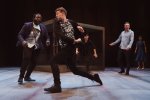
What could be more festive than a Christmas production of Shakespeare’s perennial favourite, Twelfth Night, with its separated twins, foppish companion, cross-garter’d steward and – naturally – a girl dressed as a boy. It simply wouldn’t be Christmas without it. This is one of Shakespeare’s most robust comedies, able to survive the slings and arrows of outrageous directorial decisions, always bouncing back again in rude health for another production.
 Any outrageous decisions made by director Prasanna Puwananarajah fully emphasise his vision to set it in an indistinct but modern era and give it a yuletide boot up the backside with some superbly inventive comedy to set against the darker aspects of the plot, whilst still staying pretty much faithful to the original. And one of the ways in which this production stands out is the ease with which it flips from hilarity to darkness with a truly deft sense of balance.
 It can be very tempting to overlook the cruelty and sadness that lurks beneath the surface of this play. The twins individually mourn the supposed loss of their sibling. Disloyalty and pretence abound; if you’re not part of the in-crowd, you’re definitely out. Sir Toby and Maria may head up their own clique when it comes to fooling Aguecheek or bullying Malvolio, but when it comes to the crunch, they don’t have any real power and get swatted down by Olivia like flies to wanton boys (wrong play, but you get my gist.)
 Nowhere is this clearer than with the pure decency of the character of Antonio, who gives up everything simply to serve Sebastian; bewildered by his master’s apparent denials, he is left with the bitter realisation that his generosity has been cruelly abused. And even Malvolio has feelings; he may be a puritanical killjoy, but the revenge that’s meted out on him by Olivia’s household crosses the boundary from playful teasing to outright cruelty. It’s the moment when Shakespeare becomes such a great comic writer that he bears comparison with Ayckbourn. (see end)
 Another stand-out aspect of the production is its sheer honesty and credibility. There’s not one caricature nor over-the-top characterisation; every member of the cast delivers a truly believable performance, and every situation the production presents us is recognisable and makes complete sense, despite often appearing side-by-side with something theatrically magical. Some small examples: the priest is definitely the kind of person who would drink from an I Heart Jesus mug. This particular Olivia, when trying to impress Cesario on their first meeting, would definitely castigate themselves afterwards for their idiotic use of language – What is your parentage? What was I thinking!! Orsino’s court appears to be 100% staffed by gay men who dance together – it isn’t questioned, nor does it have to be. It just is. And it helps make sense of his initial attraction to Cesario.
 And it is genuinely thrilling to see the character of Feste, so often an awkward character to get right, brought to the fore as arguably the most central character of the entire play. He blends perfectly with all the technical aspects of the production, outlandishly dressed in one of James Cotterill’s more ridiculous costumes, magically appearing from the sky, and either manipulating or being manipulated by Zoe Spurr’s fantastic lighting design and George Dennis’ sound design. He sings Matt Maltese’s musical settings of those difficult Shakespearean songs with such genuine emotion that you want to listen to them carefully rather than – as with most Shakespearean songs – just looking forward to the moment they stop and the play can carry on.
 And I haven’t mentioned the set; dominated, for the most part, by an enormous organ, with pipes so big you can hide behind, magically controlled by Feste seemingly bringing it forward and back with the power of his own summoning arms. It also provides the perfect joke when Orsino and his men arrive at Olivia’s house bearing the gift of an organ; their shock at the size of the one already installed requires their measly offering to be shunted unceremoniously offstage in embarrassment. You’ve never seen Organ Envy like it.
 Gwyneth Keyworth gives us a very earnest and no-nonsense Viola, holding her own with the likes of the Duke and Olivia, convincingly portraying both a girlish boy and a boyish girl that neither can resist. Freema Ageyman has a tremendous stage presence and her Olivia is a dream of a performance, conveying all the anger and frustration of her initial state of mourning, but quickly becoming foolishly besotted in love, whilst retaining her absolute authority over her wayward household.
 Bally Gill adds another superb portrayal to his growing list of Shakespearean successes, with a very human Duke Orsino, his measured superiority tempered by a hint of fallibility and foolishness. Joplin Sibtain’s Sir Toby is the very credible drunk uncle we all recognise from family weddings; not simply a fat fool but a mischief maker who doesn’t know when to stop until it’s too late. Demetri Goritsas portrays his companion Sir Andrew not as a vacuous fop but as an easily fooled wannabe hero who lacks any of the required depth or courage to achieve his ambitions.
 Danielle Henry is a splendidly meddlesome Maria, delighting in taking charge of the below-stairs subterfuge; Norman Bowman plays Antonio as an altruistic soul who needs someone to follow, and Rhys Rusbatch’s Sebastian is the perfect recipient for his affection – a plain-talking, fearless type who’s more than capable of looking after himself in a fight and can’t believe his luck when Olivia mistakes him for Cesario.
 Michael Grady-Hall brings all his amazing clowning skills to a fantastic physically comic performance as Feste, with split-second precise timing, a wonderful rapport with the audience, and a broodingly haunting singing voice. By contrast, Samuel West invests Malvolio with a fittingly wheedling, whiny voice; a quietly judgmental nuisance who casts a shadow over any good mood until he falls for Maria and Sir Toby’s deception, which allows his true self to burst forth with a mixture of lasciviousness and misplaced self-confidence. Like all the best Malvolios, when he is humiliated and destroyed at the end, you truly feel sorry for him and have nothing but contempt for his tricksters. It’s a magnificent and memorable performance.
 The show lasts a few minutes short of three hours but it’s so enjoyable and entrancing that it barely feels like two. One of those longed-for productions where every single aspect dovetails perfectly, creating a hugely rewarding experience. One of the best RSC productions in years, make sure you see it at the Royal Shakespeare Theatre before it closes on 18th January 2025.
P. S. Only one aspect of the production befuddled me – what was all that stuff about painting the sides of the set? First Fabian, then Feste? Answers on a postcard please, to Outrageous Directorial Decisions, PO Box 99, Illyria.
P. P. S. I love the work of Alan Ayckbourn, but you do realise that was tongue-in-cheek, don’t you?
Production photos by Helen Murray
 Five Alive, Let Theatre Thrive!