Review – A Christmas Carol, RSC at the Royal Shakespeare Theatre, Stratford upon Avon, 6th December 2017

A Christmas CarolIn the absence of Mrs Chrisparkle, who was called away on urgent business in the States, I was graciously accompanied by Lady Lichfield to see the RSC’s new production of A Christmas Carol, adapted by that fantastic writer David Edgar (Yes! Nicholas Nickleby! Destiny! Albie Sachs! Author of so many superb contributions to our stages over the past forty years or more). There are few books that have lent themselves so effectively to adaptations over the years as A Christmas Carol – from Alastair Sim to the Muppets, and not forgetting Tommy Steele’s regular reappearances in Scrooge The Musical.

Phil DavisAnd here’s another one to add to the canon. David Edgar has taken the familiar redemption story of Scrooge, the Cratchits, Marley and the Ghosts and framed it inside the creative mind of Charles Dickens. Many of the more exhilarating works of art are about the creative process that brings about that very same work of art. Consider the film of The French Lieutenant’s Woman, which is about the film crew making The French Lieutenant’s Woman. Or Elton John’s Your Song, which is about how he came to write Your Song. Now we get the chance to observe how Charles Dickens wrote A Christmas Carol.

The CompanyHis original notion, according to Edgar, was to create a hard-hitting tract on the poor and the workhouses. But as his editor and friend John Forster, who accompanies Dickens on this creation-fest, points out, it’s Christmas and no one wants to read a gloomy but worthy pamphlet. Forster makes Dickens think again. Brainstorming names, Scratch becomes Scrooge and a legend is born. Dickens then himself appears in many of the scenes as he tries to imagine himself in his own story, encouraging his characters to reveal themselves as truthfully as possible. It’s a fresh and enjoyable approach to the story and helps to place it in the context of early Victorian poverty.
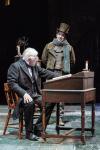
Phil Davis and Gerard CareyNevertheless, I was still surprised by how very sentimental I found it. Of course, it’s up to the individual whether that’s a good thing, or not. Some people like to wallow in it; personally, I find the story rather mawkish. It’s not often that one looks to Agatha Christie for a critical assessment of someone else’s work, but I can’t help but agree with her character Christopher Wren in The Mousetrap, when talking of the snowdrift, says “takes one back to Dickens and Scrooge and that irritating Tiny Tim. So bogus.” When the adult (not so Tiny) Tim emerges at the end, alive and well due to the generosity of Scrooge, Lady Lichfield confessed to releasing a few sobs. Sentimental? I rest my case.

Nicholas BishopIt looks as authentic and ravishing as you would expect from an RSC production, but with your imagination having to do a lot of the work to fill in the blanks – which I always think is more rewarding anyway. A couple of movable doorframes suggest a maze of corridors at Scrooge’s offices or at the Cratchits’ grim digs. A few lush furnishings create a comfortable environment at Scrooge’s nephew Fred’s place. Palely lit windows in the sky are all that’s needed to conjure up a densely populated living city; and with a mere gesture Dickens can cause the snow to fall – because, after all, everything we see is in his imagination.

John HodgkinsonPhil Davis is every bit as good as you would imagine as Scrooge; viciously arrogant and miserable when at work on Christmas Eve, his mouth curling with disgust at what he interprets as the weak laziness of others, who expect to be given a day off work and for him to bear the financial loss. His unease turns to genuine fear as he encounters the three (female) Christmas ghosts; and there’s a lovely, funny scene where, invisible, he observes the games they play at nephew Fred’s and how he is hurt by the things they say about him – all this, while the Ghost of Christmas Present (a surprisingly hilarious performance by Brigid Zengeni) is tucking into their candied fruits. And I did like the not-so subtle dig at Boris Johnson.

Vivien ParryScrooge’s transformation to a paragon of charity is very nicely done and contributes to another excellent scene with Gerard Carey as Bob Cratchit, where, at the end of his tether, Cratchit finally plucks up the courage to tell Scrooge exactly what he thinks of him….and then realises how the miser has changed his tune – very funny. Among the rest of the cast, Nicholas Bishop is an amusing Dickens, John Hodgkinson a hearty Fezziwig, Vivien Parry a scary ghost and a comic aunt (Is it a Bison?) and Emma Pallant a singularly unamused Mrs Cratchit. But the whole cast work together splendidly as an ensemble.

Brigid ZengeniThere are a few musical and dance interludes that I found a little self-indulgent; one early in the show seems to go on for ages, long beyond what I felt the story required or could sustain at the time. And there was something about the show overall that for me didn’t quite soar. It’s sentimental, but in a very shallow way; I didn’t get a pounding of emotion at anyone’s plight. But there’s no doubt that it’s a classy show with an excellent central performance and an unusual approach which gives it an extra kick. If you’re a fan of the story, you’ll definitely want to see this blend of the traditional with a quirky modern take. It’s in repertoire at the RSC until February 4th.

Production photos by Manuel Harlan

Review – The Jungle Book, Royal and Derngate, Northampton, 3rd December 2017

I agree with Tez Ilyas, the best Disney film of all time is The Jungle Book. Great songs, great characters, terrific suspense; and how I cried the first time I saw it when I thought Baloo had died. (Spoiler alert – he isn’t dead.) Over the years it’s certainly captured the imagination of generations, from those early Kipling years (my favourite – Rikki Tikki Tavi) through Disney and beyond into other spin offs, on the large and small screen, both animated and real action. Since 1894 we’ve made friends with Mowgli and cheered him on against Shere Khan and either welcomed him back to the man village or regretted his decision not to be a bear with Baloo, depending on your level of maturity.

Jessica Swale’s adaptation of the Rudyard Kipling stories for this year’s Royal Theatre Christmas Play, nicely draws from all the original source materials and not just the Disney film. There’s a lot more about Akela and the wolf pack which is often overlooked; Shere Khan is menacing the jungle right from the start, there are no vultures or elephants, and it’s his mother to whom Mowgli is drawn in the man village rather than the potential girlfriend material of the Disney film. Joe Stilgoe has written some brand new and high quality songs, so you can forget the Bear Necessities and I Wanna Be Like You – it’s Mowgli who gets all the best numbers, including a recurrent theme whose name I can’t remember – the wolf howl one – but with a brilliant hook that I’m still singing to myself three days later. Peter McKintosh’s moving set has all the attributes of a series of climbing frames that create all the branches and clearings of the jungle.

As with the best of these Christmas productions, the play has a very warm and positive message to impart. Mowgli is different from his brothers and sisters in the wolf pack (there’s a good reason for that – he isn’t one) and the message is that it’s okay to be different. When they’re assessing who might be good stand-in parents for Mowgli, it’s pointed out that it’s perfectly okay for Mowgli to have two daddies, if that’s the best way of bringing him up, or two mummies. Enlightenment indeed, and hurrah for that. But I can’t help but think that Kipling would have been nonplussed at the prospect.

Unfortunately, the performance we saw on Sunday afternoon was interrupted by a technical problem. Mowgli was just performing her (yes her) first round of wolf howl refrains when her microphone failed and half the lighting fizzed out. It was a good twenty minutes before they could get the show going again, and it really did affect the building momentum of the storyline. Everyone handled it with consummate professionalism though, and I appreciated one of the monkeys confessing that it was all his fault for chewing through some electric cables backstage.

Keziah Joseph plays Mowgli ostensibly as a boy or as a tomboy girl if you prefer – it doesn’t really matter which – and she’s excellent. She has a great voice, a mischievous stage presence and she really gets the audience on her side as she fights to survive in the jungle. There are some superb supporting performances, including Dyfrig Morris as a perpetually hungry and greedy Baloo, with insufficient intelligence to be a good father to Mowgli, and he knows it (which is ironic, really); Rachel Dawson as a surprisingly charming Kaa, sporting her long snaky body as though it were some Burlesque Boa (geddit); Tripti Tripuraneni as a serious and earnest Akela, and Lloyd Gorman as the brash and brutal Shere Khan. If the late Lemmy from Motorhead appeared as a panto villain – I think you get the picture. But my favourite of all is the sassy and streetwise performance by Deborah Oyelade as Bagheera; she’s rather like one of your stricter teachers but with a heart of gold.

This is a very enjoyable, well-constructed show, perfect for a Christmas outing – although, like a dog, it isn’t just for Christmas. In the new year it’s on quite a tour, so between January and May you can catch it at Chichester, Richmond, Liverpool, High Wycombe, Bromley, Malvern, Cambridge, Newcastle, Plymouth, Norwich, Nottingham, Canterbury, Salford and Blackpool. Great fun for a family theatrical treat.

Review – Hair, The Vaults, 2nd December 2017

That ground-breaking hippy happy musical Hairis now a demi-centenarian! It first hit the stage in New York (off-Broadway) in 1967 before smashing it all over the world, including becoming the first new show to open in London after the withdrawal of stage censorship in September 1968. As an aside, gentle reader, I shall be saluting the fiftieth anniversary of the end of British theatre censorship next year with a series of posts on the subject – it’s something I studied closely as a postgrad many decades ago and it’s high time my research was unleashed onto an unsuspecting world. So please watch out for that next year!

Meanwhile this year… my good friend and local co-blogging reviewer, Mr Smallmind, nipped up to Manchester last November to see this production of Hair at its birthplace, the Hope Mill Theatre, and he loved it; as a result, I’ve been looking forward to seeing it ever since. I’ve always had a fondness for the show, not only because of its significance in the history of theatre censorship, but also because it’s jam-packed with brilliant songs. We saw the 2010 revival in London – which for some inexplicable reason, I didn’t review – and enjoyed it, but I remember that it didn’t quite soar. Surely this 50th anniversary production would deliver in spades where the earlier one just slightly played it safe.

So here we come to one of the most awkward reviews I’ve ever had to write. You’ve heard of a Tale of Two Cities, or a game of two halves? Let me introduce you to the story of The Tale of Two Audiences. I’d not been to The Vaults before, and I must say, first impressions were very favourable. They’ve decked out the bar and reception area in all sorts of psychedelic paraphernalia; chill-out zones, groovy coloured fabrics, listening to fab tunes like Traffic’s Hole in My Shoe and the Lemon Pipers’ Green Tambourine… it couldn’t have been more delightfully 60s. Evocative retro posters lined the walls; it was so effective we could have been raided for evidence for the Oz obscenity trials.

So why two audiences? The Vaults doesn’t have a proper ticketing system that allows them to allocate seat numbers to its customers. Instead you choose an area of the auditorium, designated by a colour and its own seat price, and then it’s a free-for-all when you get in to get the best seats in your colour zone. I’ve always taken it as a rule of thumb that the higher the price, the better the seat, the better the view. Seems to make sense to me. There are two rows of seats either side of the stage area, seated in traverse – the red seats. Facing the stage in the traditional layout, you have the front two rows (yellow seats) then the next six rows were the green seats (top price) and the back row was the blue seats (cheapest price). Not knowing any better, we booked green and ended up in the fifth row from the stage, farthest left. If they’d allocated seat numbers, they would have been E 1 & 2.

What a terribly poor decision that was on my part. The whole show is designed to be played to the red seats, as that was the prime layout at the Hope Mill Theatre. If you’re in the red seats, you enjoy great interactivity between the cast and the audience. You could see how the people in the front red rows simply beamed with nonstop pleasure throughout. The people in the second row of the reds don’t get such a good deal because, bizarrely, their seats weren’t raised. The people in the front row of the yellow seats would also have been able to see everything that went on. They also came in for their fair share of interaction from the cast. However, everyone else was, frankly, ignored. Additionally, the rake of the green seats, whilst in itself effective, meant that you could not see the front quarter of the stage at all. We spent the entire show being surprised when a member of the cast suddenly popped up from our end of the stage to perform – and we had no idea anyone was there.

As I watched the finale where everyone in the red seats jumps up and dances with the cast, I felt like I was eavesdropping at a party where I hadn’t been invited but could still see everyone else enjoying themselves. I felt so excluded, and it was a really depressing feeling. And, in case you think I’m being over-sensitive, you only had to watch the different ways in which the audience reacted at curtain-call time. Everyone in the red seats leaped up for a standing ovation within about one second of its finishing. Everyone else sat, and gave muted, polite applause, and not for too long. My advice is – whatever you do – DON’T BUY GREEN. It’s a total waste of money. BUY RED; or maybe if the cost is an issue – buy yellow. And make sure you sit in the front rows of those colour codes. I certainly won’t be going back to the Vaults unless and until they change their system, so they can allocate individual seats to individual customers. The current system is way too unreliable. I know it’s regarded as a fringe venue, so you might expect a bit of pot luck and give and take on where you sit; but they’re not charging fringe venue prices. £55 for a seat in the green area is £10 more than we spent earlier that afternoon for a sumptuous centre Row E seat at the Olivier. I simply expected more for my money.

There were some very good performances; Andy Coxon’s Berger is a decadent, rather sexually ambivalent chap, full of mischief and all out for the pursuit of personal pleasure. Robert Metson’s Claude is a natural leader, charismatic and likeable. Shekinah McFarlane is superb as Dionne; I particularly loved her performance of White Boys, which gave me goose bumps, just like the lyrics suggest. I loved Laura Johnson as Sheila, reminding me what a beautiful song Easy to be Hard is, and Jammy Kasongo is a very high impact Hud who seems to be sadly under-utilised after the first twenty minutes or so.

Hair was, of course, always notorious for its ability to shock. When I saw it in 2010 I remember thinking that the burning of the draft cards was much more shocking than the nudity, which was tasteful, decorous and in the dark. In this production, the draft card burning scene had absolutely no impact on me whatsoever. As far as the nudity is concerned, I think it should either be no holds barred and in your face, or totally subtle and nuanced. Here, the cast members gradually undressed in near-darkness but then the act ended with a tableau of stark lighting for about three seconds of full-frontals then blackout. It felt like it was staged simply to prove that they had definitely got naked, but I got no sense of the purpose for the nudity. They weren’t doing naked hippy dancing for the sheer fun of it; and if it was meant to represent a naked protest, well that didn’t come across either.

But my opinion of the show is very badly affected by the fact that I felt like a spare prick at a wedding. I was so estranged from the performance that all I really felt was that it was a great opportunity wasted, and it wasn’t until sometime the following afternoon that my miserable mood lifted. A show shouldn’t do that to you. A five-star production destroyed by a one-star experience.

Review – Saint George and the Dragon, Olivier Theatre at the National, 2nd December 2017

I saw this marketing poster for Saint George and the Dragon whilst I was idly looking at shows coming up in the next National Theatre season and it really tickled my fancy. The out of place, out of era, aforementioned Saint, glumly tucking into a full English at some greasy spoon. Hardly the stuff of legends, is it? But then as George says in the play, he genuinely is a legend.

There are loads of excellent ideas in Rory Mullarkey’s play which has just ended its run at the Olivier, but, to be honest, I’d be surprised if it turned up anywhere else again in the future. In ancient days, when Chaucerian meter was all the rage, a Knyghte y-clept George found himself wandering through the green pastures of Merrie England (or was that a couple of hundred years later) and chanced upon an old man and his daughter, both verray parfit villagers forsooth. We meet the other villagers: Crier, Miller, Smith, Butcher, Healer, Driver, Brewer…. can you guess what services each provided the community? Of course, that’s where our surnames come from. So I have no idea why Mr Mullarkey has called the old man Charles and his daughter Elsa. Presumably his other kids Dave and Wayne were at some crusade or other.

Elsa is about to be eaten alive by the local ruler, a Dragon (that’s King Dragon to you) so Charles pleads with George to challenge the Dragon to save his daughter’s life. Unfortunately, George hadn’t had much luck with Dragons recently and refused (most ungallantly) Charles’ beseeching to fight the Dragon to save his daughter. But then George looked in Elsa’s eyes and Bingo! It was love at first joust. George fights the Dragon, and, blow me down with a fire-throwing breath, he defeats him. But just as he’s about to enjoy his well deserved courtly nuptuals, he hears the call of the Brotherhood, and he’s off to fight another quest, leaving Elsa to darn her medieval mittens for centuries to come.

I don’t think it matters that I’m telling you the plot, because of the reason I mention in the first sentence of my second paragraph. George comes back in Victorian times, and basically the same thing happens again; then he comes back in today’s era… and basically the same thing happens again. Repetitive? Yes, yes, yes, and yes. There’s the nugget of a very clever play in here. The nation needs a knight in shining armour to come and rescue us from the mess we’ve got ourselves into; a character that represents true England – its nobility, its bravery, its courtliness, its generosity of spirit. Against him, the Dragon, who vows to continue his war against George in more subtle, subconscious ways in the future, affecting the minds of the people, encouraging evil and ignobility; selfishness and weakness. You might say the play sticks two fingers up at Brexiteers; I couldn’t possibly comment. At the end of the play George exhorts the townsfolk to join him returning back to the good old days, but, of course, no one wants to go back in time. This is modern England, a land of smartphones and skyscrapers, of Megabowls and watching England lose at football in the pub. You cannot go back.

Nice idea. Unfortunately, it’s a very wordy, overlong, and lumpy play. It starts with George’s sub-Anglo-Saxon introduction and, I kid you not, Mrs Chrisparkle had nodded off for forty winks and woken up again before he had finished his opening monologue. There are some excellent moments of comedy, created by the incongruous juxtaposition of the ancient with the modern – rather like that marketing photo on the programme. There’s a very enjoyable scene in the second act where George, who has no clue what football is, finds himself getting absolutely plastered watching an International England match in the pub, and it’s genuinely very funny. George blames England’s poor performance on the fact that the supporters have lost sight of the fact that we are world beaters. Just have belief, and we will win the day. Good luck with that, George.

There are some very splendid actors involved in this production who really did put in an awful lot of fine effort. John Heffernan brought great virtue to the role of George, with some lovely comic timing and excellent stage presence. I’d really like to see him in something good. Julian Bleach’s characterisation of the Dragon was very amusing, especially in the first scene as a slimy pantomime villain. Brilliant actors with CV’s as long as your arm, like Gawn Grainger and Jeff Rawle, breathe as much life into the play as possible. And there are some excellent special effects – I loved how the Dragon set fire to his servant Henry’s scroll of Terms and Conditions; although the setting up for the descent of the fiery Dragon’s heads onto the stage, using two wires that slowly came into view, was cumbersome and made the whole thing look very ham-fisted.

At 2 hours 50 minutes it has some very long longueurs. My solution – omit a lot of the opening exposition and completely cut out the whole Victorian era episode. It adds nothing to the story and Mr. Mullarkey would still make his patriotic point only far more succinctly. You could probably bring it in at about 2 hours then and it wouldn’t feel anything like as hard going. Overall, it wasn’t too bad; but it wasn’t good either. Faint praise indeed. Can’t win them all!

Review – Hedda Gabler, National Theatre on Tour, Royal and Derngate, Northampton, 28th November 2017

Beware – there are spoilers! But then the play has been around for 126 years now, so it’s hardly going to come as a surprise…

Imagine a hypothetical meeting of all the best directors and producers in the country, all getting together to decide which play they next want to work on. One says I know, let’s do Ibsen, and another says, yes, great idea, what about Hedda Gabler? And everyone goes hurrah! And thus another production of Hedda Gabler takes to the stage, ignoring so many other of Ibsen’s great works that – it seems to me – get staged comparatively rarely. I first encountered the terrifying Ms Gabler (or Mrs Tesman, as Ibsen avoided calling her) in 1977 with the thrilling Ms Janet Suzman in the part. In recent years there was the slightly less than extraordinary Theatre Royal Bath production with Rosamund Pike as Hedda, and also the Royal and Derngate’s very own ex-Artistic Director, Laurie Sansom’s production in 2012, with Emma Hamilton as the arch-manipulative, butter-wouldn’t-melt bitch.

Hedda Gabler, by the way, is Laurie Sansom’s favourite play and he describes the character as a female Hamlet. That’s interesting, because the programme notes for this National Theatre production, directed by Ivo van Hove, include Ibsen’s own preliminary notes for the play – which make fascinating reading and definitely worth buying the programme for that one page alone. One of these notes reads: “Life is not tragic – life is ridiculous – and that cannot be borne.” Not tragic? So much for the female equivalent of Hamlet, then.

So, if you’re going to stage yet another production of Hedda Gabler, at least make it different. And, boy, have they done that! This version has been written by Patrick Marber, so you can guess it will be brought bang up to date, maybe with some sacrifices to the original text, of which purists are unlikely to approve. One look at the set alone tells you you’re not in Kansas anymore, Toto. If this is Kristiana in 1891, it’s not as we know it. Blank, colourless MDF panels surround the cavernous room; an electronic security system with camera buzzes visitors in and out; Hedda sits in a trendy 1960s style Scandinavian armchair; she uses an industrial stapler as part of her feng shui kit; Brack drinks from a ring-pull can (invented in 1959, according to Mr Wikipedia). Scenes are interrupted by music – uncredited in the programme but you’d swear some of it was Enya – creating a vivid, unsettling mix of the 19th, 20th and 21st centuries.

The lighting plays a significant role in creating tension. The set and lighting were both designed by Jan Versweyveld, obviously to complement each other and it really works. It’s the lighting that in many ways controls the play. A very sudden lighting change starts the performance; darkness ends it. After the interval, and when Hedda pulls back the blinds to let the daylight in, those blank colourless panels slowly take on colour. Pale at first, they grow richer through yellows and golds into redness as Hedda builds up to executing her catastrophic act at the fireplace. The final scene, where Ibsen directs that the room begins in darkness, opens with Brack and Tesman boarding up the window, drilling the boards into place, so the light is blocked out – and with it, all hope.

Then there’s the casting, which in some cases distances itself as far as possible away from Ibsen’s original stage directions. Christine Kavanagh, for instance, who plays Tesman’s Aunt Juliana, looks at least twenty years younger than Ibsen’s suggestion of a 65-year-old woman. Abhin Galeya, as Tesman, doesn’t look a bit like Ibsen’s description of a stoutish man with a round face and fair hair and beard. This is a Hedda where they’ve cut away all the trappings of 19th century convention and performance style to bring it in to sharp modern focus. As an audience member, the juxtaposition of the modern and the traditional compels you to give it your full attention.

It’s vital for a production of Hedda Gabler to have a strong central performance that really makes you understand the character’s motivation. Lizzy Watts’ Hedda is, without doubt, a smooth operator. Not merely the bored young housewife with nothing much to do and already fallen out of love with her husband; no, this Hedda is pathologically cruel, deliberately contrary, gleefully malicious. You can see her eyes widen and her smile break out when she thinks of a brand new way to cause pain and wreak havoc. It’s no coincidence that Hedda’s existence is contained within these four blank walls – you cannot imagine her existing outside them. How on earth would Tasman, or indeed Lovborg, ever imagined that she was a plum candidate for a relationship? Yes, she’s manipulative and no doubt presented well, but I don’t see how she could have held back from inflicting cruelty on even a first date. Fortunately, everything that’s gone before is in another time and place and we don’t have to consider it.

It’s at the moments when Hedda is at her most destructive that Ms Watts shows us how much the character is pleasured by the sensation. Forcing Lovborg into drinking again is her first victory; getting him to take one of her father’s pistols so that he does the right thing is another. Burning his work gives her an inner contentment and satisfaction; hearing of his death damn nearly causes an orgasm. This is a study of someone sexually turned on by evil. When Brack confronts her with his knowledge of her involvement, and she realises that Lovborg’s death was not as poetic as she had hoped, he in turn drips, pours and spews his can of drink on to her (in her sensual, satin nightdress) which reveals itself as spatters of blood, the evidence of her guilt in an homage to Grand Guignol. It’s a gruesome, visceral sight that no one else seems to be aware of; is this Hedda’s brain telling her that she has, finally, gone too far? Or is Brack equally predisposed to making a grotesque gesture? However you interpret it, it’s a truly stunning image.

Abhin Galeya’s Tesman comes across as far from being a dusty academic. He’s much more of a lad, skipping and jumping about in childish delight when he hears a bit of good news; an immature sop who’s no challenge to Hedda’s cunning. When he and Mrs Elvsted are seated, trying to piece together the original notes of Lovborg’s masterwork, it’s no surprise that they’re on the floor in the corner, like two kids playing a game. Adam Best’s Brack is a suitably nasty piece of work, affecting an air of respectability whilst concealing his own agenda; trapping Hedda against the wall, desperate to control the uncontrollable. Richard Pyros, Christine Kavanagh and Annabel Bates all give excellent support as a deeply pathetic Lovborg, a bright and kindly Juliana and a surprisingly feisty Mrs Elvsted. And Madlena Nedeva provides a slavishly dour presence as the maid, Berte; hanging on to her job for grim death by sitting permanently by the door like a grouchy Babooshka.

This is a production that occasionally provokes nervous laughter from the audience at what you might feel are inappropriate times. No more so than the final scene, when Patrick Marber has Tesman slowly approach the lifeless Hedda with the flat response “oh, she’s dead”. Such a ridiculous thing for this great tragedy to end with – but wait, what was that Ibsen note? “Life is not tragic – life is ridiculous”. So, that’s spot on for this approach to the play. It’s a very different interpretation from what the average Ibsen-goer will be used to. The sterile, stylised setting won’t work for everyone, and, if I’m honest, some of the intrusive music really got on my nerves. But, then again, I think it was meant to. Not for the purist, not for the complacent; but definitely for the theatre buff who likes to have their ideas shaken up and turned on their head. After Northampton, the tour continues again from January to March, visiting Glasgow, Wolverhampton, Woking, Nottingham, Newcastle, York, Milton Keynes and Dublin.

Review – Francesca Dego Performs Bruch, with the Royal Philharmonic Orchestra, Royal and Derngate, Northampton, 26th November 2017

Another opportunity to welcome back the Royal Philharmonic Orchestra to their spiritual East Midlands home, for a stirring concert of Beethoven, Brahms and Bruch. Our conductor was Mathieu Herzog, whom we haven’t seen before, but he’s a lively and charismatic presence on the podium. All decked out in a trendy, shiny frock coat with yellow beading, he’s one of those conductors who likes to throw himself into the music, arms reaching out in all directions to encourage every individual member of the orchestra to give their best. I think you can divide conductors into two kinds: those who never stand on tiptoe, and those who rarely don’t. M. Herzog definitely belongs in the latter category!

First on the agenda was Beethoven’s Coriolan Overture. This has nothing to do with Shakespeare’s Coriolanus, but was written in 1807 for Heinrich Joseph von Collin’s 1804 tragedy Coriolan; not that it matters to today’s concertgoer. It’s a great start to a recital as it instantly arrests you with its bold and attacking style. You can really imagine old Ludwig van stabbing his baton at a petrified orchestra coaxing all those staccato beats out of the violins. Full of stops and starts, it’s impossible to listen to it without your head nodding up and down, furiously, in time to the rhythm. It showed off the orchestra’s fantastic strings to their best.

Next, we had the first of our two Brahms’ pieces, the Hungarian Dance No 6 in D Major. From stabbing, dramatic strings to gypsy swing strings in one fell swoop, you could almost smell the goulash. It was played with a great sense of fun and briefly transported you to some Czardas club in Budapest where your mind’s eye lingered on imaginary ladies in swirling skirts and gentlemen in knee-high boots. Pure escapism in three minutes, fifty seconds.

Taking us into the interval was the performance of Bruch’s Violin Concerto No 1 in G Minor. This is quite a favourite of the Royal Philharmonic, as we have seen them perform it in both 2009 and 2014, when Chloe Hanslip turned in an amazing performance. Our soloist this time was Francesca Dego, a statuesque vision in lemon, brandishing an antique violin; according to the programme, she uses two violins, a Francesco Ruggeri, dated 1697, and a Guarneri del Gesu from 1734 – which she presumably refers to as “the new one”. Her dramatic appearance reflects her dramatic performance, as she produced the most glorious tone from the instrument, both blending perfectly with the rest of the orchestra and also standing out with its own enhanced clarity. I’m always impressed when someone plays as complex a piece as this without any sheet music to hand. I loved how the three movements all blended seamlessly together, and it was an exciting, moving, and authoritative performance which the appreciative audience in the Derngate auditorium absolutely loved.

When we came back from the interval, there was a little surprise before the final piece. Managing Director of the RPO, James Williams, introduced us to Sir Peter Ellwood, who was given the orchestra’s highest accolade, that of Honorary Membership, in recognition of his support and work with the orchestra over the past twenty years. James presented the membership together with trumpeter Adam Wright. Sir Peter also happens to be Vice Lord-Lieutenant of Northamptonshire, so we wondered if he played a role in establishing the great connection between the orchestra and the Royal and Derngate. If so, well played sir!

The second part of the concert consisted of a performance of Brahms’ Symphony No 4. I love a Brahms Symphony. In fact, I remember, as a student, treating myself to a recording of each of the four symphonies, one a week, over the first part of a very difficult term – I’d buy one as a treat and a self-congratulation for getting through yet another tutorial. Being a (relatively) penniless student, I could only afford the Music For Pleasure recordings (remember them?) and they were by the Hallé Orchestra, under the baton of James Loughran. I thought they were fantastic. I confess that the first symphony is my ultimate favourite, but who’s going to turn up an opportunity to hear the fourth symphony performed live?

It was superb. I loved how the first movement shows off like a musical version of a question and answer session. Then when the second movement got going the pizzicato sequence was so impressive. It felt almost mournful but with a great resilience. And then the final two movements, which are a) lively and b) even livelier, were played with such gusto that it was hard for your brain to keep up with the music. The violinists were playing so vigorously that their arms were literally a blur. A wonderful performance, and a fitting end to a very exciting concert. The composers may have been Beethoven, Brahms and Bruch – three B’s – but it was an A+ evening. The RPO are next back in town on February 18th 2018 for an afternoon of Beethoven, Grieg, Tchaikovsky and Mendelssohn. Already looking forward to it!

Review – Paddington 2, Errol Flynn Filmhouse, Northampton, 24th November 2017

It’s 9pm on a Friday. You’ve had a pre-prandial G&T, you’ve enjoyed your dinner; you want a little pre-weekend escapism and a good laugh. Bottle of Malbec and two glasses in hand, we took our seats at the plush Errol Flynn Filmhouse, along with 89 other adults and one child, bless her. You can keep your Blade Runners and your Star Wars…. Paddington 2 is just sheer joy from start to finish.

I should point out that we didn’t see the original Paddington film three years ago, but my guess is that you don’t have to have seen the first to be able to appreciate any subtle nuances of the second. The story is relatively slight, but bear with me (geddit?) Paddington is searching for a birthday present for his Aunt Lucy because she brought him up well and he’s a decent, kind-hearted animal. He finds the perfect item in an antiques shop – an old pop-up book of London scenes. Paddington falls in love with it. But the price! Where’s he going to get £500 from? So he vows to work for the money and save it.

So far so good. Being a trusting and honest bear, he lets slip to Phoenix Buchanan, a narcissistic actor who opens the local carnival, that he’s saving for this book. Unbeknownst to Paddington, Buchanan is also after this book and he decides to steal it from the shop. Paddington is on the scene in no time and runs after the thief – Buchanan in disguise – to catch him. Unfortunately, Buchanan gives him the slip and it is Paddington whom the police arrest and who is sent to prison in one of the greatest legal travesties in the annals of justice. But, as it’s Paddington, everything turns out alright in the end!

This is simply one of the funniest films I’ve seen in years. The blend of animation and reality is just perfect. Take the whole hairdresser shop scene as a typical example of its brilliance. When the inexperienced Paddington clings hold of the barber’s erratically over-powered electric razor for dear life, the sight of the rippling, fluttering fur caused by the vibrations brings the house down. The computer that creates Paddington definitely has a grand sense of humour.

There’s a star-studded cast that most other film makers would die for, and a few absolutely brilliant performances. Hugh Grant camps it up out of all proportion as the despicable Buchanan, in a hilarious assortment of disguises, no greater moment than in the finale (don’t leave at the beginning of the credits, whatever you do) when he gets his chance to present a showstopper (choreographed by Craig Revel Horwood, I noticed). You’ll never think of FolliesRain on the Roof in the same way again. Hugh Bonneville, as Mr Brown, is also fantastic as he blunders from situation to situation, such as when he badmouths the other prisoners whilst they can still hear him, or when he’s caught red-handed breaking and entering Buchanan’s house. Brendan Gleeson is superb as the intimidating inmate Knuckles, who, it turns out, has a heart of gold after all.

Delightful vignettes are scattered through the film, with Jessica Hynes, Ben Miller, Sanjeev Bhaskar, Jim Broadbent, Julie Walters, Peter Capaldi, Tom Conti, Meera Syal, Richard Ayoade, Tom Davis, Eileen Atkins, Joanna Lumley and many more taking tiny roles that just keep the whole thing constantly topped-up with surprise and enjoyment. Giving the bears a voice, there are vocal contributions by Michael Gambon and Imelda Staunton as Uncle Pastuzo and Aunt Lucy, and a star performance from Ben Whishaw as the voice of Paddington; the epitome of decorum and politeness, honesty and decency – but not without a dash of daftness and a measure of mischief. Paul King and Simon Furnaby’s screenplay is marmalade-packed with visual humour and funny lines, including some great set pieces like the barber’s scene, Paddington’s laundry mishap and the steam train chase.

Don’t think you have to have kids to go and see and enjoy this film. It appeals to the child in all of us – and also, in part, to the naughty grown-up as well. We were still laughing about this film 48 hours later. No wonder it’s proving to be a box-office hit. This’ll come back again and again to entertain us during Christmases Future for decades to come. A pure delight!

Review – The Snowman, Errol Flynn Filmhouse, Northampton, 21st November 2017

Nothing to do with Raymond Briggs or choirboys singing Walking in the Air, this Snowman is a lot more lethal. Based on Jo Nesbø’s book of the same name, it features his detective Harry Hole as he investigates a series of murders where the killer always leaves a calling card in the form of a snowman. A real one, built from snow, with two sticky twigs as arms. Unsurprisingly, he tends to rest during the summer months.

Confession time – but I sense I might not be alone here – I’ve neither heard of Harry Hole nor of Jo Nesbø, and had no idea that he was like the Norwegian version of Inspector Morse. I only decided to book for this film because I saw the trailer at an earlier visit to the cinema and it looked gripping. I also had no idea that it had been universally panned by the critics, with reviews that include “a mystery that feels as mashed together and perishable as its title” and “a leaden, clotted, exasperating mess”. High praise indeed.

I have to say, I think they’re rather harsh comments, because, on the whole, we enjoyed the film. In its favour: first, the excellent cinematography, with those enigmatic, snowy, mountainous wastes of Norway looming gloomily in the distance. I’ve never been to Oslo, but I have had the experience of visiting Tromso and the generally depressing Norwegian urban scenes in the film largely reflected my memory of that miserable city. Second, the suspense: about fifteen minutes into the film, a lady is sitting reading in bed and you suddenly hear a snowball being thrown at her bedroom window. Mrs Chrisparkle jolted with shock so much she almost knocked the Pinot Grigio out of the man’s hand sitting next to her. That’s how suspenseful it is. Third, the opening ten minutes or so plunge you instantly into the story, ending with a very strong visual image that I think I will remember for a long time!

In its disfavour, and it very nearly ruined it completely for me: in the final reel, as it were, there’s Harry Hole, injured and unable to move, prostrate on the floor, with the killer lumbering up to him ready to deal the final blow that will send him to the land of Old Norse. Well, it’s no spoiler to tell you that Harry survives the ordeal – after all he features in another four books after this one so that’s in the public domain – but the reason the killer fails to silence him forever? Risible. And pathetic. And nonsensical. I’ll say no more.

Overall it’s a decent whodunit, but as the film progresses, the identity of the killer becomes more and more apparent (well it did to me, at least.) The killer is fairly obviously the boy in the first scenes, now grown up to be a man. There are three characters who might most likely be that person. One gets murdered halfway through, and another is seen to be somewhere else when the next murder takes place – and, lo and behold, that third person does indeed turn out to be the killer. Ah well, sometimes it’s satisfying to guess right.

I enjoyed Michael Fassbender as Harry Hole; he’s low key and somewhat dour, but then, he is playing a Norwegian. Reading up on Harry’s characteristics in the books and on a synopsis of the novel, I’d say it was a pretty good interpretation of the role; the chain-smoking and alcoholism are certainly clear. Having said that, there are huge, interesting-sounding aspects of the original book that are nowhere near touched on in the screenplay – an opportunity missed, methinks. Rebecca Ferguson is convincing as Katrine, the detective who’s been brought in alongside Hole to keep him in check; Charlotte Gainsbourg is authoritative and serious as Harry’s ex, Rakel; and there are a few surprising cameos in the supporting cast, including Toby Jones as a police investigator and Anne Reid, would you believe, as a nosey neighbour. Plus there’s a very rough looking Val Kilmer as a now dead detective, frequently returning to interrupt the flow of the investigation. He also just so happens to be Katrine’s dad. Curious.

How come no one ever saw the killer building the snowmen outside his victims’ houses? I think it must be asked. And how on earth did he manage to shape a snowman on the roof of a car? The cops need to focus their investigation on a man with his own stepladder and mittens. Despite all its shortcomings, I still found it entertaining enough to stay awake (that, gentle reader, is something one should never take for granted) and I generally enjoyed it in the way, I think, that the creative team wanted me to – in other words, taking it seriously and not taking the mick. I do sense though that this is a film that is going to sink without trace in the annals of movie history.

P. S. If you’ve always wanted to hear the Norwegian version of Cliff Richard’s Congratulations, your prayers are answered.

Review – Young Marx, Bridge Theatre, 19th November 2017

First of all, a great big stagey welcome to the Bridge Theatre, a new venture on the south side of the Thames, a few minutes from Tower Bridge, opposite the Tower of London, along from HMS Belfast. I don’t think there’s any other theatre with such a selection of iconic views from its front door. Inside, there’s a wide bar/reception area that leads to the circle and galleries, and stairs down to the stalls. Inside it’s very comfortable, with a great rake and terrific sightlines, as the rows are slightly staggered so that you don’t have someone else’s big head right in your line of vision. Our interval glass of Minervois was exceptionally tasty; my only criticism is that the box office was closed at the end of the show, even though it’s an extension of the bar area, where people were still working. There were at least four people, maybe more (including myself) who hung around waiting for someone to come so that we could buy a copy of the playscript (and after all, it’s not until after the show that you really know whether you want to buy a copy or not) – but alas no one appeared. That was at least £40 worth of sales they missed out on. Still, what a great theatre!

Its inaugural production is Young Marx, from the pen of Richard Bean (who seems to be unstoppable with his writing at the moment) in collaboration with Clive Coleman. Yes, even that towering, intimidating, bewhiskered old commie Karl Marx was once a young roister-doister. Penniless and thoroughly amoral, he steals from his wife to get money from the pawnbrokers, sleeps with the maid and then passes her child off as someone else’s, hides from his creditors, and from the law; even causes a fight in the library. He’s an appalling procrastinator; his pal Engels begs him to knuckle down and write his Magnum Opus that will change the lives of working people for ever more; but he’d sooner go out and get drunk. The play lets us into his chaotic life; his relationship with his wife (not good); with Engels (very good); and with his children (extremely good). It emerges that there is a spy in the midst of their political gatherings, but who is it?

To be honest, we don’t particularly care, as the play is much more character-driven than plot-driven, and all the better for it, I feel. Mark Thompson’s gloomy revolving set provides a strong evocation of the poverty-stricken streets of London, and the Marx’s spartan apartment; and contrasts with Grant Olding’s rock-style incidental music, which deliberately clashes anachronistically with the 19th century story, startling and unsettling the audience with its constant interruptions. Messrs Bean and Coleman provide Marx with a couple of farcical fight and flight scenes, just to create a larger than life sense and to distance the story from reality a little bit more – even though almost everything that takes place in the play did actually happen for real. It must be said, that first fight scene was clumsy and ineffective; Mrs Chrisparkle feared she was going to be in for a very tedious afternoon. But she needn’t have worried. Everything else afterwards worked well; and the second fight scene, in the library, is simply hilarious and superbly executed.

Rory Kinnear is perfect casting as Marx. He has that knowing air; that look that weighs up the difference between the sensible and the mischievous but will always go for the mischievous, just because he can. Switching effortlessly between faux-sincerity and childish naughtiness, he manages to keep one step ahead of the law but not necessarily ahead of his wife. He has brilliant comic timing; his scenes with the excellent Laura Elphinstone as Nym, where he’s having to cover up his infidelities, are a joy. Oliver Chris’ Engels is another superb performance, bright, polite and cheery, full of decency to compare with his pal’s lack of it. Nancy Carroll, whom we last saw as the delightfully naughty Maggie in Woyzeck, gives a great portrayal of his long-suffering wife Jenny, dispensing kindness to all and sundry apart from her wretched husband. Tony Jayawardena, hilarious as Mr Bhamra in Bend it Like Beckham, again shows his fantastic ability to get the best humour from throwaway lines as Doc Schmidt. If you think the receptionists at your GP can be occasionally indiscreet when blurting out your symptoms to a full waiting room, just be grateful you don’t have Schmidt treating your venereal disease.

I also really enjoyed the performance of Eben Figueiredo as the servile and over-enthusiastic Konrad Schramm. Mr Figueiredo was one of the few good things about Chichester’s Pitcairn a few years ago, so it’s good to see him in a show worth his talent! And the always entertaining Miltos Yerolemou is on top form as the grumpy French revolutionary, Emmanuel Barthelemy, with his constant translation issues. In the performance we saw, Marx’s children, Qui Qui and Fawksey, were played by Matilda Shapland and Logan Clark and a jolly fine job they did of it too. But the entire cast works extremely well together as a very fluid and entertaining ensemble.

The whole thing is played for laughs from the start to the finish. Serious students of political ideology need not apply. But if you like to see Marx hiding from his enemies in a cupboard or on the roof, or witness Marx and Engels nick a gate from a park and then pee up a wall together like naughty schoolboys, you’re on to a winner. It runs at the Bridge Theatre until 31st December. Good fun, highly entertaining – and a lovely new theatre to explore!

Review – Simon Amstell, What is This, Royal and Derngate, Northampton, 17th November 2017

I’d only previously come across Simon Amstell in the fantastic TV programme Grandma’s House, which Mrs Chrisparkle and I used to watch with regular and loyal expectation. Not only for Mr Amstell’s contribution, but also Rebecca Front, Samantha Spiro, Linda Bassett and the late Geoffrey Hutchings were all on brilliant form. Mr Amstell also co-wrote it, so that’s got to indicate that he’s a bright spark. I realised he also regularly indulged in a spot of stand-up but for reasons that are too dull to mention here, we never got around to seeing him – until now.

But I’m running before I walk. As a support act, Mr Amstell has engaged the services of another bright spark, Mawaan Rizwan. As soon as I read that he would be starting the show, I instantly remembered where I had seen him before; he made a very illuminating documentary for BBC3 entitled How Gay is Pakistan? Answer: not particularly. Apparently, he’s most famous for being a Youtube sensation, but of course I wouldn’t know anything about that.

There’s a similarity between Mr Amstell and Mr Rizwan – they’re both gay. However, there the similarity ends; Mr Amstell is lugubriously gay, whereas Mr Rizwan is effervescently gay. If Alka-Seltzer could turn you gay, they would market Mr Rizwan in soluble form. But whereas a large amount of Mr A’s material centres on his life as a gay man, Mr R plucks hilarious, surreal routines out of absolutely nothing, with his sexuality being largely irrelevant to the material. He rendered a full house helpless with laughter by pelting us with baby wipes, each time giving us a perfectly good reason why we deserved the pelting. He has another routine where he tries out new (silly) walks – a John Cleese for the 21st century, perhaps? Mr R’s physical comedy is absolutely first rate. He was joined by the very helpful Matt from the end of Row C who then had to spend the rest of the show nursing a bundle of disparate hardware items – don’t ask. He had some great material about using his boyfriend as a therapist, and he created a lovely callback regarding his previous job; get me being all comedy-technical. He had the entire theatre in hysterics, and I expect the cleaners will be hoovering up glitter for months. I thought he was brilliant.

After the interval we’re back for the main event, Simon Amstell asking What is This; this being life, the world around us, the daily treadmill that governs our waking hours. Can’t remember if he came up with an answer; don’t think he did. Mr A has a very diffident manner of delivering his stand up; he’s quiet and unassuming. Mr R bounded on stage and his body shrieked Hey Look at Me, whereas Mr A sidled on, and his body muttered Hey Please Don’t Look at Me; a very interesting pairing. Mr A’s material centred solely on his life experience, how he realised he was gay, and how his general awkwardness in life doesn’t naturally go hand in hand with his sexuality. He had a lovely story about going to Magaluf with a bunch of mates, and how they got on; a slightly less lovely story about going to Paris to find himself as a teenager, but still with a classic punchline.

His recollections and accounts are indeed very funny, but the whole hour in his company felt like one massive group therapy session. It’s as though the NHS has granted him one precious appointment to come on stage and talk about himself, to get things off his chest. Of course, most comedians spend their entire act talking about themselves – because, after all, they’re the people they know best – but with Mr Amstell it does tend to feel somewhat egoistical. Not, in any way, big-headed or arrogant, in fact far from it; more in that it’s totally his experiences, his thoughts, and the way life affects him. If you drew a Venn Diagram on how Mr A and the outside world interact, you’d just have a picture of him in a circle.

I did also feel that he lacks a sense of light and shade in his delivery; it’s all recounted at one pace, and in one tone of voice; very much in the style of the therapeutic confessional. Much of his material turned into an analysis of his relationship with his father, which was fascinating, and wry; but you didn’t feel like he’d welcome you laughing at what he was saying, because it would be quite insensitive. Having said that, there were clearly some stony-faced people in the front row who were unsettling Mr Amstell with their arm-folded frostiness. One of them made the tactical error of getting her phone out. Mr A wasn’t having any of that (and quite right too!)

I don’t want to give the impression that I didn’t enjoy his set, because I did. It’s just that after about half an hour I found that the initial smile and happy countenance that had greeted his earlier material had started to freeze on my face and I discovered that I just wasn’t giving any laughter back. The smile remained, because I enjoyed hearing what he had to say, but despite my pressing F5 in my head, it wasn’t getting refreshed into laughter. There are just a handful of tour dates remaining up to the end of the month, but Mr Rizwan is doing a full work-in-progress show at Contact, Manchester, on 2nd December. If you’re around, that’s a no-brainer.