Review – The Fantastic Follies of Mrs Rich, Royal Shakespeare Company, Swan Theatre, Stratford upon Avon, 14th April 2018

Fantastic Follies of Mrs RichI don’t think I’ve ever encountered the works of Mary Pix before. She lived from 1666 to 1709 and I presume must be considered one of the earliest female playwrights whose works are performed today; only the still renowned Aphra Behn appears earlier in history. In 1700 Mary Pix wrote The Beau Defeated, or The Lucky Younger Brother, which Jo Davies and her team at the RSC have unearthed and re-shaped into The Fantastic Follies of Mrs Rich, a later Restoration period comedy of manners, and with which they have chalked up a most palpable hit.

Mrs Rich as Mrs RichMrs Rich (employing all the usual subtlety of 18th century character names) yearns for acceptance into society which she feels would fully recognise her innate style, elegance and quality. Trouble is, she’s all cash and no class. Pally with her cheeky maidservant Betty, whom she renames De la Bette because it sounds French, (although it sounds like it would mean of the beast!) she is the widow of a banker (who were clearly as popular in 1700 as they are today) and desperate to marry someone to get a title. Just the mention of the word Countess make her nose twitch excitedly like some Restoration Bisto Kid. In an attempt to become a Lady, she dallies with the foppish Sir John Roverhead, but he has an eye and a kiss curl for other ladies. Will Mrs Rich hit the big time with her social status or not? Will perhaps country squire the elder Lord Clerimont be the man she is looking for? You’ll just have to watch it to find out.

Susan Salmon, Tam Williams, Sophie Stanton, Sandy FosterMrs Rich is a dream of a comic character; one of a long line of pompous persons in drama who are ridiculed because of their pretentiousness. But she’s not just a female Malvolio. It’s her desire to achieve recognition of her quality to the outside world that is her true weak spot. She’s not actually an unkind person – far from it, although she will trample over you to get what she wants and if she spies a rival, woe betide them. She has Hyacinth Bucket’s need for everything to look perfect; she has Leonard Rossiter’s Rigsby’s desire to impress the mayor and join the golf club. You sense Mrs Rich would definitely wear The Emperor’s New Clothes if she thought it would bag her a Baron.

Laura Elsworthy, Daisy BadgerThis totally superb new production also plays around with the gender assumptions of the era. Though she may not have class, Mrs Rich has power, by virtue of her money. Normally it would only be men with that luxury. We see her powerplay with Sir John through her eyes rather than through his. She is surrounded by her own set of sycophantic women who, of course, support her every whim, until rivalry in love rears its ugly head and a duel ensues – but this time, it’s between two women.Jessica Turner, Daisy Badger In a side plot, it is the Lady Landsworth, who has come to a position of power by inheriting from a rich old reprobate when she was extremely young – we’re sensing Operation Yewtree levels here – who seeks to test potential future husbands/lovers/wealth providers by pretending to be a courtesan to see if they take the bait. Again, women control the men. Lady Landsworth’s object of desire is the pathetically lovelorn young Clerimont, who swoons to his bed with woeful regularity, thereby adopting the traditionally feminine role of languishing and being pursued whilst Lady L does all the running. It’s a fascinatingly different slice of life and of course extremely funny to see it from the other perspective.

Susan SalmonWhen you enter the auditorium, the fantastic orchestra is already there, knocking out Classics’ Greatest Hits but on saxophones! So you’ve already got a classic setting but with a surprisingly modern treatment, which sets the tone for the rest of the show. The backdrops inform you of the setting – so the salon chez Rich has an extravagant Hogarthian large scale painting on the back with the words Mrs Rich’s House spray-painted irreverently over the top. It’s classic, but it’s audacious. Young Clerimont’s rooms are depicted with a backdrop of a washing line with the name Mrs Fidget’s picked out in cross-stitch like a Victorian sampler. Colin Richmond’s costumes are exquisite, reflecting all the finery money can buy for Mrs Rich and her like, the practical country tweed for the huntin’ and fishin’ brigade, and Mrs Fidget’s “seen better days” cheap and cheerful look. Aretha AyehThe songs are by Grant Olding, who seems to be composing everything nowadays, and he’s clearly on top form as Mrs Rich breaks off from the narrative to deliver a few cabaret style numbers that do precisely what all the best songs in musicals do – push forward both the action and our understanding of the characters, with humour and pathos. If there was a cast album, I’d buy it.

Sandy Foster, Sophie Stanton, Tam WilliamsAt the heart of all the action is Mrs Rich, played with a tremendous sense of fun by Sophie Stanton. From the moment we meet her, dignity in tatters following an affront, you never want her to leave the stage. With her hair all bouffant’d up, and her portly skirts all hooped out, she looks like a cross between Madame de Maintenon and one of those dollies your Gran used to conceal a toilet roll. It’s a simply fantastic comic performance from start to finish, with brilliant throwaway lines (don’t forget your things, she mutters, as she dismisses her upstart niece), fabulous knowing looks to the audience we’ve not seen the like of since we saw Tyne Daly on Broadway, and – oh my stars – a complete revelling in the magnificent grandiloquence of her lines. Added to which, she has a startlingly beautiful and sincere singing voice that’s a perfect match for Grant Olding’s songs. She dominates the stage, but it’s a generous performance too, that allows her to be upstaged by the appearance of two lurchers over whom everyone fawns, whilst she’s left to pirouette vacantly as an attention-seeking device because the dogs are much more cute. A memorably classic comic performance.

Solomon Israel, Will Brown, Sadie ShimminShe is accompanied by a brilliant ensemble who take to the comedic opportunities of the show like a canard à l’eau. Too many to mention individually, but here are a few of the performances that really stood out for me. Solomon Israel’s brilliantly feeble Younger Clerimont had me in stitches throughout, as he mopes around in his blanket, lamely seeking solace from his manservant and landlady, the cheeky yet loyal Jack, played absolutely spot on by Will Brown and the delightfully faux-posh Mrs Fidget, played by Sadie Shimmin – whose fabulous drunk act brought back memories of Freddie Frinton.

Solomon IsraelDaisy Badger is a charmingly enthusiastic and confident Lady Landsworth, Laura Elsworthy a fearless and nicely impudent Betty, and Tam Williams a hilariously flamboyant Sir John. “I am…” he bows, flouncingly to Mr Rich, trendily removing “your humble servant” from the usual greeting to show his flighty modernity. “You’re what?” grumpily replies the surly brother in law.

Tam WilliamsMrs Rich’s gaming partners (who of course are out to fleece her) are beautifully played by Sandy Foster as the brilliantly pinch-expressioned and two-faced Mrs Trickwell and Susan Salmon as the trying-very-hard-to-be-French-but-not-quite-that-classy Lady La Basset. Amanda Hadingue is a hearty Toni the gamekeeper, and Leo Wringer an even heartier Elder Clerimont, terrifically conveying the unrefined enthusiasm of the rough diamond out-of-towner; a bit like Crocodile Dundee in New York but without the knives.

Amanda HadingueWe absolutely loved it and laughed all the way through. We could easily have gone back in and watched it again that evening; Duchess of Malfi was on instead though, so it wasn’t an option. I don’t think this is scheduled for a London transfer, so I urge you to get on to the RSC straight away to book tickets. It’s on until 14th June. Refusal is futile. You have to go!

Leo Wringer, Jessica TurnerP. S. Got to love those lurchers. Never work with animals they say, but these two spread joy on every appearance. On its final entrance to the stage the bigger one got sidetracked by the presence of an interesting chap in an aisle seat. You could almost hear the dog’s thought processes. “Hey! You look like a friendly type! Would you give me a stroke? Awww thanks! Any sweeties? I bet you do!! OK better get on with the show now. Bye! See you at the stage door!”

Production photos by Helen Maybanks

Review – The Duchess of Malfi, Royal Shakespeare Company at the Swan Theatre, Stratford upon Avon, 8th March 2018

“Webster was much possessed by death and saw the skull beneath the skin” says T. S. Eliot. Wasn’t he just? But maybe not quite as much as Maria Aberg, whose visceral and highly stylised Duchess of Malfi opened last night at the Swan Theatre. I don’t think I’ve ever seen such a bloody stage in 52 years of theatregoing. If you sit in the front row you will be issued with regulation grey blankets to cover yourselves when you return from the interval. The lady seated next to me told me that she’d heard that on its first performance, blood spurts reached as far as Row H. Fortunately I can advise that the gore has been sufficiently turned down so that it no longer has such a far-reaching trajectory.

There’s not a lot of plot. The Duchess (young, widowed) has been forbidden to take on a second husband by her villainous brothers The Cardinal (not a Mafia nickname even though we are set in Italy) and her twin Ferdinand, who employs Bosola, a knavish and complicitous gentleman, to spy on her. The Duchess knows her own mind and secretly weds Antonio, her steward, with whom she has three children. When the Cardinal and Ferdinand eventually twig that she has gone against their wishes, they have her murdered. And her children. And her husband is killed. And the spy. And themselves. And anyone else within a hundred kilometres of Malfi.

I jest. If you haven’t seen it before, The Duchess of Malfi is a superbly exciting and suspenseful tragedy in the Jacobean tradition, first performed around 1613, written by John Webster from source material by William Painter (his “Palace of Pleasure” from 1567) and loosely based on the true story of Giovanna d’Aragona, Duchess of Amalfi, who died in 1511. The Duchess is a feisty, independent, free-thinking spirit, a bright spark of warmth attacked by the cold rays of her enemies from all angles. Diamonds are of most value, they say, that have pass’d through most jewellers’ hands, she avers; and like diamonds, the Duchess is one tough cookie. Even when there is no hope of her survival she remains dignified and defiant to the end – I am Duchess of Malfi still is her simple self-proclamation that no one can take away from her. The Cardinal, Ferdinand and Bosola, however, show exactly the opposite traits; controlling, manipulative, double-crossing and, in the case of Ferdinand, ultimately weak-willed. The evil characters are all men; the women are all good.

I think that’s why the production so strongly centres on the struggle between masculine cruelty and feminine virtue. There is a chorus of officers, gentlemen and other assorted guys who weave in and out of the production; gym bunnies working out and pumping iron, or a rabble of enemies to the Duchess, or a group of madmen whose only purpose is to distress and derange her. It’s as though they arrive on stage, perform a set piece, and then disperse.

It’s very unsubtle; but then again, is it a subtle play? Cuts from the original text have certainly made it less subtle, downgrading the influence of Antonio, and removing insights into the motivation of the characters. For me, the regular appearance of the brutal male chorus doesn’t grow organically from everything else we see on stage; indeed, in a rather excellent put-down, Mrs Chrisparkle thought of them as the RSC Haka, limbering up for the next scene. After all, it isn’t as though the portrayals of the Cardinal, Ferdinand, or Antonio are excessively masculine. But there is a balance between the forces of good and evil in this play, and Maria Aberg’s vision seems to me to address the evil too strongly and not concentrate enough on the good. In its attempts to prove certain theoretical points about the nature of masculine cruelty, the actual truth of the play has got lost in places. Rather than illuminating the text, I felt it obscured it at times.

There are articles in the programme about how the music was written trying to explore masculine and feminine rhythms, and how Naomi Dawson’s set was created from ideas of masculine environments – a gym, a sports stadium and an abattoir. I’m not trying to be obtuse, but can’t women use these places too? At the time it wasn’t clear to me that the design was in part meant to reflect an abattoir setting, but in retrospect it makes so much sense. My copy of the play has as its opening scene a conversation between Antonio and Delio, explaining that Antonio has been in France, and setting the character up as the common thread that links the whole play. In something of a surprise change, the opening scene in this production shows the Duchess single-handedly dragging an oversized animal carcass across the stage; slowly, laboriously, exhaustedly. It’s then plonked upstage left, until the Duchess next appears, when she trusses up its legs and suspends them in the air from a chain.

And then, for the rest of the play, no one mentions the carcass. It’s like the elephant in the room – although apparently it’s meant to be a bull, but actually, it looks much more like an oversized rubber chicken. Now we know what caused the KFC shortage. I tried to give it the benefit of the doubt and wondered what it might represent, symbolically. The Duchess’s own private burden, perhaps? Her vulnerability? Now I understand the abattoir setting, I suppose it presages her slaughter (although not her being sliced up and served on dinner tables, that’s much more Titus Andronicus.) After the interval, Ferdinand comes on and sticks his dagger into the carcass’s belly. And it starts to bleed. And it doesn’t stop. Which is where I refer you to my first paragraph, gentle reader.

As the actors squelch around on stage, variously murdering each other, the blood just seeps everywhere. Not just the floor but all over the costumes, on their faces, in their hair; I can only assume that the water pressure throughout Stratford drops after the show comes down as about 20 actors all huddle under the dressing room showers. Ferdinand and the Cardinal writhe on the floor together in an exhibition of what I can only describe as Blood Wrestling. Pity the Wardrobe Department; I hope they have lots of one-pound coins for the laundrette.

So gruesome is the final twenty minutes or so that the audience starts to laugh nervously, almost hysterically, at a few choice moments that you wouldn’t think of as funny – I guess that’s just a natural, human release of the tension. One poor man in the front row buried his head in his regulation blanket so firmly and refused to look at the stage for about 45 minutes, until his friend told him it was safe to come out again. Oh, I forgot to mention the first act contains a superb performance by Aretha Ayeh of I Put a Spell on you, written by Screamin’ Jay Hawkins – approximately 343 years after the first performance of The Duchess of Malfi.

Nevertheless, despite the heavy-handed symbolism, the savage cuts to the text, the anachronistic add-ons and the excessive blood, it’s still a strong and powerful production. There are some striking mental images that will stick with you for ages – whether or not you want them to. Orlando Gough’s incidental music resounds with tension and fear, immaculately played by the five musicians up in the sky, and Francis Gush’s superb counter tenor performance unsettles with its eeriness accompanying the madmen scene. The Duchess’s sophisticated dresses, Antonio’s classic clerical grey, Ferdinand’s lightweight pink suit and white shirt combination and the menacing black terrorist outfits of the mob are all perfect for the roles.

Joan Iyiola is a magnificent Duchess, entertainingly conveying her playful aspect, strong in her dignity, and heart-rending in her tragedy. I also enjoyed Alexander Cobb’s jittery Ferdinand; villainous through and through, but thoroughly convincing as the conspirator who denies ever having had anything to do with the plots, and very discomfiting in his descent into madness. Paul Woodson is a splendidly clean-cut Antonio, his gentle Geordie accent serving to distance himself further from the murkiness of the Calabrian court. Amanda Hadingue gives great support as Cariola, and there is decent villainy from Chris New as the Cardinal. I wasn’t quite so comfortable with Nicolas Tennant’s performance in the multi-faceted role of Bosola; to my ear he garbled quite a few of his lines and I didn’t really get a feel of quite how sinned against or sinning he was, although he does snatch the horoscope from Antonio’s back pocket rather than having Antonio accidentally drop it, as in Webster’s original, which is clearly the act of a bounder.

In the final analysis, this production is all about the visuals; Grand Guignol goes Jacobean. A feast for the senses in many respects; but you may find you need spiritual indigestion tablets to get over it. Love it or hate it, you can’t forget it. Worth going just to see how squeamish you are! It’s on in repertory until 3rd August.

Review – Imperium, RSC at the Swan Theatre, Stratford upon Avon, 7th December 2017

ImperiumWhat’s an imperium, I hear you ask? Good question. Tiro, Cicero’s slave, whom he frees to become his personal secretary, explains all in the first play of Mike Poulton’s adaptation of Robert Harris’ Cicero Trilogy. Imperium is the word the Romans used to mean the power of life and death given by the State into the hands of a single individual. In other words, if you get an imperium, you’re an awfully powerful guy.

Cicero the ConsulI had no expectations of this theatrical treat in advance of the full day’s commitment required to see the plays in one fell swoop. Gentle reader, I am no classics scholar, unless you count my Latin O level, Grade B, of which I am (I believe) justly proud. Before seeing this production, I knew very little of Cicero; apparently, he came from a family of chick-pea magnates, who knew? I haven’t read Robert Harris’ books, although I did spot him in the audience – along with, inter alia, Richard Wilson and Jeremy Irons. I know, shamelessly star-spotting. If anything, I was fearful of a rather dry and dusty Latinate trawl through speeches and murders and Ides of March. And whilst those elements do exist in this seven hours plus marathon (yes, really), there’s absolutely nothing dry or dusty about it. In fact, I had no idea at all that within the first ten minutes I’d be laughing my head off at the interplay between Tiro, nattering intimately with the audience, and Cicero, moaning in the background, complaining of Tiro’s excessive exposition.

Tiro the SecretaryThis is a hugely entertaining, beautifully written, superbly performed examination of Cicero at the heart of Roman Republic conspiracies, and one of the most enjoyable trips to the theatre I’ve had in ages. There are two plays – Part One, Conspirator, and Part Two, Dictator, and if you don’t see them all on the same day I would most definitely recommend you see them in the right order. Each is split into three parts, so you get the rather old-fashioned delight of having two intervals. I always think that makes more of an event of an evening at the theatre; Coward, Rattigan and their ilk would have been thrilled. Part One follows Cicero’s successful election as Consul, much to the annoyance of his rival Catiline; and the machinations of those other power-players, the super-rich Crassus and the ambitious Julius Caesar. We also see Cicero’s family life, with his loyal but frequently dismayed wife Terentia, and his adored daughter Tullia; and there are his protégés, Clodius and Rufus, neither of whom are entirely reliable. By the end of the first play, Cicero seems to be on his way down, and Clodius is on the ascendant. The second play moves on to Caesar’s success and his murder – which has consequences that permeate the remainder of the evening, plus the subsequent misrule of Mark Antony, and the rise of young Octavian, Caesar’s adopted son.

Antony the UnreliableAnthony Ward’s superb design literally sets the scene, with a close-up of two mosaic eyes on the back wall suggesting that, when in Rome, Frater Magnus is always watching you. Stairs descend on to the stage, creating the perfect illusion of the Senate; behind them are hidden further stairs where the mob might approach from below. Beneath the surface of the main stage, the floor opens up inventively to reveal further stairs down; or Lucullus’ fish pool; or any one of a number of clever entrance/exit opportunities. Gareth Ellis’ merry band of six musicians play Paul Englishby’s stirring incidental music to great effect, at times both spookily conspiratorial and triumphantly magisterial.

Terentia the HumiliatedThere are a couple of things that slightly irritated me about the production; and they are slight. The first, I guess, is Robert Harris’ fault. I was a little disappointed to discover at the beginning of the second play that we don’t get to see what happened under Clodius’ rule; he ends the first play so menacingly that there’s got to be a fine tale to tell there. Sadly, we don’t see it for ourselves, although good old Tiro fills us in with all the missing information that happened between the two plays. Secondly, why does Cicero age throughout the second play, so that by the end he is an old man, whereas neither Tiro nor Cicero’s brother, Quintus, befall the same fate? Maybe they dosed up on the Caligae Numerus Septem; they should let us know their secret. And they didn’t need the unsubtlety of presenting Pompey as a Roman Donald Trump, which was basically a cheap laugh at the expense of a more appropriate characterisation. He should have taken a leaf out of Tiro’s book, who makes some very funny allusions to 2017 Britain and its crises whilst still remaining definitely Anno B.C. However, having a couple of aberrations in seven-and-a-half hours’ worth of theatre is, I think, perfectly forgivable.

Catiline the BrutalI’ve seen Richard McCabe on stage a few times in the past, but nothing could have prepared me for how stupendously good he is as Cicero. I know it’s a cliché, but this genuinely is the role he was born to play. He captures every aspect of his personality perfectly, from his oratory, his thinly veiled faux-humility when he’s told how great he is, his calculating ability to take a risk when dealing with powerful people, to his doting on his daughter and his severe disappointment to his wife. Noble of spirit, but also delightfully human too, he’s a sheer joy to watch. For much of the time he performs an incredibly effective double act with Joseph Kloska as Tiro. A faithful servant, but always on hand to speak his mind and give valuable advice, Mr Kloska gives a tremendous performance. He takes us the audience into his confidence and we look on him as a likeable old pal and a direct conduit for us to get involved in all these political machinations. We trust and admire Tiro, and believe every word he says. For this to work, it’s vital for Mr Kloska to build a great relationship with the audience and he truly does.

Caesar the RuthlessNo one in this wonderful cast puts a foot wrong, with some stunning individual performances and extended scenes of really exciting and memorable drama. Joe Dixon is superb, first as the aggressive and bullying Cataline, scarred and scary, and then in the second play as the mercurial Mark Antony, with his alternating soft and violent approaches to dealing with the SPQR. Peter de Jersey is also riveting to watch as the cutthroat Julius Caesar, from his early days “discussing land reform with the wife of a client” (yeah right) to his maniacally imperious ascendance to becoming a god. Pierro Neel-Mie is outstanding as the louche Clodius, following his progress from caring Ciceronian acolyte to power-mad Tribune; a man who says it’s time to seek a wife, and this time not someone else’s, a man prepared to commit sacrilege at the temple of the Vestal Virgins by waving his willy at them. Mr Neel-Mie returns in the second play as the quietly vicious Agrippa, Octavian’s right-hand man; and you wouldn’t want to cross him.

Cato the InspirationalThere are also excellent performances from Oliver Johnstone as Cicero’s follower-cum-opponent Rufus, and as the totally unnerving Octavian – if ever butter-wouldn’t-melt turned into the sourest desire for retribution, he’s your man. Siobhan Redmond is excellent as Terentia in a performance that progresses directly from comedy to tragedy; as is John Dougall as a delightfully hesitant Brutus, Michael Grady-Hall as a scruffy but charismatic Cato and David Nicolle as a slimy Crassus. But the whole ensemble is magnificent, and everyone works together to create a superb piece of tight, gripping theatre. You’d never know you’d spent virtually all day in the theatre, it’s so enjoyable that the time just flies by.

Octavian the VengefulIf you don’t know how Cicero’s story ends – well I’m not going to tell you, but if a cat has nine lives, I guess he reached his tenth. Find out for yourself by going to see these brilliant plays between now and 10th February 2018.

Production Photos by Ikin Yum

Review – A Christmas Carol, RSC at the Royal Shakespeare Theatre, Stratford upon Avon, 6th December 2017

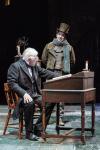
A Christmas CarolIn the absence of Mrs Chrisparkle, who was called away on urgent business in the States, I was graciously accompanied by Lady Lichfield to see the RSC’s new production of A Christmas Carol, adapted by that fantastic writer David Edgar (Yes! Nicholas Nickleby! Destiny! Albie Sachs! Author of so many superb contributions to our stages over the past forty years or more). There are few books that have lent themselves so effectively to adaptations over the years as A Christmas Carol – from Alastair Sim to the Muppets, and not forgetting Tommy Steele’s regular reappearances in Scrooge The Musical.

Phil DavisAnd here’s another one to add to the canon. David Edgar has taken the familiar redemption story of Scrooge, the Cratchits, Marley and the Ghosts and framed it inside the creative mind of Charles Dickens. Many of the more exhilarating works of art are about the creative process that brings about that very same work of art. Consider the film of The French Lieutenant’s Woman, which is about the film crew making The French Lieutenant’s Woman. Or Elton John’s Your Song, which is about how he came to write Your Song. Now we get the chance to observe how Charles Dickens wrote A Christmas Carol.

The CompanyHis original notion, according to Edgar, was to create a hard-hitting tract on the poor and the workhouses. But as his editor and friend John Forster, who accompanies Dickens on this creation-fest, points out, it’s Christmas and no one wants to read a gloomy but worthy pamphlet. Forster makes Dickens think again. Brainstorming names, Scratch becomes Scrooge and a legend is born. Dickens then himself appears in many of the scenes as he tries to imagine himself in his own story, encouraging his characters to reveal themselves as truthfully as possible. It’s a fresh and enjoyable approach to the story and helps to place it in the context of early Victorian poverty.

Phil Davis and Gerard CareyNevertheless, I was still surprised by how very sentimental I found it. Of course, it’s up to the individual whether that’s a good thing, or not. Some people like to wallow in it; personally, I find the story rather mawkish. It’s not often that one looks to Agatha Christie for a critical assessment of someone else’s work, but I can’t help but agree with her character Christopher Wren in The Mousetrap, when talking of the snowdrift, says “takes one back to Dickens and Scrooge and that irritating Tiny Tim. So bogus.” When the adult (not so Tiny) Tim emerges at the end, alive and well due to the generosity of Scrooge, Lady Lichfield confessed to releasing a few sobs. Sentimental? I rest my case.

Nicholas BishopIt looks as authentic and ravishing as you would expect from an RSC production, but with your imagination having to do a lot of the work to fill in the blanks – which I always think is more rewarding anyway. A couple of movable doorframes suggest a maze of corridors at Scrooge’s offices or at the Cratchits’ grim digs. A few lush furnishings create a comfortable environment at Scrooge’s nephew Fred’s place. Palely lit windows in the sky are all that’s needed to conjure up a densely populated living city; and with a mere gesture Dickens can cause the snow to fall – because, after all, everything we see is in his imagination.

John HodgkinsonPhil Davis is every bit as good as you would imagine as Scrooge; viciously arrogant and miserable when at work on Christmas Eve, his mouth curling with disgust at what he interprets as the weak laziness of others, who expect to be given a day off work and for him to bear the financial loss. His unease turns to genuine fear as he encounters the three (female) Christmas ghosts; and there’s a lovely, funny scene where, invisible, he observes the games they play at nephew Fred’s and how he is hurt by the things they say about him – all this, while the Ghost of Christmas Present (a surprisingly hilarious performance by Brigid Zengeni) is tucking into their candied fruits. And I did like the not-so subtle dig at Boris Johnson.

Vivien ParryScrooge’s transformation to a paragon of charity is very nicely done and contributes to another excellent scene with Gerard Carey as Bob Cratchit, where, at the end of his tether, Cratchit finally plucks up the courage to tell Scrooge exactly what he thinks of him….and then realises how the miser has changed his tune – very funny. Among the rest of the cast, Nicholas Bishop is an amusing Dickens, John Hodgkinson a hearty Fezziwig, Vivien Parry a scary ghost and a comic aunt (Is it a Bison?) and Emma Pallant a singularly unamused Mrs Cratchit. But the whole cast work together splendidly as an ensemble.

Brigid ZengeniThere are a few musical and dance interludes that I found a little self-indulgent; one early in the show seems to go on for ages, long beyond what I felt the story required or could sustain at the time. And there was something about the show overall that for me didn’t quite soar. It’s sentimental, but in a very shallow way; I didn’t get a pounding of emotion at anyone’s plight. But there’s no doubt that it’s a classy show with an excellent central performance and an unusual approach which gives it an extra kick. If you’re a fan of the story, you’ll definitely want to see this blend of the traditional with a quirky modern take. It’s in repertoire at the RSC until February 4th.

Production photos by Manuel Harlan

Review – Twelfth Night, RSC at the Royal Shakespeare Theatre, Stratford upon Avon, 9th November 2017

Twelfth Night is one of those true, perennial crowd pleasers. It lends itself so well to modern reinvention, in new settings and new eras, and when you’ve got a central comedic role like Malvolio it’s a gift for a grumpy comic actor to breathe new life into it. It has songs – so you can make as much or as little of them as you want; it has a girl dressed as a boy making up to another girl on behalf of another boy (that’s bound to lead to trouble); it has drunks and idiots; it has separated twins who dress alike even though they haven’t seen each other for ages; it even has a Fool. If you were to cut up little pieces of all the Shakespeare plays throw them up in the air and then try to put all the most typical aspects back together into one play, you’d come up with Twelfth Night.

Orsino and CesarioChristopher Luscombe’s new production draws inspiration from the late Victorian era. Orsino’s Illyria is a Wildean, Swinburnean palace of decadence, where the Duke paints pictures of pretty young men with few clothes on and despite his protestations of love for his countess seems naturally more attracted to fellas. As a result, the whole Viola/Cesario setup takes on a greater significance. When Viola as Cesario is telling the entranced Duke about how she/he plans to return to Olivia to woo her even more, the Duke gets closer and closer to Cesario until he can’t resist but plant a big sloppy kiss on his/her lips, much to Cesario’s (and ours) dumbstruck surprise. Oh those Illyrians.

Sebastian and ViolaIn more Victorian design, the garden at Olivia’s country estate backs on to a beautifully realised minor extension to the Temperate House at Kew Gardens; and Feste, her jester, here is cast as her munshi ( Victoria and Abdul has a lot to answer for). That reassessment of the role of Feste absolutely makes sense in this setting. Shipwrecked foreigners Viola and Sebastian have clearly travelled from the East Indies or thereabout, with their stunning Maharajan robes looking strangely none the worse for their experience. Britain in the late 19th century was fascinated by all things oriental; it affected their costumes, their designs, their artefacts, even their drugs. Simon Higlett’s magnificent sets and costumes capture both the spirit of that fascination and the general sense of Victorian England, with the train station, garden statuary, Orsino’s studio and so on. I loved the use of the old-fashioned Polyphon player to provide Feste his backing tracks – a really nice touch.

MalvolioAs seems to be on trend at the moment, we opened with Viola’s arrival, off the shipwreck, for the first scene and then went to Orsino’s studio for his music be the food of love scene, rather than the other way around, as Shakespeare had it. Which among us is going to tell Shakespeare he got it wrong? This way round is much better; it somehow allows for a greater understanding of the characters and the opening scenario if we meet the earnest Viola first and then move on to the louche Orsino.

Malvolio crossgarteredAs in virtually every Shakespearean production nowadays there are a few tinkerings with the script or characterisations; and they are all successful and constructive – apart from just one aspect, in my humble opinion. There’s a lot of incidental music; and nine times out of ten it’s either too loud, or the actors’ amplification is too soft. Many speeches are drowned out by the music – Feste seemed to me to be the biggest casualty – and it’s simply too intrusive. On occasion it’s almost as though they’re trying to make it into a musical; that doesn’t work as there simply isn’t enough music to achieve that. Musically, it’s neither one thing nor the other and I was a little irritated at that imbalance. As usual, as Malvolio’s plight develops, we see him as more sinned against the sinning (yes, I know, different play), and Olivia’s final assessment that he has been most notoriously abus’d is quite right. However, this Twelfth Night is totally played for laughs, and the finale involves the whole cast singing all the songs again (really?) so any lingering sadness for Malvolio gets kicked into touch straight away. Maybe the production sacrifices a little of the play’s darker side so that it can end with one foot in the air going oi, oi, which isn’t necessarily for the best.

Sir TobyWhere this production really does come into its own is with some superb performances and truly entertaining characterisations. Let’s start with Malvolio – Adrian Edmondson in that role sounds like a dream come true and will rightly encourage plenty of bums on seats. He’s wonderfully dour as the strict puritan steward, dishing out death stares to reprobates, straightening out the angle of a stationary teapot with pernickety accuracy; and his transformation into a yellow stocking’d, cross garter’d, grinning ninny is very funny and not remotely over the top.

OliviaI absolutely loved Kara Tointon as Olivia. Her girlish relish at her constant meetings with Cesario is a sheer joy; her facial expressions really share that sense of physical enjoyment! John Hodgkinson puts his height and his vocal power into a strong performance as Sir Toby Belch, making what can be a somewhat tedious character genuinely funny; farting noisily and uncontrollably as he leaves the stage. Michael Cochrane’s Sir Andrew Aguecheek is another genuinely funny characterisation, collapsing through drink whenever it’s necessary, teetering across the stage in a discreet attempt to escape, mangling his words as he juggles dignity with debauchery. There’s a lovely scene where Sir Toby, Sir Andrew and Sarah Twomey’s gutsy scullery maid Fabia have to blend in with the broken statues in Olivia’s garden in order to hide from Malvolio. Simple physical comedy in many respects, but beautifully done.

MariaVivien Parry, last seen as the hilariously over-ambitious Mrs Walsingham in Half a Sixpence, brings a huge dollop of Welsh intrigue to the role of Maria; she couldn’t have been more dramatic (and indeed hilarious) in her account of how Malvolio has fallen for her trick – and it’s a really lovely reading of the part. Beruce Khan’s Feste is suitably mystic and exotic, combining the tradition Fool elements with a little touch of munshi magic. Dinita Gohil brings a natural dignity and nobility to the role of Viola; I really admired her clarity of diction with just that hint of Indian refinement that’s particularly pleasing to my ear. Esh Alladi’s Sebastian is a delightfully straightforward chap who can’t believe his luck with Olivia, and he exudes thorough decency whenever he’s on stage. Hats off to the casting department for uniting Mr Alladi and Ms Gohil in these two roles; with their similar heights and frames you really could believe they were twins. And there’s an excellent performance from Nicholas Bishop as Orsino, overflowing with artiness, always confusing the girl for the boy; a perfectly underplayed Victorian version of a Restoration fop.

Sir AndrewThe press night audience absolutely loved it, and it does fill the theatre with genuine contented vibes and a wonderful sense of good humour. I’d just like them to hold back on the musical intrusions a little; apart from that, what’s not to love?

P. S. Interesting to note from the programme how many of the cast of this show will also be appearing in the RSC’s A Christmas Carol, which opens next month; the two productions being played in repertoire until February. I’ll look forward to seeing that!

Production photos by Manual Harlan

Review – Coriolanus, Royal Shakespeare Company, Royal Shakespeare Theatre, Stratford upon Avon, 21st September 2017

Big plays and small plays, Shakespeare wrote them all. Even though it’s big in stature, Macbeth, for example, is small in size, at only 2,086 lines – little Comedy of Errors only has 1,754. At the other extreme, Hamlet has a whopping 3,798 lines – no wonder that uncut version with Albert Finney at the National back in 1976 took four full hours to endure. Coming in at fourth longest is Coriolanus (3,320 lines), and I reckon a good many of them are spent covering the hard battle for the city of Corioli, city seat of the Volscians. Allow me to give you a potted outline of what takes place: Caius Martius forces open the gates of the city and joins the leader of the Roman army, Cominius, to defeat Tullus Aufidius, commander of the Volscian army. In recognition of his valour, Caius Martius is renamed “Coriolanus”.

Coriolanus Tullus Aufidius and CoriolanusWith an eye on future greatness, his bossy mother Volumnia wants him to stand as consul, but he’s most definitely not a man of the people. He is a man of martial valour, not petty suburban squabbling; and he finds it impossible to conceal how he despises the common man. The crowd turn against him for his attitude, and he ends up seeking refuge with his old foe Tullus Aufidius, who was previously defeated, but not dead. Together they plan to attack Rome, but at the last minute Volumnia makes Coriolanus repent his double-dealing, and a peace treaty is quickly hatched between Rome and the Volscians. As a thank you for his treachery, Tullus Aufidius kills Coriolanus. Oh, those Volscians.

Coriolanus CoriolanusI’d only seen Coriolanus performed once before – also courtesy of the Royal Shakespeare Company, back in 1978 with the tremendous Alan Howard in the title role. In that production, his name was pompously pronounced “Cor-eye-o-larnus”; thank heavens for the return to the present day sanity of “Cor-ee-o-laynus”. My main memory of the late Mr Howard is that he emerged from the battle covered head to toe in blood; it was Visceral Central. Fast forward almost forty years and Angus Jackson’s gritty new production has our new Coriolanus, Sope Dirisu, also covered head to toe in blood. Plus ça change… In fact, when Mr Dirisu appeared out of the darkness with his black leather armour soaked in gloopy red stuff, I swear the lady next to me almost fainted. It does provoke a strong response from the audience’s collective gut – and it’s not entirely comfortable. Plaudits to Terry King, the fight director, who must have been working overtime to get so many soldiers to clash so closely in hand to hand combat; never has the clinking of axes and the wielding of knives sounded so perilous.

Coriolanus Coriolanus and VirgiliaThis production is the final in a series of Shakespeare’s Roman plays that previously featured Julius Caesar, Antony and Cleopatra, and Titus Andronicus. I didn’t see those productions – although they are all returning to the stage at the Barbican later this year – so I can’t make any observations about how it fits in with the directorial vision of those other plays. What I particularly took from this production is how it highlights both the harshness of the reality of day-to-day life, and also how it exposes opposites within life; like the tough life of the working citizens and the easy life of the patricians.

Coriolanus TribunesThe play opens with a fork lift truck driver removing some pallets from the centre stage to the back of the set. It’s a slow, deliberate, unemotional procedure; it has absolutely no bearing on the story or the first scene at all other than to show you the world from the point of view of the working man; in other words, the opposite of Coriolanus. Stark grey metallic grille shutters descend and ascend throughout the whole play, imposing their unsentimental clattering on whatever scene is taking place. They disturb the peace, they suggest a life of hard, manual work; the opposite of Coriolanus. The noble warrior in question, having previously gloried in the full gore of war, must present himself to the people, in an opposite light; as the wannabe consul who has to wear the cloak of humility (literally) in the marketplace to win the peoples’ support. He’s as uncomfortable as a pre-op patient in a theatre gown, carefully straddling the podium to retain as much dignity as possible (and not to let the citizens catch a glimpse up his legs.)

Coriolanus VolumniaThen there are the two opposing women in his life; his mother Volumnia, the power behind the throne, is as tough as nails and manipulative as can be in her constant quest to mould him into the vanquishing warrior she desperately wants. His wife Virgilia, by contrast, barely dares make a sound as she hopes her husband will survive the battle with “no blood”; clearly the make-up department didn’t listen to her plea. There’s also a stark contrast between the bloody mess that Coriolanus made of Tullus Aufidius, and his later appearance as a society chappie hosting extravagant dinner parties at his pad in Antium. Angus Jackson makes the most of Aufidius’ words of affection for Coriolanus by amusingly tempting the Volscian chief right out of the closet. You’d imagine this Aufidius has shirtless pictures of Coriolanus littering up his browsing history. It’s definitely a production of contrasts.

Coriolanus Final sceneTechnically it’s a tremendous production – Richard Howell’s lighting is evocative, moody, and indeed sometimes quite terrifying. It reveals the harshness of life and the dark uncertainty of the battlefield; and the final tableau is a magnificent capture showing the dead hero being carried into an all-devouring but inexplicable light. As you would expect, the modern-day costumes do a grand job to reflect either the battle scenes, the comfort of the patricians, or the everyday clothing of the working citizens. The only downside to the play is that it’s just unfortunate that so much of the first act is either over-wordy or straightforward battlefield fodder, extremely well performed though it may be. The battle scenes occur too early for the audience to have a real sense of the characters involved, and they end up being somewhat confusing. Who’s fighting who over what? It isn’t always obvious. Added to this, you realise that Shakespeare reserves all his best scenes for the second half of the play; you may feel you have to wait a long time for the whole thing to really get going. It’s a potential problem for any production.

Coriolanus MeneniusSope Dirisu cuts an enormously grand figure as Coriolanus; a natural hero of the battlefield but a fake friend to the hoi polloi in the marketplace. Nowhere is his true character shown more vibrantly than when he rounds on the citizens as “you common cry of curs” – Mr Dirisu is just brilliant in this scene. He really makes you feel how wonderful it would be, if you’d had a bad day at the office, just to be able to turn on everyone and say, to hell with the lot of you. He has a fantastic stage presence and you have no doubt that he would win the day at any battle. Paul Jesson is superb as the over-comfortable, benignly complacent Menenius, apparently wandering from social engagement to social engagement with absolutely no clue that there’s unrest below the surface. In modern Britain he would be the archetypal so-called Metropolitan Elite Remain voter who was gobsmacked to discover the majority voted Leave.

Coriolanus CominiusHaydn Gwynne brings all of Volumnia’s strength and determination to the fore in a performance that leaves you in no doubt that she would dominate any family gathering. James Corrigan is particularly good as the socialite Aufidius, and his fury when he finally kills Coriolanus is truly shocking. There’s a wonderful performance by Charles Aitken (superb as Brick in Cat on a Hot Tin Roof a few years ago) as Cominius, liable to get hilariously over-emotional at times. The extended ensemble of actors give a great impression of the citizenry at large, in all its unhappy forms. I really enjoyed the scene where they all refused to take the blame for Coriolanus’ exile and his resultant joining forces with the enemy – so typical of how no one takes any kind of responsibility! Finally, a special mention to Jackie Morrison and Martina Laird as the two tribunes; delightfully stirring up trouble and doing their best to manipulate the populace – politics hasn’t changed, has it?

Coriolanus Tullus AufidiusThis excellent production emphasises the relevance of the story today and shows you how no single man can be all things to all people. Encouraged too far out of their comfort zone, who knows what calamity might ensue. Don’t push too far, your dreams are china in your hand, as the poet once said. Recommended!

Production photos by Helen Maybanks

Review – Dido, Queen of Carthage, Royal Shakespeare Company, Swan Theatre, Stratford upon Avon, 21st September 2017

Here’s a riddle for you: When is a Press Night not a Press Night? Answer: when it’s a matinee! A 1pm start for a slice of Christopher Marlowe heralded the beginning of a long but satisfying day in Stratford surrounded by the Royal Shakespeare Company in all its glory (or, when it came to Coriolanus in the evening, all its gory, but that’s a matter for another day).

DQOC DidoI don’t know what the prospect of Dido, Queen of Carthage, by the aforementioned Marlowe, first staged circa 1590, does for you, gentle reader. This is the first time I’ve seen this play, having read it when I was knee high to a Punic warrior and probably not understanding a blind word of it. So I came to it with no preconceptions, other than the fact that “Dido” always makes think of a dodo and I’m not sure I would want to see a play about a dead old bird.

DQOC Nicholas DayDon’t let that put you off! Kimberley Sykes’ exciting and visually eloquent production brings this rather hidden classic bang up to date, including scenes of drug abuse and homoeroticism – and that’s just in the first five minutes. The play opens with a grand gentleman, white linen suit reflecting his white flowing locks, like Santa Claus in a snow drift, wandering through a sandy landscape, out-staring any member of the audience who dares to stare back. This is Jupiter, annoyed that Juno has taken umbrage at his dalliance with Ganymede, a pouting, svelte young man who has difficulty keeping his top on. Meanwhile Venus, who has been mainlining some substance injected by her dealer, Cupid, is also clashing with Jupiter about the safety of her son Aeneas, who is lost at sea after seeking refuge leaving sacked Troy. Jupiter ensures that Aeneas and his followers are safely washed up on the coast of Libya; Venus ensures that they all meet up and will be looked after by the beneficence of the local queen Dido.

DQOC Aeneas and his teamBut Venus has further ambitions for Aeneas, so she engineers it that Cupid will disguise himself as Aeneas’ son Ascanius, prick Dido with his hypodermic, and ensure that Dido falls head over heels in love with Aeneas. It strongly reminded me of Shakespeare’s Hermia and Helena falling for Lysander and Demetrius – and vice versa. There’s a delightfully underplayed scene where Dido and Aeneas nip off to the cave for some Carthaginian Carnals, emerging later like a couple of relieved yet still bashful teenagers. At times it’s almost like a Libyan Midsummer Night’s Sex Comedy. What would Colonel Gaddafi have said?

DQOC Chipo Chung and Amber JamesBut for every light moment Marlowe provides plenty of shade. There’s a very deeply tragic aspect to this play, from Aeneas’ moving (if long) account of the fall of Troy, to the genuine personal suffering of Iarbas, Dido’s suitor who can’t understand why she’s being so inconstant in her affections, to the imprisonment of the faithful nurse, and to Dido’s death by fiery self-immolation and the subsequent suicides of those around her. (I’m assuming after 425 years that it’s too late for spoilers.) I found it fascinating that, at the moments of high tragedy, when Dido and Aeneas part, and when Dido immolates herself, Marlowe gets the characters to quote directly – in Latin – from Virgil’s Aeneid, which would have acted as source material for the play. It’s like an early example of verbatim theatre.

DQOC Ben Goffe and Ellie BeavenThe fascinating meshing between the gods and mankind not only acts as a framework for the play but is a running thread that weaves the lives of the mortals and the immortals together. There’s a simple truth here – if you’re a god, or you’re supported by a god, you will do well. If a god’s got it in for you, or you get in the way of what a god wants – then perish you shall. With the dramatic sifting of one handful of sand, they can create any kind of havoc they want. With one jab of his needle, Cupid can cripple or liberate your emotions. It just takes one message from Hermes, and Aeneas knows he has to abandon Dido; it takes two, actually; Aeneas proving remarkably stubborn over this.

DQOC Will BlissThere are so many refreshing elements to this production that delight and astonish. The surface of the stage is covered with sand, enabling it to represent a beach, where refugees might land or from where mariners might set sail, or a visual idea of the “sands of time”, or the dust that is everyone’s fate (gods excluded.) I loved the stylistic entrance of the shipwrecked Trojans, performing energetic diving forward rolls through the curtain of (real) torrential rain at the back of the stage. I loved the imaginative use of the torn down sails to create the ring in the sand inside which Dido would end her life. I loved the scene where Dido invited the men to inspect the portraits of her previous suitors on imaginary walls, where they would recognise someone they’d seen before, as though they were checking actors’ biographies in a programme – if only Marlowe had written “oh look, he was in Juliet Bravo”; alas a missed opportunity. I loved the updating of Cupid’s arrow to a drug pusher’s syringe. I loved the fact that Hermes was wearing a shirt made by Hermès (it might have been Versace, but the joke still stands). As you can see, there’s a lot to love.

DQOC Bridgitta RoyNormally, musical accompaniment to a play like this feels artificial and invasive; but Mike Fletcher’s innovative and sympathetic soundtrack was absolutely spot on. From the portentous strings that evoke Venus’ doves to the plaintive clarinet that creates the smell of the souk (there’s even a wow moment of rock guitar in there too) the music really enhances the action and helps convey the emotions on stage. Ciaran Bagnall’s dramatic lighting adds power and exhilaration to the forces of Nature; and the costumes (see P. S. below) precisely reflect the finery of Dido’s court, the shabbiness of the refugees and the innate elegance of the gods – Venus’ and Juno’s dresses are particularly stunning.

DQOC Daniel YorkWhat is a production without its performers? This is crammed full of exquisitely observed, finely delivered performances right across the board. Chipo Chung’s performance as Dido is a thing of beauty. When she presents Aeneas with her late husband’s cloak for him to wear, despite his protestations she’s never going to take no for an answer. When Cupid’s hypodermic is working its magic, she’s a most convincing bedazzled young girl, trying, but failing, to be appropriately coquettish as she reacts to Aeneas’ every syllable. To relieve the sadness of the account of the fall of Troy, she turns into Party Animal, every inch the good-time girl; and when she’s swallowed up in her own tragedy, she cuts an immaculately forlorn figure. At first, I didn’t think her death scene was going to work – there are no flames, for example – but cunning stagecraft and perfect stillness creates a devastating final tableau. We’d seen Ms Chung in Sheffield’s Julius Caesar earlier in the year where she was a fine Portia – but this was on another level.

DQOC Sandy GriersonShe is matched by a strong performance by Sandy Grierson as Aeneas; his Scottish accent somehow underlining the character’s dour and warlike essence – this is an Aeneas that will leave light protestations to his co-refugees. Delivering that long speech about the fall of Troy – it probably accounts for over 10% of the play in itself – is a tough job, but his account never becomes long-winded or tedious as he brings the imagery of what happened fresh to our minds in all its lively atrocity. Although, physically, he’s not the beefiest of chaps, he’s like a coiled spring ready to leap into action without warning.

DQOC Andro Cowperthwaite and Will BlissEllie Beaven’s Venus also lights up the stage as she conveys the simple enjoyment of all her mischievous interventions in the mortal world; she has great presence, and her double act with Ben Goffe as Cupid is both funny and unsettling as we see the effects of drug abuse amongst the celestial beings. Mr Goffe is required to spend much of his time pretending to be Ascanius, physically cosying up to Dido, or the Nurse, or indeed whoever he wants – and the cheeky pleasure he derives from it is very infectious. The gods are all superbly presented; Nicholas Day is a naturally imperious Jupiter – you’re never going to cross him; Bridgitta Roy a splendidly sly Juno, lurking in the background, waiting for her moment to pounce; Andro Cowperthwaite revels in Ganymede’s brief but lascivious interchange with Jupiter; and Will Bliss’ Hermes is an amusingly world-weary postman until Jupiter plucks one of his feathers and then his nose starts twitching, ready to race like a Springer Spaniel on heat.

DQOC Chipo ChungThere are some great supporting performances from Aeneas’ Trojan followers; I particularly liked Tom Lorcan’s effervescently upbeat Iloneus and Tom McCall’s permanently suspicious Achates; and having a female Cloanthus, played by Lucy Phelps, creates an unusual but effective mix amongst the otherwise all-male retinue. Amber James is terrific as Dido’s sister Anna, always holding a helpless candle for her love for Iarbas, who’s superbly brought to life by Daniel York in a performance that combines brilliant throwaway humour and emotional trauma. At the performance I saw, young Ascanius was played by Samuel Littell and he truly held his own amongst all those grown-ups. Good work, young sir.

DQOC Tom McCallAn unexpected treat of a play, that gives life to what otherwise could remain a dusty old tome on the bookshelf. Very enjoyable and highly recommended! Dido runs until 28th October at the Swan Theatre – get booking!

RSC Stitch in TimeP. S. On the subject of costumes, the RSC has launched their Stitch in Time campaign, highlighting the importance, and unsurprisingly the expense, of accurate and evocative costumes in their historical productions. Even if you’re not able to contribute to the campaign, their website offers a fascinating insight into the attention to detail that their expert staff bring to creating Just The Right Outfit. Well worth a little donation, I reckon, if you admire their work.

Production photos by Topher McGrillis

Review – The persecution and assassination of Marat as performed by the inmates of the asylum of Charenton under the direction of the marquis de Sade, Royal Shakespeare Theatre, Stratford, 19th October 2011

Or, the Marat/Sade to be concise; not that concise is a word that comes to mind when thinking back to Wednesday’s preview. At a good hour and three quarters before the break, having just witnessed a feast of anal rape, the interval Shiraz should be available through the NHS.

But I’m giving away the plot. Actually the (full) title tells you all you need to know. The Marquis de Sade really was imprisoned at the asylum in Charenton and really was allowed by the director Coulmier to stage plays acted by the inmates. So the story created by the writer Peter Weiss is a perfectly legitimate fantasy, and it was originally produced in the UK by the RSC as part of their Theatre of Cruelty season in 1964.

Herr Weiss is no longer with us so we cannot tell what he would have made of the liberties taken with his text. It’s certainly been updated, with additional speeches by Marat, Roux and the Herald (there may be more); his descriptions of his characters’ attributes and their costumes have largely been ignored; and Weiss was very minimalist with his stage directions, which allows the director Anthony Neilson, pretty much Carte Blanche to do what he wants.

Some of these liberties are very successful. Coulmier controls the inmates through a system of mobile phones and the piercing sound of ringtones has a startling effect throughout the play. A dangerous ploy – it would kill the atmosphere if a phone accidentally went off in the audience. Marat himself prepares his speeches using a laptop in his bath – in fact the whole production couldn’t have gone ahead without the late Steve Jobs.The Herald is no longer a male clown-cum-harlequin, but the role is performed by an actress with restricted growth who often uses an electric wheelchair to move around the stage. She’s quite an arresting sight, and often has a glint in her eye that she can turn to evil effect; it’s a very good performance from Lisa Hammond.

Mrs Chrisparkle, however, is less charitable of the director’s motives. Her reaction to the production was that he had a checklist of faux offensive activities he wanted to ensure were included, and that he wouldn’t be satisfied until every one of them was ticked off.

The programme makes much of the play’s parallels with the Arab Spring of today and its relevance to the 21st century. There are some excellent lines (in the original text) about having trust in “our minister of war” and also the irony of “calmly watch these barbarous displays that could not happen nowadays”. All that on the week that Colonel Gadaffi was killed. You couldn’t make it up. It’s true that the play hasn’t dated at all – I think it was probably always timeless.There is some surprising use of the hijab, and Khyam Allami’s stirring and atmospheric music for the production lends an eastern lilt to the play. The four asylum inmates who act as singers in the production are in excellent voice and contribute to making the music one of the highlights of the play. I particularly enjoyed the performance of Amanda Wilkin as Kokol.

In fact one of the really strong points of this production is the excellent ensemble work of the actors playing the inmates. They provide a really credible image of they type of people who might inhabit an asylum – their walks, their tics, their habits are all well observed and totally believable – apart perhaps from Lanre Malaolu’s Duperret, who really does masturbate an awful lot (tick). I felt that was probably only so they could often call him a “w**ker” (not in the original text) (tick), so I’m not blaming him.

Whether it’s the play itself or the specific production, it’s hard to determine, but I have two main problems with the show. Firstly, it’s way too long, particularly in the first half. A lot of that is Weiss’ fault. In the text, the first act covers 69 pages, the second act, 30. But there’s a lot of self-indulgent activity in the first act that could either be completely removed or drastically cut down – the anal rape (tick) scene goes on and on, and on… and on. One feels that he’s proved his point; now can we get on to something else please. Many of the speeches by Marat and Sade are very heavy and wordy – to the extent that you stop paying attention and focus on the stage activity instead. As they haven’t treated the text with reverence, I think it some of these speeches could have done with extra pruning. The result of all this is that there are many sequences that are just plain boring.

Secondly, basically, it’s a play that hates its audience (which is one of my pet hates). A member of the audience gets approached by one of the cast which results in their being called a c**t on stage (tick). Members of the cast variously insult and moon at the audience (tick), people have popcorn chucked at them like a weapon, a black actor turns to a white man in the audience and says “Death to the White Man!” (not in the original text) (incitement to racial hatred? Tick), the dildos that are used in the anal rape scene are then waggled in the faces of elderly ladies in the front row (tick). I’m sure you get the picture. There is a moment when Marat walks down an aisle asking patrons if any of them can speak French, because he wants them to translate something for him. Only a fool would offer to help, because God knows what trick would have befallen that person. I certainly kept schtumm, as did everyone else. It’s up to you to decide whether this is a legitimate way of challenging an audience, or if it’s merely taking the Mick.

Having said that, one thing I did like at the end of the first act was how Arsher Ali’s Marat started deconstructing the piece. Voltaire and Lavoisier do their interminably dull speeches to the audience and frankly no one is paying any attention, at which point Marat says, “you’re losing them, it’s no good, stop now, they all want the interval, they all want their ice-creams” and then he starts to go around the front row taking ice-cream orders. Nice. That’s what I call subversive, much more than the bizarre over-use of jockstraps (although that did reveal a curious tattoo of a map of Africa on one person’s buttock).

What of the main roles? I wasn’t quite sure what to make of Jasper Britton’s Marquis de Sade. Weiss’ description makes it clear that he should be an imposing figure. But I didn’t find him that imposing. I found him very human, very flawed; to be pitied rather than to be in awe of him. They’ve made him into a cross-dressing chameleon, taking on a different persona almost every time he comes on. I wasn’t very convinced by him as an American cowboy; but he was absolutely right as Mary Portas. There’s also a scene where he comes on dressed as the Herald, in her wheelchair, and with shoe attachments on his knee so that he can mimic her stature when on all fours. In the first act her character abused an audience member who had been tricked into patronising her disability. In the second act, the production itself patronises her. You can’t have it both ways, Mr Director. Which is it to be?

Christopher Ettridge’s Coulmier is every inch the respectable director and on the face of it a world apart from the general madness surrounding him. The coup de theatre at the end is effective but not in keeping with Weiss’ original; and it’s been done before in Rocky Horror. Actually, the whole meaning of the end of the play is changed – in the original version the play ends in total anarchy with Coulmier attempting to restore order by striking his patientsmuch to the delight of the Marquis de Sade who glows with pleasure at the mischief. Not so in this production. I also very much enjoyed Nathaniel Martello-White’s performance as Jacques Roux, who has a very commanding presence, natural authority and moreover a voice as clear as a bell. This is his RSC debut season; I think he could become a bit of a star.

Imogen Doel as Charlotte Corday looks very much the part, but I couldn’t always understand the words she was saying; and this production has the character played by an inmate with sleeping sickness (which is quite funny) whereas Weiss described her as a somnambulist. Do you think someone ought to have checked the dictionary definition?

Arsher Ali as Marat was very convincing, spoke clearly, and I admired the clever make up job that makes him look like he’s had part of his head shaved. Was it entirely necessary to have him sitting on the toilet at the beginning of the second half? Was it just so that one of the inmates could smear themselves in his excrement? (tick).

A number of people left at the interval. To be fair, a play like this isn’t doing its job properly if at least some people aren’t motivated to prefer their own more polite company. The audience reception at the end was more rapturous than I expected, although a lot of it was from some whooping girls who had got more into the sex and nudity elements of the evening than might otherwise be deemed dignified.

So in conclusion I’d say yes to its still being relevant; yes to its ability still to shock; yes to the overall standard of acting; but no to a feeling of overall satisfaction. A plucky failure? Probably, but often that can have more artistic value than an unambitious success.