Review – 4.48 Psychosis, Royal Shakespeare Company at The Other Place, Stratford-upon-Avon, 15th July 2025

Sarah Kane’s final play is a challenge to any director or cast. How do you treat this poetic but agonising piece of writing, which leaves few clues as to how it should be staged, with the dignity and respect that it deserves, without simply creating a gloomfest? It cries out for its voice to be heard and demands that you at least try to understand the mental torture of its writer. But, when all’s said and done, it’s not a lecture or TED talk, it’s a play and decisions have to be made as to how to present it.

CastIn what must be an almost unique venture, the entire original creative team have reunited 25 years later in this co-production with the Royal Court Theatre, at whose Jerwood Theatre Upstairs the play was first produced. Not only the same cast and the same director, James Macdonald; it’s the same team of designer, lighting and sound. So, even without seeing the original, I feared this might be an exercise in preserving something in aspic rather than an attempt to find new things in the text that were not obvious 25 years ago.

MirrorIt is, however, a brand new production, and James Macdonald and designer Jeremy Herbert have come up with a masterstroke; a huge mirror, the same dimensions as the stage, slanting at a daunting angle, reflecting the on-stage activity as a backdrop, and even capturing the first few rows of the audience to add to its theatricality. Nigel Edwards’ inspired lighting design highlights the two chairs and table in the mirror to create some truly impressive effects, and Ben Walden’s projection adds to the magic by turning the table surface into a window on the world, or blasting the entire stage with white noise, offering an insight into the clarity of vision and thought (or lack thereof) experienced by our protagonist.

Daniel EvansEach of the three actors takes on many guises over the 70 minutes; not only someone suffering from severe depression, but doctors, friends, colleagues and all the other voices who do their best to offer support or lend reason to the central character. And it’s in those side characterisations that Kane gives the cast an occasional opportunity to lighten the weight of the text. There’s a truly laugh out loud moment when Daniel Evans, portraying a doctor who’s clearly had a long hard day, bursts out with I fucking hate this job and I need my friends to be sane – only to realise that it was a Did I say that out loud moment and then have to apologise profusely.

Madeleine PotterMacdonald places his actors in all sorts of unusual positions for several of their speeches – resting flat on the ground in a crucifixion or savasana pose, or on top of the table with their head tilted over the edge, talking directly to the mirror, or furiously writhing on the table, all of which create fascinating images in the mirror, helping us to see them, literally, from a different perspective. It sounds gimmicky, but it works. The actors write backwards on the table top – medical prescriptions, or simply their thoughts – so that we can see the writing in the mirror; a clever touch.

Jo McInnesThe ensemble of Daniel Evans, Jo McInnes and Madeleine Potter dovetail their speeches and actions immaculately, with superb vocal clarity throughout. One of the most powerful moments comes when Jo McInnes struggles violently on top of the table, so that in the mirror she appears trapped within a tiny box, a true metaphor for the state of her mind. The whole play is performed with devastating sincerity but emotionally controlled, peppered with daringly long pauses where the characters find neither the words, the impetus, nor the need, to speak.

White NoiseSarah Kane submitted her text to the Royal Court in 1999 and within a few days had taken her own life. It’s impossible to separate the personal tragedy from the theatrical product, but it’s clear that this is a lucid, deliberate, structured piece of work. The title, it is said, comes from the fact that she would wake at 4.48 due to her mental anguish. As her text states: At 4.48 when sanity visits for one hour and twelve minutes I am in my right mind. When it has passed I shall be gone again. One hour and twelve minutes is almost exactly how long it takes to perform the play; is this as an affirmation that the piece is written in those brief times of sanity surrounded by mental torture?

RSVP ASAPA very intense piece of writing given a great performance with an inspired setting. This isn’t the kind of play one enjoys; rather it’s an opportunity to bear witness to a state of mind that one hopes one never encounters personally but which is very real and prevalent all around us. And it is the sad swansong of a huge talent taken too young.

Production photos by Marc Brenner

4-starsFour They’re Jolly Good Fellows!

Review – Pericles, Royal Shakespeare Company at the Swan Theatre, Stratford-upon-Avon, 10th September 2024

There aren’t many Shakespearean plays that one misses out on during a lifetime of theatregoing, but Pericles is likely to be one. I’d never seen this play before, and, indeed hadn’t looked at the text for at least 45 years. But there’s no doubt this is a fascinating play – rarely can the old phrase “from the sublime to the ridiculous” be so appropriate concerning the pen of our Beloved Bard.

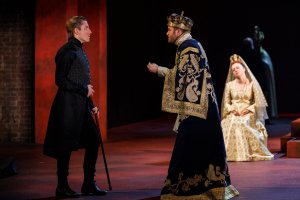
Alfred EnochWith more episodes and locations than your average picaresque novel, we follow the fortunes of Pericles as he leaves Tyre (where he is Prince) to sail to Antioch, where he hopes to marry the unnamed Princess of that city state. To win her hand, he must answer a riddle; failure to answer it results in death. Pericles solves it in an instant, but making the solution public also results in death – bit of a Catch-22 there, probably a riddle worth avoiding. Therefore he flees Antioch before he can be murdered. Next, he reaches Tarsus, stopping by to offer food to the famine-stricken city; shipwrecked on leaving Tarsus, he lands in Pentapolis, where King Simonides is allowing the winner of a jousting contest to marry his daughter Thaisa. Naturally our hero wins the contest, and Thaisa’s hand. But all is not well; sailing back to Tyre, they are shipwrecked (again) and Thaisa dies giving birth to a daughter, Marina. Following tradition, Thaisa’s body is placed in a coffin and cast off into the waters, never to be seen again. Or is she…?

AntiochusThat’s enough storytelling to fill a book and we’ve only just reached the interval. Pericles must be the direct opposite of Waiting for Godot, where, famously, nothing happens. Here, everything that could possibly happen, happens. However, the early scenes of the play – up till Pericles’ arrival in Pentapolis – are (there’s no point beating about the bush) absolutely awful. Not, I hasten to add, because of the RSC’s production, Tamara Harvey’s direction or the company’s acting; it’s simply the words with which they have to grapple.

Pericles aloftIt is largely believed that the play is a collaboration between Shakespeare and An Other Writer; Shakespeare wrote the good bits and AOW did the rest. The mystery man is likely to be George Wilkins, an innkeeper, criminal and pamphleteer, and an associate of the King’s Men acting company, hence his familiarity with Shakespeare and his work. The language in those opening scenes is flat but garbled; intractably impersonating the florid style of the silver poets who had gone before, but falling far short of the standard required. Fortunately, the use of judicious cuts combined with the happy circumstance that Pericles is one of Shakespeare’s shortest works, means we can get on with the decent meat of the play after about half an hour or so.

SimonidesThe average Collected Shakespeare will list the play as one of the comedies. But there is some tough material here: incest, kidnapping to be sold into prostitution, death during childbirth; frankly, not a lot to laugh at. However, these elements are balanced with some truly engaging scenes and performances, resulting in many feelgood moments and comic sequences. The highlight of the production is King Simonides’ not-so-secret machinations to engineer a marriage between Thaisa and Pericles, a blissfully funny performance by Christian Patterson. All the scenes set in the brothel prickle with danger and corruption; and if you love a happy ending, I can’t think of a bigger jump from despair to elation than that experienced by Pericles in Act Five.

The ropes that bindJonathan Fensom’s simple set is dominated by ropes, suspended and intertwining; a perfect choice for a play where so many scenes are set at sea. Claire van Kampen’s evocative music is delicately and moving played by Elinor Peregrin’s team of five musicians, strong on woodwind and percussion. The text has been smartly cut and revised so that what remains of Gower’s chorus-type introductions to each act have been given to Marina, even before the audience realises it is she who is speaking. There’s only one directorial decision that jars; the artificial and showy use of hands aloft by the background ensemble. Perhaps it’s meant to recreate the dumbshows of the original text; whatever, it just looks silly. Stop it.

Rachelle DiedericksAlfred Enoch gives a compelling performance as Pericles; a truly noble character who rises above all his misfortunes to remain magnanimous, honest and beneficent. Mr Enoch embodies these virtues throughout the play with his clarity of interpretation, physical agility and the sheer emotion of that final scene. As his long lost Marina, the ever-reliable Rachelle Diedericks is a chip off the old block, conveying the essence of purity and decency, pleading her case for survival with lucid clarity. There are also excellent performances from Philip Bird as the super-reasonable Helicanus, Christian Patterson as the excitable Simonides, Leah Haile as the modest Thaisa, Kel Matsena as the noble Lysimachus and Alfred EnochJacqueline Boatswain as the kindly Cerimon and a truly villainous Bawd, matched with an equally vicious Pander played by Felix Hayes.

An excellent opportunity to see a rarely performed Shakespeare; not exactly a masterpiece but containing some of his best characterisations and individual scenes. After Pericles leaves Stratford on 21 September, it transfers to the Chicago Shakespeare Theater from 20 October.

Production Photos by Johan Persson

4-starsFour They’re Jolly Good Fellows!

Review – The Merry Wives of Windsor, RSC at the Royal Shakespeare Theatre, Stratford-upon-Avon, 19th June 2024

Forsooth, at these times when the UK body politic is working out exactly what the next five years have in store, it’s verily a buckbasket amount of fun to enjoy a laughter tonic in the form of Blanche McIntyre’s brilliant new production of William Shakespeare’s occasionally vicious comedy The Merry Wives of Windsor. It goes without saying that this is a play at which you can throw the kitchen sink, but Ms McIntyre has backed in the entire stock of the local Wickes in a pantechnicon at the stage door – and it works superbly.

FalstaffIt’s a surprisingly complicated plot, if you follow it in depth; that fat fool Sir John Falstaff is down on his uppers and lodging at the Garter Inn, so plans a two-way attack on the hearts and bank balances of local well-to-do Mistresses Ford and Page. When they discover that he’s not remotely serious in his intentions, they decide to double-cross him. Twice. On both occasions he has to be secreted from the Ford house without Master Ford knowing; much hilarity ensueth. However, Ford himself has become genuinely jealous and suspicious of his wife and tricks Falstaff into keeping him updated with the fat knight’s “progress” with her. Once that’s come out into the open, and Ford repents his jealousy, they all decide to trick Falstaff one more time by spooking him in the deep dark forest. Gosh, those wives truly are merry.

Windsor ParkRobert Innes Hopkins has pulled a masterstroke with the set. An immaculate lawn fronts the perfect suburban front door of 37 Acacia Avenue Windsor (it may as well be). As the scenes develop, the house frontage spins around to reveal various locations inluding the front door of the Garter Inn (showing the Germany v England game courtesy of Pie Sports, nice touch), and Dr Caius’ surgery – he appears to be a dentist for the purposes of this play, and why not? The production makes excellent use of the hidden trap on the stage to present Falstaff’s bed, a pub garden table, and so on; and for the final scene, the suburban landscape is whisked away and we find ourselves presented with the ominous trees and threatening foliage of Windsor Park.

Shallow and PageThe text has been decently revised to include a few modern references whilst still retaining the full authenticity of the original; of those, I particularly enjoyed Caius’ unexpected nod to McDonalds. The whole approach of the production is to concentrate on the humour – that’s really the only reason why you would do this play in the first place. The darker sides to the story take something of a back seat; the viciousness of the revenge on Falstaff isn’t overly stressed – this is a resourceful and mentally strong Falstaff who can definitely give as good as he gets. The veiled cruelty of trying to prevent the marriage between Mistress Anne and Fenton – who love each other – is only briefly hinted at, and quickly redressed at the end. Only Ford’s jealousy is developed more strongly; a well-judged, subtle performance by Richard Goulding reveals his inner torment but it never gets in the way of a good belly-laugh.

Mistresses Page and FordSamantha Spiro and Siubhan Harrison lead the cast as the eponymous wives, with hilariously conspiratorial and comically energetic performances as they entrap husbands, suitors, offspring, and whoever comes into their orbit. Wil Johnson is excellent as the dignified Master Page, John Dougall is nicely busy-bodying as Shallow, Emily Houghton gives us a gutsy Host of the Garter, and Tara Tijani and John Leader are well matched as Anne and Fenton, charming in their decently developing relationship and quietly victorious at the end when their plans have come to fruition.

Mistress Page and Sir HughIan Hughes and Jason Thorpe make the most of Shakespeare’s near-xenophobic language to poke wonderful fun at their characters, Sir Hugh and Dr Caius’ Welsh and French backgrounds; Mr Thorpe bringing a beautiful petulance to the acerbic doctor’s barbed lines, and Mr Hughes as a delightful windbag of pomposity and hypocrisy, seizing the surprise chance to take a sniff at Mistress Ford’s discarded undies.

Slender and AnneAll the cast give superb, committed performances. There are some scene-stealing comedy moments worth mentioning; Patrick Walshe McBride as the tongue-tied Slender, Omar Bynon and Yasemin Özdemir as the double act of Pistol and Nym, and, triumphant in the magnificent basket scenes, Riess Fennell and David Partridge as the two hapless laundrymen dealing with removing the hidden Falstaff.

Mistress Ford and FalstaffBut it’s John Hodgkinson who takes centre stage with a marvellous portrayal of Falstaff; so often you see Falstaff played as a glutton with his mouth dribbling with food and drink and his attire filthy and uncared for. This Falstaff is the opposite. Smart suit, a clean cut appearance; which makes his mud-caked reappearance after the Thames incident even funnier. His only nod towards gluttony is when he sinks his quart of sack in two mouthfuls – each of which get a cheer and a round of applause from the riveted audience. He’s lascivious, but comparatively subtly; for example, not moving out of the doorframe when Mistress Page has to squeeze past him, much to embarrassed but sexy giggles from both of them. Mr FordHodgkinson gives us a totally believable Falstaff; not a caricature of excesses but a real man whose actions we can’t approve of but completely understand. No spoilers, but whilst the ending of the play shows him completely humiliated and outdone, you have absolutely no doubt that the next morning he’ll just carry on as normal. A true survivor in fact!

One tiny note: the short scene involving the two German football supporters doesn’t entirely make sense; but then again, Shakespeare’s original equivalent doesn’t make much sense either. Otherwise this is a tremendously uplifting production that frequently has you hooting with pleasure, and a wonderful way to spend a summer night in Stratford. Highly recommended!

Production photos by Manuel Harlan

Five Alive, Let Theatre Thrive!

Review – English, Royal Shakespeare Company at The Other Place, Stratford-upon-Avon, 15th May 2024

Samuel Beckett first brought his play Fin de Partie to the Royal Court in London in 1957 performed in the original French. This was still during the era of stage censorship, but the Lord Chamberlain’s Office had no objection to this production. However, when it was translated into English as Endgame, for a repeat performance at the same theatre six months later, suddenly the censor perked up and objected to the description of God: “The bastard! He doesn’t exist!” on grounds of blasphemy. However, there was no objection to this line when the same blasphemous concept was expressed in French. Words are much stronger than thoughts or actions. Especially when they’re in English.

CastSanaz Toossi’s Pulitzer Prize winning English proves that point superbly. Four Iranian students embark on a basic English course, guided by their kindly and supportive teacher Marjan. We see their initial struggles, coming to terms with the prospect of only speaking English in class, and not drifting into Farsi. All the lines in the play are actually spoken by the actors in English, so we can understand everything going on. When the language flows confidently and rapidly we know the characters are speaking in Farsi, where they feel comfortable; and when they start to speak in English, they adopt a stilted, faltering tone, loaded down with a heavy accent. It’s a very entertaining device, and once your brain has adapted to the trick, it works extremely well and is the source of much of the humour.

Teaching gamesWe see the characters’ building confidence – or waning, depending on how well they are progressing. We note the element of competitiveness between them, and how jealous the female students are of Omid, who already seems to be very good at English. It’s extremely funny to relate these struggles to any times we, the audience, might have tried to learn a foreign language. You realise that those feelings of utter stupidity, such as when trying to have a conversation about the ownership of a pencil, or bewilderment when you can’t keep up with the pace of conversation of a native speaker, are problems that all language students face, no matter where they’re from. It serves as a good leveller; it’s all very recognisable, and at times hysterical.

RoyaThe play questions the motivations behind all the characters. The oldest student, Roya, is learning English because she wants to be able to speak with her granddaughter, now living overseas. Others might need it for a visa application, or a job as a teaching assistant. The play also examines the need for honesty within a closed community. There are secrets – some are kept, some are betrayed; when it is discovered that one of the five characters in the play is not telling the truth as to why they are there, the shockwaves it sends through the group is very destructive.

MarjanWords can be used as a weapon, for division, or as a symbol of identity and belonging. Roya is annoyed that her Canadian granddaughter has been given a name she can barely pronounce; it’s just one symptom of how the older woman is being estranged from the rest of her younger family. Teacher Marjan talks of how she was called Mary when living in England because it was easier for the lazy locals to pronounce; she looks on this eccentricity with Anglophile affection, but Roya is offended at the way it belittles and disrespects Marjan’s Iranian heritage. This is not new; think of the Kapoors and the Rabindranaths in TV’s Goodness Gracious Me, obscuring their Indian backgrounds as they aspire to be recognised as the traditional English families, the Coopers and the Robinsons.

ClassSanaz Toossi’s fascinating play keeps you spellbound from the very start and is like one of those big flowers with masses of petals that you can keep stripping away at until you finally get to its well-hidden core beneath. Diyan Zora’s delicate and modest production gently reveals these layers as we get to know the characters – that is, to the extent that Ms Toossi will allow us. There’s no change of scenery; Anisha Fields’ simple set is all we need – some tables and chairs, and a TV and DVD to allow the students to watch Romcoms to perfect their language skills. Each short scene progresses through the five or six weeks of the course, the characters taking up different positions around the tables. You might think this would feel static; but Ms Zora’s clever direction makes us see the progress through language and character development rather than location.

Nadia AlbinaAll five actors give tremendous performances. Heading the cast is Nadia Albina as Marjan, the kind of teacher you would have enjoyed having at school, ready to praise you for the progress you have achieved, trying her best to make her limited resources go as far as possible. Like all teachers, she has her favourites; and when they inevitably let her down her frustration and hurt becomes subtly apparent. It’s an excellent and highly believable performance.

Sara HazemiSara Hazemi is terrific as the willing and sunny Goli, the youngest in the class and perhaps the nearest to being a “schoolchild” in her helpful attitude. Serena Manteghi is also superb as the more cynical Elham, prepared to work up to a point but also more at home when she’s in disruptive mode.

Nojan KhazaiI really enjoyed Lanna Joffrey as Roya, fully aware that her age makes her a fish out of water, trying to grapple with the basics of a foreign language that is beyond her capability, and trying even harder to hang on to her position within her family. And Nojan Khazai gives a quietly strong performance as the slightly mysterious Omid, who can always be relied on to speak with confidence and ability – even to the extent that he can correct the teacher.

Classroom anticsI came away from the play uncertain as to Omid’s motivations. He has a secret, that I won’t reveal, that makes you question his commitment to the course. It’s a loose end that isn’t tied up. But that’s life isn’t it – full of loose ends? The ending of the play also breaks the convention that had been established throughout the previous 89 minutes of the 90 minute production; the final two characters start talking Farsi (we assume it’s Farsi) to each other. As a result, it ends with a conversation that the audience doesn’t understand. Are they just saying “Goodbye, it’s been nice knowing you”? Are they saying, “I hated every minute of this rotten English course”? Are they concealing another secret about the relationships in or the purpose of the classroom? It’s simply a moment of privacy between two people, so we’ll never know. Just like the first British audiences of Becket’s Fin de Partie, who didn’t know that they were hearing highly censorable blasphemy, it all just goes over our heads as an indistinguishable sound. Language is possibly man’s most powerful tool; and English provides a very intriguing and thought-provoking contribution to the discussion.

The show runs at The Other Place in Stratford-upon-Avon until 1st June and then transfers to London’s Kiln Theatre from 5 – 29 June.

Production photos by Richard Davenport

4-starsFour They’re Jolly Good Fellows!

Review – Ben and Imo, Royal Shakespeare Company at the Swan Theatre, Stratford-upon-Avon, 29th February 2024

In 1952, Benjamin Britten was riding high. With operas like Peter Grimes and Billy Budd under his belt, not to mention the famous Young Person’s Guide to the Orchestra, he was an obvious choice to compose an opera to celebrate the young Queen Elizabeth II’s coronation – Gloriana, based on Lytton Strachey’s Elizabeth and Essex. However, a composer – or any creative artist – is often not the best judge of their own work, and nine months before Gloriana was to grace the stage of Covent Garden, into Britten’s life stepped Imogen Holst. The daughter of Gustav, she was a composer and conductor in her own right, and her all encompassing passion was music, in all its forms and from all its angles. But she turned her back on her career in favour of teaching, support and assisting. At one point Britten suggests she should be designated as his amanuensis. But that’s too grand for Holst; she prefers the understated “musical assistant”.

Ben ImoWhat is it about creative geniuses that means they always seem to have a dark side? That’s one of the many questions posed in Mark Ravenhill’s thought-provoking and beautifully written Ben and Imo, an account of the nine months that led up to the first performance of Gloriana on 8th June 1953.  We see their shared love of music, the arduous and cantankerous creative process, the struggle to overcome obstacles, and above all, their mutual reliance (although both, you feel, would deny it). What we don’t see is their lives outside of these four walls, or this circular stage. There is a huge contrast, for instance, between Imo’s austere existence and the affluence of Ben’s society lifestyle, wonderfully demonstrated by the difference between his enviable Astrakhan coat and her dowdy outfits.

Ben ImoWe also don’t see the people who have shaped them into who they are: Gustav Holst, who had died many years before, and Peter Pears, Ben’s partner, always singing his way around the world. The play removes the protagonists from these prime influences, so that they are left to fend for themselves. The only other element that makes an incursion into the “Ben and Imo” environment is the sea off the Aldeburgh coast; a constant background reminder of the unpredictable power and destructive force it can wield.

Imo BenThis is not a portrayal of a harmonious relationship. Britten is one of those people who bring others into their lives because they need them for a purpose, and when that need has been fulfilled, they drop them. Holst, however, is the complete opposite; she’s loyal, nurturing, and generous. At first, Britten wants her to make all the decisions for him; later, he resents her for trying to take control. He attracts people towards him, but once a friendship is established and successful, he unexpectedly and without reason drives them away. He needs Imo’s encouragement, and she needs to give it to him. But when she envisages a plan to refine and develop his Gloriana score, he can’t abide the thought of her presence and so arranges for her to go to America for three months. In modern parlance, he catfishes, cancels, and then ghosts. No wonder Imo doesn’t know where she stands.

BenBen’s progress is marked by a series of seemingly petty victories, such as when the Lord Chamberlain backs down over his refusal to allow the appearance of a “pisspot” as part of Elizabeth I’s domestic regime. He has a splendid time trashing Dame Ninette de Valois, Frederick Ashton, Covent Garden director Lord Harewood, and others. This man is nothing if not a name-dropper. As well as the creative process in general, the play examines not only the tricks that are played within a power struggle, blaming others for failure, but also the concept of the dumbing-down of art, and the perils of royal patronage. The powerplay between Britten and Holst was always going to be the sticking point of their relationship, and the play’s wonderfully sudden ending seems to nail that question once and for all.

ImoSoutra Gilmour’s set places the piano at the heart of the play; no need for anything else on the stage unless it serves the piano – such as the stool and the supply of sheet music, or a few drinks to fuel the musicians. The piano is the ultimate visual indication that music is all.

Ben ImoErica Whyman directs two stunning performances by Samuel Barnett as Ben and Victoria Yeates as Imo. Mr Barnett truly inhabits Britten’s enclosed, reserved mind, giving of himself only when he needs to, and spitting out volumes of unexpected vitriolic fury when he doesn’t get his own way. He shows us Britten as both masterful and pathetic; both a genius and a lame duck. Ms Yeates gives us a superb study of a willing slave, insightful and practical, prepared to give up her own success and dignity for the sake of what she perceives to be the greater good. But there is always a point where the worm turns, and she provides all the genuine emotional reactions that Mr Barnett’s Britten refuses to indulge in.

HouseThere were just two elements to the staging that jarred with me and became an unnecessary distraction from the pure realism of the play. Perched on top of the piano is a model of Britten’s house; no one ever refers to it or touches it, so presumably only we can see it. Its little windows are lit, as if to show there’s someone living there. When the second act opens, we understand that the house has been flooded and that the electricity has been cut off; yet the little lights in the model house remain on. That just doesn’t make any sense to me.

Ben ImoThat flood is represented not only by the audience hearing loud lashings of rain and sea, but also by a little bit of water that trickles off the surface of the piano. Knowing how graphically the RSC can represent a storm when they want to (imagine Edgar on the blasted heath in King Lear), I’m afraid that little bit of rainwater dripping off the piano is hardly a deluge – it’s laughably pitiful.

Nevertheless, it’s a very well-written and structured play that grapples with some fascinating issues and aspects of humanity that some of us would prefer to remain hidden; and Samuel Barnett and Victoria Yeates are fantastic. Gloriana may well have been a flop – Ben and Imo makes up for that in spades.

Production photos by Ellie Kurttz

4-starsFour They’re Jolly Good Fellows!

Review – Julius Caesar, RSC at the Royal Shakespeare Theatre, Stratford-upon-Avon, 28th March 2023

Without making it sound like an end of the pier revue, the Royal Shakespeare Company’s summer season kicks off with Atri Banerjee’s production of Julius Caesar. Having started with The Tempest, it’s the second in a series of plays grouped under the theme of Power Shifts, and there’s no doubt that’s highly relevant in these tortuous political times that we’re all facing. I’ve no statistical proof of this, but I think if you got a bunch of Shakespeare devotees in a room together they’d agree that Julius Caesar is one of their favourite offerings from the Great Bard. It’s packed with exciting characters, memorable speeches, impactful incident and more deaths than you can shake a stick at. And it couldn’t be more suited to an examination of power shifting. So it’s a great shame to come away from a production regretting many of its directorial decisions and opportunities lost.

Community ChorusThe production is so heavily stylised that it alienates you from the start. Six members of the Community Chorus come on stage, and you think they’re going to sing something passionate and portentous. Instead they give us some heavy breathing like they’re expelling the bad energy at the end of a Vinyasa Yoga session. The rest of the cast come on stage and start running around; after a while they form into a pack and give what I can only describe as an homage to the Michael Jackson Thriller routine. This leads into some chanting (naturally) and Mark Antony starts to howl like a wolf. It’s at this stage that you realise this production is not for purists. The trouble is, if you’ve already lost the goodwill of the crowd by this stage – and Mrs Chrisparkle had already decided that this wasn’t going to be for her – then you’ve got a big uphill struggle trying to get it back.

ThriillerAs you might expect from the Royal Shakespeare Company, there’s an abundance of female actors taking on the traditionally male roles and, despite the odd misplacement of a pronoun here or there, it never seems forced or inappropriate; in fact, it helps gain a new insight into some of the characters. The acting is also first-rate throughout, which really gives purpose to the production. The text is spoken clearly and with conviction; in fact there’s very little that you hear* in this production that doesn’t satisfy even the most pernickety Shakespeare fan. (*One exception, that I’ll return to later.)

ClockNo, the problem with the production is with what you see. A blank stage, with a distracting back projection that does little to set the scene. A mishmash of costumes that neither inform us of the status of the characters nor the era in which the play is set. There’s the return of what I think of as the RSC Clock – a ticking countdown that creates a two-minute pause after the death of Caesar – for no discernible reason whatsoever, other than to minimise its impact – and a twenty-minute countdown during the interval. It was the RSC Clock that contributed to the mess that was their Macbeth in 2018, and whilst it’s less damaging here, it’s still a pointless complication. Nothing looks sillier than when a clock ticks down to zero and nothing happens – as at the end of the interval, when at zero hour some people were still queueing for the loo, and it was probably another two minutes of staring at a stopped clock before the play resumed.

CaesarDespite a number of deaths, there are no dead bodies – think about that – nor are there are any weapons. Killings are mimed, and there’s lots of semi-balletic prancing around which certainly takes away from death’s sting, but unfortunately looks rather ludicrous. When Brutus kills herself by running onto Lucius’s outstretched hand, it resembles the kind of game you might have enjoyed in the school playground aged seven. And there’s the blood. Being Julius Caesar, there’s an awful lot of it. “Let us bathe our hands in Caesar’s blood,” says Brutus, “…and waving our red weapons o’er our heads, let’s all cry “Peace, freedom, and liberty!””

CassiusThere’s a clue there – red. So why is the blood in this production black? And it’s not blood-like but a thick gooey gunge that gets on everyone’s hands and clothes; and, of course, with no weapons, Caesar is basically patted to death by messy hands, making the memorable “unkindest cut of all” reference redundant. It’s as though everyone is smeared with molasses; maybe Caesar was diabetic and was killed by a high blood sugar surge.

ConspiratorsLet’s not forget the revolving cage of death. As more and more characters get despatched to heaven above, they start to populate a huge cube at the back of the stage. The more people who join them, the happier those already dead seem to be to greet old friends; and I must say, the silly childlike hello wave between Caesar and Brutus is cringeworthy. And the cage revolves; not by some magic stage technology but by two stagehands pushing it around like a broken-down car. Frankly, it’s inelegant and embarrassing.

CiceroYou may not be surprised to see that the ghetto blaster makes a reappearance, so that Brutus can relax to the tune of Caetano Veloso’s song Nine Out of Ten. I know this because the programme told me. I’d never heard the song before and I’d never heard of Veloso, but I’ll bet my bottom dollar it’s contemporary of neither Roman times nor 1599. When aspects of a production only make sense to the audience after they’ve read a programme note explaining them, there’s something not quite right with the production. It’s a little like trying to wade through T S Eliot’s Waste Land and then turning to his notes in desperation. The programme also explains the reason for the RSC Clock; personally, I think it’s pretty tenuous. Banerjee describes the collaboration between the various cast members which led to the structure of the production as being “quite magical”; whereas to us it felt like it was a production that had been put together by committee. And what I can only describe as being far too clever-clever.

BrutusSo let’s turn to those show-saving performances. Thalissa Teixeira is superb as Brutus. Noble, honourable (as Mark Antony will tell us) and with a vulnerable compassion that defines her dilemma of being an unwilling conspirator, she gets all the character’s nuances and conveys them with clarity and authority. There’s a terrific balance between her and Kelly Gough’s Cassius; Ms Gough gives us a volatile and excitable reading of the role, emphasising the character’s motivations and emotions with great clarity. And William Robinson is terrific as Mark Antony, slightly wet behind the ears, turning that “tide of man” with a brilliant performance of the Friends Romans Countrymen speech.

Decius BrutusThe other conspirators are all very well portrayed – Gina Isaac’s Decius Brutus is delightfully deceitful, Matthew Bulgo’s Casca splendidly reserved, and Katie Erich’s Caius Ligarius impressively earnest. Joshua Dunn makes a good job of Cinna the Poet’s untimely death, and there is some light comic relief from Jamal Ajala’s Lucius being made to run on and off the stage ad fatigatum – at least I think it was meant to be comic relief. Annabel Baldwin’s Soothsayer is turned out like they’d just got off the exercise bike at the gym, but nicely delivers their portentous lines with matter-of-fact clarity rather than with Up Pompeii-style wailing.

Mark AntonyNigel Barrett plays Caesar as an atypical military hero; you’d get the sense that he’d rely on his foot soldiers to win any battles, and he appears as a someone more likely to enter a dad dancing contest rather than being a feared General. It’s an interesting reading of the part – not one that I really attuned to, but you can’t win them all.

LuciusI was so looking forward to this production; but in the end I was so disappointed with it. To say this is a curate’s egg is to be kind to curates. Worth seeing for the acting, especially Ms Teixeira and Ms Gough’s verbal sparring and Mr Robinson’s oratory. As for the rest, I’ll draw a veil. Julius Caesar is playing at the Royal Shakespeare Theatre until 8th April, and then goes on a nine date tour until June, to Canterbury, Truro, Bradford, Newcastle, Blackpool, Nottingham, Norwich, York and Salford.

Production photos by Marc Brenner

Two Disappointing For More!

Review – The Tempest, RSC at the Royal Shakespeare Theatre, Stratford-upon-Avon, 2nd February 2023

News of the shipwreck of the Sea Venture off the coast of Bermuda in 1609 is thought to have been the major impetus for Shakespeare’s The Tempest, one of only a couple of his plays that appear to be completely original. A few years before its first performance in 1611, there had been major floods in Wales, and those early audiences would have been well aware of the dangers that water – in all its forms – could create.

Rain Sky EarthElizabeth Freestone’s new production takes our new understanding of the problems of climate change as its impetus, and it’s an alignment that makes a lot of sense. Not only is there an admirable use of green sustainability in the construction of Tom Piper’s set, his costume design (with Natasha Ward) evokes all those worrying statistics about the amount of plastics in the sea, with the spirits of Rain, Sky and Earth partially clad in old carrier bags and plastic containers. Ferdinand litter picks the rubbish on the beach (he did kindly ask our section of the audience if we had any empties) – and this litter was genuinely collected from the beach at Weston-super-mare; you’ve got to respect the fact that the RSC are walking the walk on this one.

CastI’ve always had a bit of a problem with The Tempest. It’s one of those plays where you’re familiar with the major characters, and the quotable lines, and even the main plot (there’s a tempest, an island, lots of shipwrecked people and a whole shebang of sorcery) but for me it always feels stodgy. There are a number of long speeches and protracted conversations that can make the whole thing get bogged down, and, considering it’s Shakespeare’s second shortest text (after Comedy of Errors), it can feel rather long. Above all, there is little of the usual expectation for some Shakespearean conflict, or suspense, or dramatic tension. So it’s vital to accentuate the magic to give the play its necessary dynamism.

ProsperoThere are two occasions when magic rules the Stratford stage. The first is in the extraordinary first scene – the shipwreck that Prospero has caused – where the unlucky passengers and crew are tossed, turned and terrorised at sea. It’s a truly exciting start to the show, stunningly realised and beautifully performed by everyone. The second is Ariel’s Act Three Scene Three appearance as a harpy, to frighten the living daylights out of Alonso, Sebastian and the others. The costume is fantastic – and I really liked the comic touch with Ariel’s next appearance still wearing the harpy’s claw, as though it was a quick change routine that didn’t change quickly enough. A tiny attention to detail, but it subtly reveals the artifice of the magic – very nicely done. So, is this production the stuff that dreams are made on?

Trinculo and StephanoNot entirely. Unfortunately, the problems of climate change detract from the magic. Magic is all about illusion, creating the appearance that the impossible is possible; it’s delight and wonderment, and, for want of a better word, pizzazz. Climate change is the opposite. It’s reality, it’s hardship, it’s a step towards oblivion. Magic takes something of a back seat in this production; and even when magical things happen, they’re brought back to earth by the harshness of real life – like the detritus in the spirits’ costumes.

Prospero and MirandaConsequently, the success of this production comes strongly from the incredible cast, each of whom bring the magic that might otherwise be lacking. You’ve got to start with Alex Kingston as Prospero. This is the first time I’ve seen Ms Kingston live and she is a truly charismatic stage performer. The whole show lights up whenever she’s on stage, and she brings true humanity to the role. Prospero is the one controlling force in The Tempest; everything and everyone is in his/her thrall, and Alex Kingston shows how that is completely possible. Her reading and understanding of the text is superb, and she makes the most intractable of Shakespeare’s language readily comprehensible.

FerdinandJessica Rhodes is steadily working her way towards being one of our brightest young actors – she was superb in Chichester’s Doubt last year, and her performance as Miranda here is even better. She conveys the character’s young innocence and total amazement at the presence of other people superbly well. Having Prospero as her mother, rather than her father, creates perhaps less of a “hero-worship” for the parent and more of a true devoted affection; an enviable mother/daughter relationship indeed. She is perfectly matched by Joseph Payne’s Ferdinand, an innocent abroad with an instant attraction to Miranda, and, even though we know his father is a villain, you’d be hard pressed not to be moved by his heart warming reaction to discovering Alonso is still alive.

CalibanHeledd Gwynn is superb as Ariel; she has a naturally ethereal quality that makes the character’s flighty tricksiness even more believable. This was the first time I’ve seen an Ariel who really made me believe that their true goal was to attain their freedom. This is no Puck, who’s happy to do whatever Oberon wants unquestioningly; this is a character who constantly expects this is the last time they will have to do their master’s bidding, yet is thwarted time and again. Tommy Sim’aan’s Caliban, by contrast, is no savage and deformed slave, as Shakespeare would have had it – there’s nothing remotely inhuman about him, which brings him more on a par with his co-conspirators Stephano and Trinculo, but at the same time maybe brings us further away from the idea of magic. Nevertheless it’s a very strong and clear performance.

Antonio Alonso and SebastianSimon Startin and Cath Whitefield have (for me, at least) an enormous uphill struggle to make Stephano and Trinculo watchable, as I personally find those characters’ scenes rather tedious. Mr Startin’s Stephano is a clearly a distant relation to Barry Humphries’ Sir Les Patterson; Ms Whitefield’s Trinculo is entertainingly quirky and clownish. Peter de Jersey is excellent as Alonso, as is Jamie Ballard’s Antonio; but in fact all the cast are superb – there isn’t a weak link in the chain.

All in all, a thought-provoking new production, with excellent performances. Rooted in our climate crisis as it is, the magic never really soars; but its environmental message is received loud and clear.

Production photos by Ikin Yum

4-starsFour They’re Jolly Good Fellows!

Review – Richard III, RSC at the Royal Shakespeare Theatre, Stratford-upon-Avon, 1st July 2022

The Royal Shakespeare Company continues its trawl through the annals of the House of Plantagenet, specifically following on from the recent productions of Rebellion and Wars of the Roses, with this strikingly designed new production of Richard III, and a satisfying continuity of casting in many of the leading roles, including the welcome return of Arthur Hughes as King Richard, the first time a disabled actor has taken this part in the history of the Company.

Arthur HughesEdward IV reigns as King of England, but Richard, Duke of Gloucester has other ideas. First, eliminate his kindly brother George, Duke of Clarence. Then marry Lady Anne, who had been previously married to Henry VI’s son Edward of Westminster, who died at the Battle of Tewkesbury. Edward IV dies naturally, but Richard can’t tolerate his son, the twelve year old Edward V, being king. He enlists the Duke of Buckingham to engineer his path to the throne, but when Buckingham refuses to kill Edward, he gets professional assassin Tyrell to do the deed instead. The young prince is murdered in the tower along with his brother. But it’s still not enough; and when Henry Tudor, Earl of Richmond, arrives with an army to claim the throne, it results in the Battle of Bosworth Field and we all know what happened there. (You don’t? You’ll have to see this play then.)

Nicholas ArmfieldShakespeare didn’t hold back from presenting Richard as the architect of a lot of blood and violence, and Gregory Doran’s production rings the changes by portraying these deaths in a wide range of styles, from the literally gory to the subtly suggested. It is perhaps curious that Shakespeare does not let us see the actual death of King Richard in battle: “Alarums. Enter King Richard and Richmond; and exeunt fighting. Retreat and flourish. Re-enter Richmond, Stanley bearing the crown, with divers other Lords, and Forces.” This gives a director carte blanche to finish Richard III off in whatever manner they wish, and Mr Doran has chosen to make it rather elegant and ethereal. Matt Daw’s inventive lighting design is used extensively to convey death, with maybe a quick flash of red light to depict one dispatch, or the visceral descent of vivid red seeping down the one feature of the set, a cenotaph-style tower, to suggest others. Death’s never far away in this play.

Matthew Duckett and Arthur HughesI know this isn’t a football match, but this production really is a game of two halves. Even with some judicious cutting, this is a long play, and the first Act takes us all the way from Shakespeare’s beginning to Act Four Scene One. The second Act begins with Richard’s coronation, Act Four Scene Two. As a result, we have more or less two hours before the interval, but then little more than an hour afterwards. Although there are obviously some highlights – the wannabe king’s pretence that he doesn’t seek the crown and is much happier with his virtuous Bible study is a sheer delight –  the first Act has more than its fair share of longueurs. The second Act, however, is stuffed with theatrical magic and flies by. The exquisite grandeur of the Coronation. The knife-edge debate between Richard and Elizabeth regarding his plan to marry her daughter. The superb staging of the Ghosts that taunt Richard the night before Bosworth Field, and how they merge to become his ghostly horse for which he’d give his kingdom.

Minnie Gale as MargaretHowever, the overall vibe of the production is distinctly uneven. It veers from bloodthirsty tragedy to deep dark farce, and you can never quite pin down exactly what it is that Doran wants us to take away from it. On the one hand, for example, you have a very traditional presentation of the bereft Queen Margaret, Henry VI’s widow, with Minnie Gale giving a very accomplished portrayal of someone so destroyed by grief that they have lost all their senses. On the other hand, the two murderers almost descend to vaudeville with their interchanges and re-appear very tongue-in-cheek as the two godly clerics either side of Richard when’s he allegedly resisting being made king. Stephen Brimson Lewis’ set suggests the staging is purely of its actual era – the music, the costumes etc are all truly fifteenth century; but then you have a couple of anachronistic piece to camera moments from Richard and his rival Richmond just before the battle as if we were watching CNN.

Eloise Secker and Mical BalfourFortunately the production is blessed with some terrific performances, none more than Arthur Hughes as Richard. Because Mr Hughes genuinely has a physical disability, that frees him up from the arduousness of adopting a stoop or mimicking a hunchback, so visually it’s a much more convincing presentation than you’ve ever seen the character before. With ambition written through him like a stick of rock, he fair darts about the stage in his quest to Get Kingship Done, as the phrase might be today. He doesn’t care if we like him or not; he sees other people as either useful tools or mere obstructions and has no compunction about dismissively eliminating them – even his own wife. Mr Hughes is completely riveting throughout the play, his eyes calculating risks, his gestures mocking all those around him, his vocal delivery conveying that spoilt petulance of a man who can see no other outcome than his own preferment. It’s a wonderful performance.

Claire BenedictKirsty Bushell is also superb as Queen Elizabeth Woodville, controlling her own grief and behaviour with quiet suppression, as a perfect contrast to the brashness of the King, or the loud lamentation of Margaret. Claire Benedict has fantastic stage presence and natural authority as the Duchess of York, and Rosie Sheehy cuts exactly the right amount of fury and suffering as Lady Anne. Jamie Wilkes’ Buckingham is delightfully conspiratorial, punching the air with a very un-Shakespearean Yes! when Richard manipulates his way to the throne. Micah Balfour is excellent as the good-humoured, trusting Hastings, Nicholas Armfield is a suitably noble Earl of Richmond (he also has a terrific moment as the Bishop of Ely when King Richard commends his strawberries), and there’s great support from Matthew Duckett as Catesby and Simon Coates as Stanley.

Joeravar Sangha and Conor GleanIn addition, Ben Hall absolutely captures Clarence’s innocence and shock at being fatally lied to, and Conor Glean and Joeravar Sangha are simply brilliant as the Murderers. And huge appreciation for our Boy Treble, whose vocal purity cut through the villainy like a sword of light; for our performance on Friday night, we think he was Lysander Newton, but I am sure all four taking the role are terrific.

Jamie WilkesPart gruesome drama, part black comedy; at times slow and cumbersome, at others jam-packed with incident. A bit like life, really. But it’s the many highlights that you remember and that you appreciate, and this production is certainly a convincing and memorable end to the Plantagenets. It continues at the Royal Shakespeare Theatre all the way through till 6th August when it is joined with the new production of All’s Well That Ends Well, and then both continue until 8th October.


Production photos by Ellie Kurttz

4-starsFour They’re Jolly Good Fellows!

Review – Much Ado About Nothing, Royal Shakespeare Company at the Royal Shakespeare Theatre, Stratford-upon-Avon, 25th February 2022

You know how you wait two years for a bus and then three all come along at once? This is the fate of Much Ado About Nothing for 2022. Not only has it been chosen as the opening “Big Play” for the RSC at the beginning of the year, but there’s also a production by Simon Godwin coming at the National Theatre this summer and in September we’re seeing a production by Robert Hastie at the Crucible in Sheffield. But then it is an enduringly popular play and there’ll always be a demand for it.

BenedickMichael Balogun, who was originally cast as Benedick, withdrew from the play days before Press Night which has played a spot of havoc with the timings for its reviews. But if we have learned nothing else from the pandemic, it’s that the show must go on. And there’s no doubt about it, it’s a fascinating production. If you are a loyal reader of my random jottings, you’ll know that one of my  watchwords is that I much prefer a brave failure to a lazy success. And this is one of those occasions. Yes, for the most part, this production fails to deliver on many levels. But, my word, does it put in a brave attempt to do so, and does it have a lot of fun getting there!

Claudio Leonato and HeroSet in some kind of futuristic otherworld, traditionally this play takes place in Messina, but this dramatis personae has been no nearer Italy than an outer space Pizza Express. This is a world of glowing orbs, fanciful fruits, swirly benches and magic blackboards. No extravagance is understated in the set or the costumes, with outrageous headdresses, topiaried hairdos, gold-emblazoned tabards, a Robocop-style constabulary and formal white wellies. Hero’s wedding dress resembles a huge butterfly, while Beatrice frequently reminds you that the spirit of Xena Warrior Princess is not dead. Facial make-up includes enough glitter, swirls and highlights to make Adam Ant look like a funeral director. Characters appear descending from the Flies or via a floral walkway. It’s as though Shakespeare has been taken over by The Magic Roundabout with Ermyntrude and Zebedee as the bickering lovers.

Aruna Jalloh and Adeola YemitanDone wrong, this could look cheap, tacky and ridiculous. But it’s a huge credit to Jemima Robinson’s set and Melissa Simon-Hartman’s costume design that it comes across as innovative, luxurious and aspirational. Imagine going on holiday to this futuristic playground – you’d be on a permanent high! Femi Temowo’s accompanying music is cleverly pitched, near-outrageous, and frequently off-putting; a kind of louche jazz that suggests a whole new notational language of music that we don’t recognise yet. You’d expect magic mushrooms in the saxophone and amphetamines in the keyboard, and it’s simply, thoroughly, delightfully and disconcertingly weird.

BeatriceThere are also some terrific performances, none more so than Akiya Henry’s irrepressible Beatrice, who gives us one hilariously cantankerous appearance after another, chockfull of inventive characterisations, impetuous mischief and some brilliant physical comic business. The best scene in the whole play is where, separately, both Benedick and Beatrice overhear how the other is apparently in love with them; and Ms Henry’s contortions to hide behind or blend in with the set’s outrageously stylised vegetation so she can’t be noticed is comedy genius. By comparison, Luke Wilson’s Benedick comes across as an unusually decent sort of chap, rather reasonable and sensible. As a result perhaps there aren’t quite as many fireworks set off in the interchanges between the two characters, but at least Benedick is a beacon of sobriety in an otherwise hippy-trippy world.

Don PedraAnn Ogbomo is also outstanding as Don Pedra (minor quibble, but shouldn’t she be a Donna?) with tremendous stage presence and a gloriously authoritative voice that commands you listen and pay attention. Micah Balfour is also excellent as the manipulating Don John, and Taya Ming also impresses as a rather childlike and fragile Hero. Karen Henthorn plays the difficult role of Dogberry purely for laughs and gives us some excellent malapropisms.

Don JohnWasn’t it Shakespeare who said – and I think it was – the play’s the thing? And that, sadly, is where this production starts to fall apart. In his vision for the play, director Roy Alexander Weise has turned all his attention to the look of the thing, but not much thought has gone into its meaning. The futuristic otherworld is beautifully realised, but what light does it shed on, say, the motivations of Don John, or the common sense of Claudio, let alone whether Benedick and Beatrice have a future together? The bright façade of the production has seeped through to the plot, making almost all the characters much more lightweight and shallower. There’s little sense of the danger or tragedy that lurks beneath the surface because it’s all just a bit too nice and bland.

The Cast of Much AdoIt also bumbles and stumbles along at a very slow pace, and at three-and-a-quarter hours feels way too long. The second half in particular gets very boring at times, and feels very stop-starty with the plot progression; you feel the occasional urge to mutter just get on with it, rather than stop for another bit of music and sombre standing around. Scene changes need to be more dynamic – Act One ends with a whimper rather than a bang and no one has a clue whether to applaud or not; the movement of the actors needs to be more decisive and meaningfull; in fact, the whole thing just needs to be a lot snappier.

UrsulaDefinitely a brave failure rather than a lazy success. I hope the RSC keeps the set and costumes and uses them to much more telling effect in another play. Much Ado About Nothing continues at the Royal Shakespeare Theatre until 12th March.


Production photos by Ikin Yum

3-starsThreesy Does It!

Review – The Magician’s Elephant, RSC at the Royal Shakespeare Theatre, Stratford-upon-Avon, 15th November 2021

I’d like to start this review with an old joke that was doing the rounds at school circa fifty years ago:

Question: What do you get when an elephant defecates (shorter words were used at the time) on a bell?

Answer:  DUNG!

One of the most wonderful things about theatre is that different members of the same audience can watch the same show and have so completely different a reaction to it. The Magician’s Elephant opened a couple of weeks ago to a range of mixed reviews, from 2 stars to 4 stars. At last night’s performance quite a few people gave it a standing ovation. As we were leaving the theatre, we heard one woman say to her friend that she enjoyed it more than Matilda. On the other hand, as we left the auditorium for the interval break, we heard another woman say to her child, “well, they do say that the second act is better than the first…” Such a wide range of reactions, an experience you can only get in the theatre. And it was a complete joy to be back in the happy buzz of the Royal Shakespeare Theatre for the first time since The Boy in the Dress almost exactly two years ago, before all that horrible pandemic interregnum.

NarratorAs a rule of thumb, I much prefer a brave failure of a production to a lazy success. However, gentle reader, it would be wrong of me to say I enjoyed something, and saw value and merit in something when neither was true. Thus, with a sad heart, I must report a serious crime to you. It happened on the stage of the Royal Shakespeare Theatre last night. It involved a waste of the audience’s time, the cast’s talent, the RSC’s resources and, above all, the unforgivable theatrical crime of creating an evening of sheer tedium. Yes, I’m afraid, The Magician’s Elephant is a bit of a stinker. Shame indeed, as Kate DiCamillo’s 2009 children’s novel of the same name sounds rather a hoot. An anarchically inventive story where a boy named Peter suspects his sister (whom his guardian has told him is dead) is still alive, and a fortune-teller foresees that an elephant will lead him to her. Lo and behold, at the opera house, a magician performs a trick that makes an elephant crash through the ceiling. Surely some coincidence? How and why did it happen? Will Peter be reunited with his sister? Did the Opera House have insurance?

Queuing for the elephantFrom such inspirational lunacy Nancy Harris and Marc Teitler have distilled a book, music and lyrics totally lacking in spark, humour or emotion and have created a piece that’s as heavy and slow as a brigade of pachyderms. The constant repetition of lines within songs is abominable, and simply kills the show even before you consider any other aspects of it. As soon as one character comes up with a sentence, it gets pummelled to death by singing it again, and again, and again. (And again.) As the show went on, I tried my hardest to refrain from shouting out “noooo!” and “aaargh!” and “someone come up with another line!” at sequences like: “Follow the elephant, follow the elephant, follow the elephant, follow the elephant, follow the elephant, follow the elephant, follow the elephant, follow the elephant” which was closely followed by “don’t follow the elephant, don’t follow the elephant, don’t follow the elephant, don’t follow the elephant, don’t follow the elephant, don’t follow the elephant, don’t follow the elephant, don’t follow the elephant” ad nauseam. Bear in mind that at this stage of the show I don’t think we’d even seen the elephant yet – another problem of the show in that it’s all talk but precious little action.

Count and CountessIf I had a pound for every time the injured Mme LaVaughn bemoaned “I was crushed by an elephant” to which the magician responded with “I only meant lilies”, I could charter a private jet to Bermuda. Well, not quite, but you get my drift. The repetitions throughout were so exasperatingly boring, it was though it had been written as a punishment; stay behind after school and write fifty times, I must not follow the elephant. To be fair, there is one good song, The Count who doesn’t Count, but it’s elongated beyond elasticity so that by the end the fun of it has been extinguished. But for the most part the songs are drab, dreary and forgettable.

Peter and LutzMother always said, if you can’t say something nice about someone, say nothing. Of course, as always, I will do my best to accentuate the good bits. This won’t take long. There is one very good performance by Jack Wolfe as Peter, who conveys a very real, wistful sense of loneliness, on a search for his missing sister to make his family complete again. He also has a great singing voice and an impish stage presence. I also enjoyed the performance of Miriam Nyarko as Adele, the feisty orphan with an inbuilt spirit of adventure/fantasist, possibly the only character who’s allowed to show a genuine sense of fun. Such a shame, then, that when the two are reunited as brother and sister (gasp! Who knew to look in the likeliest place to find her?) it’s a moment surprisingly devoid of emotion that registers no higher a reaction than an implied “oh, that’s nice”. Sam Harrison makes the best of the quirky Count Quintet and tries his damnedest to bring out as much humour as possible from his characterisation as a hen-pecked husband. Mark Meadows looks like he’s stepped out of another production as old soldier and Peter’s guardian Vilna Lutz, but that’s quite appropriate as the character is trapped in a post-war PTSD-style existence. It’s a shame that the production doesn’t integrate him more into the story.

Peter and the elephantAnd of course, there’s the elephant, who’s a technical treat and a slice of puppetry perfection; she looks pretty much like the genuine article and her trunk is carefully operated to cleverly express her thoughts. Sadly, the elephant only really has one thought, which is that she is sad and unwell and she wants to go home. Peter understands her plight and tells us that she is sad and unwell and wants to go home. In fact, he tells us several times. I think we understood it the first time, Peter. Sad and unwell and wants to go home? Yes. Sad and unwell and wants to go home.

Police ChiefElsewhere some of the characterisations go rather awry. Forbes Masson’s cartoony Police Chief is all light and no shade – all Keystone Kop where we could have done with the occasional whiff of Bergerac. Amy Booth-Steel’s narrator should have been a conduit between the Stratford audience she constantly chats with and a distant land of magic, but instead came across as rather smug and self-important. For our performance the role of Countess Quintet, usually played by Summer Strallen, was played by Alison Arnopp as a virtual copy of Queen Elizabeth from Blackadder 2. The endless screechy petulance wasn’t remotely endearing or entertaining even as a pantomime villain. Marc Antolin, an actor I always admire and who can create genuine magic on stage with his clown and movement skills, seems sadly restrained in his role as police officer Leo, and you only occasionally get a glimpse of his true talent.

LaVaughn Leo and MagicianThere are many underwhelming moments in this production; I choose only one to illustrate where it could have been so much better than it is. There’s a scene where Adele triumphantly gets to turn the tables on the wicked Count and Countess by strapping them down and hurling a bucket of elephant dung over them. It should be a moment where revenge is sweet and the baddies get their come-uppance. The dung should cover them and, much to their hilarious struggles to get away from it, they’re slopped with the stinky stuff. Everyone in the audience shrieks with disgusted delight. However. Instead, the Count and Countess, clearly no more strapped down than if a Christmas paper chain was securing them, get the bucket tipped over them to reveal it contains nothing more than a bit of few strands of grass or straw. It sits on the Countess’ lap and looks ridiculous. A true disappointment and an opportunity wasted.

Count Countess and AdeleA good Christmas show should be a thing of joy. What have the poor kids done to deserve this? Mrs Chrisparkle was itching to leave at the interval, which would have been a mistake for more than one reason. The interval lady was right, the second act is undoubtedly better than the first; for one thing, the plot actually progresses (whereas the first act is static and irrelevant) and there is some emotion (the first act is devoid of emotion). Regrettably, the emotion is pure schmaltz, but if you can somehow accept the tenet that the elephant is a symbol of a kinder, more wholesome society, then you might get something out of it. We couldn’t and didn’t. “Hate” is a strong reaction to a theatre production; I’ve only hated one other RSC show in the forty-five years since I first saw the company, and that was the recent Macbeth that became a prisoner to the misplaced vision of its director. But at least that had a vision, that you could disagree with. The Magician’s Elephant is rudderless, with a false sense of its own significance, and certainly of its own entertainment value. Couldn’t wait to leave.

Production photos by Manuel Harlan

One wonders why they bothered