Review – Screaming Blue Murder, Royal and Derngate, Northampton, 25th January 2025

Having been banished from the stages of the Royal and Derngate more effectively than a bunch of Faithfuls picking on themselves, how rewarding it is to see Screaming Blue Murder back in the hallowed portals of the Royal Theatre after such a long time, with a fittingly large and buzzing audience to welcome it. When regular host Dan Evans bounded on stage to galvanise us all into attention, a little voice in the back of my head sang Hello Danny, well hello Danny, it’s so nice to have you back where you belong. Please don’t ever send Screaming Blue Murder back to the dreaded Screen 2. It makes no sense!

Dan was on unsurprisingly blistering form as he (and we) got to know Tommy, the unenthusiastic Royal Mail recruiter, a triumvirate of front row Petes, an uninhibited Nana celebrating her 50th birthday, and sensible Kelsey with her hench Physical Trainer boyfriend. If the Royal has one fault, on a cold winter night the wind can whip off that stage into the audience, but Dan was able to keep us warmer than our massed ranks of gilets and duffel coats.

First up, and someone we’ve seen many times before, was the pride of Wolverhampton, Susan Murray. With oodles of attack, she regaled us with tales of her Glaswegian parents, the secrets of the menopause, and fully justified disdain of President Trump (2.0). Northampton audiences rarely go for political comedy in a big way, and Saturday’s crowd was no different. Nevertheless, she has a remarkable ability to generate big energy, and all her observations are on point and hilarious. An excellent start to the evening.

Next, and new to us, came Bennett Kavanagh, a self-confessed middle-class single gentleman, with an electronic keyboard slung over his shoulder like an outsized manbag. Beautifully self-deprecating, he uses the instrument not only for some comedy songs, but also for its jingle potential. I loved his routine about lift music, the perils of not having Spotify Premium, and how you can use the Windows chords in awkward moments. Terrific timing, an intriguingly funny stage persona, and with some brilliant material, he had us howling throughout.

Our headliner was Joey Page, who has a mischievous way of making sure we know his socials are JoeyPageComedy, and who trades on his slightly unusual physical presence for maximum comic effect. He has great insight into the laughter potential of the British class system, and his idea of being Upper Working Class is an eye-opener. He has the measure of a Northampton audience, teasing us with our Cultural Quarter, and guessing that no one comes here unless you’re born here; it’s true, the game’s up. Admirably verbally dextrous, he delivers his very clever and inventive material that makes you think as well as makes you laugh, and he went down a storm.

Best Screaming Blue Murder for a very long time. The show returns to the Royal (hurrah!) on 27th February. Book now for a great night out!

Review – My Eyes Are Up Here, Sarah Keyworth, Royal and Derngate, Northampton, 27th September 2024

What a remarkable ascent up the greasy pole of comedy success Sarah Keyworth has achieved over the last couple of years! It was only last September that we saw them at the Charles Bradlaugh pub in Northampton. Now they are taking their successful Edinburgh show on tour around the country, including a sold-out date at the London Palladium next February! That’s some achievement, and fully deserved for what must be one of the most assured comedians on the scene.

But first, our support act was Louise Atkinson, a bright and boisterous stage presence who grabs our attention from the start. Instantly likeable, she blames her behaviour on the fact that she lives by herself and so needs to talk to people whenever she can. She engaged the services of front row ex-policeman Stuart to alert her when she might trip over her microphone wire or potentially split her trousers; he was to shout Bollock! if it was to happen; she didn’t, but he did. She describes herself as the Yorkshire Shakira – it’s all in the hips – and has some brilliant material about the way people look, and much more besides. She offered us an alternative ending to her show – we opted for a mind blowing way of showing passive aggression in a text. Very funny throughout, we’d look to see her doing a full show if the opportunity arises!

As soon as Sarah Keyworth walks out on stage, you know you’re in for a good time, because they’re just so amazingly reassuring to the audience. They were obviously very well brought up in a very nice family, because their innate politeness just shines through, both in the pre-prepared material and any off-the-cuff interaction with the audience. If they talk to you, it’s always thank you for coming and lovely to meet you and it is a genuinely welcoming feeling; you never get the sense that it’s put on just for the show. That makes their brilliant routine about the pitfalls of managing a lesbian foursome even more hilarious, because you can just imagine them trying to be the perfect host, making sure everyone has all their needs attended to.

At the heart of My Eyes Are Up Here is the story of the elective surgery that Sarah Keyworth had last year to have a double mastectomy. This is never something that anyone would undertake lightly. It seems that ever since they were a child, Sarah has rebelled against anything girly, including wearing the horrible dress that constituted their first school uniform. Their hero – as far as an ideal body look was concerned – was their older brother Tom, and you can tell they are genuinely thrilled to be looking more like him than ever before.

Although there is a serious element to the show, it is also crammed with heaps of fun and the laughs come thick and fast. They have a brilliant positive spin that they put on any negative comments received by online trolls, plus a moment or two to celebrate good men which is nothing if not inclusive, and a wonderful account of inviting a male stripper to a hen do in a Devon caravan. Much of their material reverts to their relationship with their mother, who sounds like a most remarkable woman, and there’s an amazing feelgood ending to the show which makes everyone go home feeling happy.

Sarah Keyworth’s My Eyes Are Up Here UK and Ireland tour continues through till March 2025, but with many venues already sold out; and don’t even think of trying to come to the Palladium.

Review –Pete Firman, TrikTok, Royal and Derngate, Northampton, 15th March 2024

Book for a Pete Firman show and you know you’re bound to have an evening of both laughter and total perplexity. His latest show, that was due to appear at the Royal and Derngate a few months ago but was postponed due to the dreaded RAAC, is two hours of Pete, alone on stage apart from when he is joined on stage by his victims, I mean, members of the audience who have volunteered to assist him, and it’s as joyful an experience as ever.

In some respects, he’s an unlikely looking showman, walking on stage without a lot of fuss, sporting a stripy T-shirt like it’s Dress Down Friday, a mass of unruly hair like an overgrown kid from The Romper Room. He has a touch of the modern day Eric Morecambe to him, and instantly garners a terrific rapport with the audience, whom he gamely insults, but we let him get away with it because he’s clearly such a nice guy.

I’ve lost count of the times when I have said to myself, I’m not going to take my eyes off his hands so that I can work out how he gets that signed card/£20 note into the zipped up part of his wallet, and once again I let myself down. In TrikTok (I see what he did there), Mr F has assembled a good dozen or so pretty much brand new tricks to astound us, ranging from the deceptively simple handkerchief that changes colour to the swinging helicopter of peril – the peril being that if in you’re in the first few rows you might get splashed with cola.

But some of his tricks truly defy everything we understand to be basic truths of life. For me the most gob-smacking moment was his moving pattern of solid wooden blocks that shatters the laws of geometry. I won’t say anymore so as not to ruin it for you – but how on Earth does he do it? It was also fun to be involved in one of his tricks, as one of three audience members who had to select a card from a pack that had been thrust to us from the stage in a bucket. Naturally, by the power of mentaltransference, he guessed which card I had picked. (Note – it wasn’t mental transference, it was a trick, and I have a tiny inkling of how he did it, but again I’ll say no more.)

Trick after trick entrances us, and the evening flies by. The tour has been so successful that extra gigs have been lined up during the summer, so if you haven’t had a chance to catch this show, you still can in Maidstone, Beccles, Andover, Middlesbrough, Barnard Castle, Chipping Norton and Darlington. A great night out – and you’ll go home buzzing with confusion!

Review – Miles Jupp, On I Bang, Royal and Derngate, Northampton, 5th March 2024

An evening spent in the company of Miles Jupp is always a convivial affair. We saw his Songs of Freedom tour in 2016, a delightful pot pourri of comic observations channelled through his suave gentlemanly persona, where his public school charm turned on a sixpence to deliver unexpectedly downright rude material. His new show, On I Bang, is a much more concentrated affair, telling one complete, true story: his brush with an alarming health scare in 2021.

Picture the scene: having had a pleasantly undemanding day on the set of a TV programme, delivering the words of Jed Mercurio to an eager creative team, he found himself in the unenviable position of suffering from the mother of all brain spasms – a veritable mental explosion of bright lights in his head and incapacity in his body. An undiagnosed brain tumour had started to work its magic and caused a seizure. Mr Jupp takes us through that initial horror and guides us through the next few months of his life, in hospitals, on an operating table and in recovery. And whilst he does create an atmosphere where you have a ghastly sympathy for everything he went through, it’s primarily an account of all the humorous aspects of that awful event.

Mr Jupp is a raconteur par excellence; he knows how to make an occasion out of a chat. It was good to see that he’d made an effort with his appearance – smart suit, nice pink tie, pocket handkerchief and all that; the man treats his audiences with respect, which we consequently return.  It occurred to me during the show that he is rather like a heterosexual Julian Clary; full of rather barbed sideways comments, delivered with deliberate, disarming charm, elegant savagery, and frequently fabulous.

He is a master of the passive aggressive remark, which he makes with effortless ease about all manner of people and things, certainly including his own kith and kin. He’s clearly in a happy place with his family, yet he shares his perils about having five children, a wife with a tendency to clutter, a mother who doesn’t know when to stop, and a father-in-law who always knows best.

His exquisitely structured monologue creates a bond between us, so that we completely understand his fears from the whole situation. Not just the life or death stuff, but the more hard-hitting aspects, like whether or not he can still drink alcohol, and the ignominies (not to mention pain) of administering an MRSA swab test and having a catheter removed.

They say that if you don’t know what to write about, write about what you know. If you’re going to suffer a life threatening health-based episode, you might as well make it work for you. Sometimes if you go to a comedy gig and the comedian is using you as therapy for something they’re trying to come to terms with themselves, it can be a tricky and uncomfortable event. That’s not the case here.Rest assured that Mr Jupp is perfectly at ease with everything he’s experienced and is completely in charge of his emotions; not that you would expect anything different from the product of one of the more minor prep schools in Berkshire.

A painstakingly beautifully written show, delivered with deft assuredness and a true feel for the comic potential that lurks under the surface of disaster. Miles Jupp has been banging on about this for a couple of months now, but his tour runs until May and still has several more dates in some of the UK’s most charming locations, although many of them are sold out so you’d better be quick. A brilliant night of comedy!

Review – Screaming Blue Murder, Royal and Derngate, Northampton, 2nd March 2024

Well hello again, old friend. Since the regular Screaming Blue Murder nights in the Underground were suspended due to the RAAC we have missed you very much. Now in the grander setting of the Royal Theatre, prior commitments meant we couldn’t attend the earlier Royal Screaming Blues, but at last we have put this right. A big phew all round! I must confess, I wasn’t sure how the Screaming Blue vibe would adjust to the Royal, but it works superbly – organisers take note, this is a very good combination of show and venue!

And it’s a welcome back to Mr Murder himself, Dan Evans, hosting the proceedings with all the sure-footedness of a mountain gazelle. Just because we’re now in a more formal venue, it doesn’t mean he can’t spy the characters in the first few rows of the audience. Thus we gained a certain degree of insight into phone-fiddler Lee and her ex-train driver husband, the Hunsbury Probation officer, the English teachers from Rugby who missed the last act to get their train, the Nottingham University trainee medics, and someone in telemarketing. That was all much more entertaining than it sounds. Dan was on terrific form with some blazing retorts and all the talk in the foyer and Gents’ toilets was how funny he was. Hope it doesn’t go to his head.

Our first act, and someone we’ve seen many times before, was the excellent Diane Spencer, a self-confessed vision of ginger pallor, whose strength lies in that marvellous contrast between an innocently posh exterior and not-so-posh nor innocent material. She gave us an excruciatingly brilliant routine about pole dancing and didn’t hold back on telling us the details of what can happen under her sheets. She has a wonderfully self-deprecating style and it’s easy to identify with all her stories. A superb start to the night.

Next up, and new to us, was Joshua Bethania, the funniest thing to come out of Bangalore since the last call centre excuse you were told. His delivery is quiet, gently paced and could be mistaken for laid-back; but in fact his set is exquisitely structured, with a wordsmith’s ear for le mot juste, and immaculate timing that nails every joke. Although his material is all from familiar territory, he puts a fresh spin on everything so that it feels completely original. Sometimes the languid approach by a comedian can fall flat on its face, but Mr Bethania uses it with such inventiveness that his act is a joy.

Our headliner was Richard Morton, another familiar face, full of attack right from the start, riffing off the audience with effortless ease, and giving us some truly funny musical parodies. His cost of living crisis version of Eddy Grant was (literally) priceless, and he ends with a hilarious reworking of a Tom Jones classic with which you can’t not join in. I reckon he and second-row-Rob will be besties after their comedy collaboration! You’re in the safest of hands with Mr Morton, guaranteed to make you shake with laughter.

A brilliant night of comedy. The next Screaming Blue Murder will be on 2nd May – can’t wait!

Review – Upfront Comedy Slam, Royal and Derngate, Northampton, 14th May 2023

A happy welcome back to the Upfront Comedy team, bringing a little light and laughter into a Northampton Sunday evening. Hosted by the inimitable John Simmit, also known as The Artist Formerly Known as Dipsy, he told us of his grim experience of getting back from a gig in Ulverston over the weekend when there were no trains. Nasty. My sympathy stopped, however, when he said that Eurovision (which had taken place the day before) is rubbish. Minus mark to Mr Simmit – time to join the 21st century!

All the acts had the benefit of noticing a young lad in the front row seeing the show with his Mum. We ascertained that he was 16 years old, and I think his name was Anand. My guess is that he was a lot more knowledgeable about many aspects of life and language by the end of the evening.

Our first act, and someone new to us, was Sukh Ojla, a very jolly lady with a lot of very enjoyable material about living at home with your parents at the age of 38, deciding she’s now way too old for an arranged marriage, and trying to ascertain who else in the audience was hopelessly single. She has a very appealing stage persona and a warm way of communicating with the audience that made it easy for us to confide in her. A very happy start to the proceedings.

Next up, and someone whom we’ve seen at an Upfront gig before, was John Ryan, whose act is all based on promoting equality; so even though he looks like he’d be a wise-cracking London comic of the old school, he’s as right-on as right-on can be. He explores racial and ethnic stereotypes with effortless ease and you know he’s never going to put a foot wrong as far as giving offence is concerned. It’s a clever act because it fools with the audience’s preconceptions, and he has a lot of entertaining material.

Nevertheless, as we went into the interval there was a slight feeling that somehow the evening as a whole was holding back – whether the audience weren’t quite letting themselves go, or whether the acts weren’t quite tickling our funnybones, it was hard to tell. However, the second half of the show devoted a big chunk of time to the company of headliner Stephen K Amos, and he completely nailed it. He grabs an audience by the scruff of the neck and dares them not to adore everything he does. Almost all his act is simply reacting to whatever the audience offers him – so young Anand was a gift, but when he realised brother and sister Matt (47) and Claire (44) had brought their mum and dad along with them it was like all his Christmases had come at once. Biffing off hecklers with withering putdowns, always choosing le mot juste and with immaculate timing, it was an hour or so of pure comedic beauty.

Upfront Comedy will return later this year and I’ll definitely be there!

Review – The Wellspring, Royal and Derngate, Northampton, 24th March 2022

When is a play not a play? A possible answer to this is when it’s a Memory Cycle, which is how The Wellspring is described on the front cover of its play text. It’s always intriguing to watch a stage production that’s unusual in some way. Yes, it’s scripted, ergo, it’s a play. But when the two performers, playing a father and son, really are that very same father and son playing themselves, you know you’re going to see something out of the ordinary.

David and Barney lay the tableA few years ago, playwright Barney Norris worked with his father, musician David Owen Norris, on a series of interviews to tell the story of the older man’s unorthodox journey through his career in music. It was when Barney’s production of The Remains of the Day was being presented at the Royal and Derngate that it was suggested that he might work up those interviews into a play format. And this is the result – with the usual Covid-enforced delay that almost every new production has had to undergo, of course. It has the feel of a chat show, but without a host, where the guests just volunteer anecdote after anecdote without prompting. With Barney playing Barney and David playing David, you can assume they’ve got the characterisations spot on; and you can assume they’re telling the truth.

Wellspring setBut can you? Memories can play tricks on you, and sometimes where one side believes something to be gospel, the other is convinced they’ve got it wrong; New Year’s Eves spent together – or apart – for example. On one occasion, Barney recalls hearing a rural 19th century song at a festival that blew his mind, as being such a brilliant insight into those hard times. But was it truly from that era? And if it blows you away, does it matter anyway? A lie can be much more rewarding than the truth. At the end of the play, Barney confirms that they’ve told a truth, not necessarily the truth; reality mixed with fantasy to create an end product, perhaps. Often old videotapes from Barney’s childhood are screened in the background, so that gives you an extra sense of truth. So, yes, it’s clearly autobiographical in style and presentation, but is it true autobiography? The audience must decide for themselves.

David Owen NorrisYou can see why this is a Made in Northampton production. David was brought up in Long Buckby, went to Daventry Grammar School and spent much of his youthful leisure time in Northampton. Although his parents separated when he was young, Barney also spent many childhood weekends in the county, and, when he was 19, organised a music festival for his dad with gigs all around rural Northamptonshire. That local connection acts as another bridge between the Norrises and the audience.

Non!The play is very beautifully written and performed with effortless ease. Individual moments from their past take on a whole new significance when explained in terms of the present day. I loved David’s recollections of standing on the bridge over the new M1 at Watford Gap, looking towards the north in one direction (because Watford Gap is traditionally where the north starts) and then looking south in the other (no one ever said that Watford Gap is where the south starts, but it must be by definition!) It’s one of T S Eliot’s still points in the turning world; rather like how he attributes his whole career to the one black note on the piano, B Flat, or how Barney lost his shyness when he realised it was ok for people to look at him when he was onstage in a junior school play. Tiny events such as these build into a life.
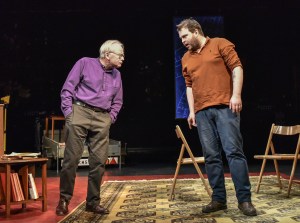
Father and sonThere are some great stories recounted; none as hilarious as David’s account of his appearance at the Sydney Piano Competition. There are also his tuition sessions with the scary Yvonne Lefébure in Paris, Barney’s reliving getting beaten up in Oxford, he and his friend Jeb playing Beatles songs at Stonehenge whilst an American guy scattered his wife’s ashes, and many more.

Barney tells a storyI can imagine that this is a difficult play to stage without it appearing too static. The old home movies and the constantly changing compass image work well to provide a little background movement. At one stage Barney rolls out a carpet on the stage, whilst he’s telling us about all the places in London he’s lived, even for the shortest time; a very rootless existence. The carpet emphasised his Wherever I Lay My Hat That’s my Home attitude to his rather nomadic lifestyle. A piano is onstage, for David to intersperse his recollections with snippets of music; and we see Grandad’s wonderful old music stand given pride of place next to it.

David at the pianoI’m not a fan of extraneous, unnecessary action on stage, and, during much of the first part of the play, we see Barney cooking – always something that an audience finds fascinating to watch. He and David sit down to eat it. But it’s never referred to in the text, we never know what he’s cooking, or why; and I did find that distracting. I also couldn’t understand why they painstakingly removed everything from sight at the end of the play; table, carpet, music stand, even the piano. It’s at odds with the concept that your memories are always with you – which is definitely one of the messages of the play. What was the point of hiding them away at the end? It felt like it was just to give the performers something to do; and whilst I understand the need for that, there also has to be a purpose to it. Just my little quibble.

Barney in full flowThe Wellspring only has a couple more nights in Northampton and then it will tour to various theatres and festivals, largely in locations that feature in their stories. Home is a moment that’s quickly lost, says Barney; afterwards you can only sail through the ghost of it. Charming, thought-provoking, and immensely nostalgic; private moments shared in that common hunt for home. At only 70 minutes with no interval, it fits neatly into a festival programme with admirable brevity of wit!

Production photos by Robert Day

4-starsFour they’re jolly good fellows!

Review – An Improbable Musical, Royal and Derngate, Northampton, 1st March 2022

Cunning use of language in that title, as it’s not only improbable because this is an improvisation show, so who knows what musical the cast will come up with every night, but also because the show is co-produced by a company called Improbable. Although their name suggests one of those lesser successful teams on an iffy series of The Apprentice, Improbable are, actually, an innovative theatre company that takes all manner of performance arts and mixes them together to make exciting and unpredictable new pieces. So now you know.

I must confess, gentle reader, that neither Mrs Chrisparkle nor I have been great fans of the improvisation genre in the past. I never really got the appeal of Whose Line is it Anyway (although everyone else did) and improvisation that I’ve seen on stage normally just raises a few minor chuckles at best. So I didn’t have massive hopes that I’d enjoy this show much – but, of course, I went in with an open mind and a glass of Shiraz to ease the pain.

The CastVerdict: it was a lot funnier than I expected! We were all advised at the beginning that they were two cast members down due to the dreaded Covid, but the structure of the show is such that you got no sense that anyone or any element was missing. One of the things I tend to dislike about improv is the audience constantly having to come up with ideas for the next sketch. But in this show, the audience were just asked three simple questions at the beginning, and the cast set about incorporating those answers during the show. That’s the audience input over and done with.

The process of identifying the audience’s responses within the material that emerges on stage is a source of great amusement. Sometimes you can see it looming obviously right at the beginning of a scene; sometimes it creeps up on you unexpectedly during a conversation or song. Hats off to everyone for seamlessly tailoring their material around the audience’s chosen subjects. It worked extremely well.

Adam CourtingWhat makes this show different from other improv shows is the musical aspect – yes, the clue’s in the title. This is not just an evening of sketches, but an attempt to put together a piece of musical theatre, with a distinct narrative that more or less makes sense from a distinct start to a distinct end. And they pretty much nailed it. Yes, one or two of the scenes came across as a mite random and overly-prolonged; I guess one of the problems with this genre is that you can’t always tell at the beginning of a scene how well it’s going to hang together or how funny it’s going to be. But for the most part it was funny and musically rewarding.

Our story concerned the trial separation of long-married Daisy and Simon and their adventures whilst apart. I really loved the scene where Daisy met up with her old college friends only to realise their relationship was more intimate than she had expected! This was interspersed with another story thread of a single mother finding she’s attracted to a man in a red hat. But who knows what story they’ll perform from show to show? The depth and intensity of the workshopping that they must have done to prepare for this run must have been immense, and it’s a credit to everyone that there wasn’t one moment where things broke down; such self-confidence deserves massive respect.

Josie LawrenceIt’s very much a team effort, but I must give special mention to the wonderful vocal characterisations of Ruth Bratt (not many people can make an entire theatre guffaw at the word cacao) and Niall Ashdown, whose Simon managed to be the biggest drip in the shower whilst still being irresistible to women. And of course Josie Lawrence, whose prestigious musical theatre background lit up her performances of a couple of searing big numbers. All this plus a group of musicians who instinctively knew which direction the show was going without comparing notes with the cast; as I said, that preparation must have been immense.

A unique entertainment, and performed with great style and wit. And no two shows are the same! Catch it at the Royal Theatre before it closes on Saturday night.

Production photos by Marc Brenner

4-starsFour they’re jolly good fellows!

Review – Four Quartets, Royal and Derngate, Northampton, 9th June 2021

T. S. Eliot’s Four Quartets comes to the Royal and Derngate hotfoot from its opening at the Theatre Royal Bath last week, with star of stage and screen Ralph Fiennes ambitiously presenting these four connected poems as a theatrical event; the perfect antidote to COVID, as it’s a naturally socially-distanced play in front of a socially-distanced audience, and lasting 75 minutes so that it needs no interval. It examines the concept of time, and who wouldn’t wish to go back to the relatively carefree days of 2019 when all we had to worry about was who would win the General Election.

Personally, I’ve always struggled with the Four Quartets. The first poem, Burnt Norton – which isn’t an obscure colour on an artist’s palette but a manor house in Gloucestershire – was published in 1936 as a stand-alone work. Later, Eliot decided to write three more poems, sharing the same five-part structure, to create an extended collection. Each poem starts with a series of statements and counterstatements; then moves into a more lyrical mode; then movement becomes the central theme; then a short lyric precedes a final resolution. Reading them, some of his lines bounce off the page with elegant clarity and inspirational thought. The still point of the turning world, for example,  is a phrase that has seamlessly floated into everyday language. Other parts come across as intractable and turgid, and you resent Eliot for being just too darn clever-clever for his boots, with his classical allusions, religious façade, and use of deliberately obfuscatory language. No wonder Toilets is T. S. Eliot spelled backwards.*

Back in the day, Eliot recorded a reading of the Four Quartets, and his recitative skill was utterly abysmal. Every word sounds the same, portentously, and dully given the same emphasis. It’s a very boring experience. The challenge for Mr Fiennes is to make the four poems come to life as a dramatic narrative, that either clarifies their meaning for us, or makes us look at them in a new way, or somehow gives us something more than just sitting down and getting our old Faber edition out.

And Oh My Giddy Aunt does he succeed! From the moment he gives extra, inquisitive weight to the word perhaps in the second line of Burnt Norton, you know this is going to be a real interpretation of Eliot’s words, not mere recitation. Imagine that Mr Fiennes is Mr Eliot, trying to grapple with a complicated concept that is emerging in his brain, speaking out his mind’s words to see if they make any kind of sense; if they do, he runs with it, excitedly giving them meaning and truth; if they don’t, he falters, his words fall away and we all feel as though we’ve reached the same dead end. If the Four Quartets were a game of rugby, and Mr Eliot the fly-half, he winkles an idea out of the scrum and either scores an instant try in a blaze of glory, or gets tackled by half a dozen burly opponents and gets squished. Either way, Mr Fiennes takes us every step of his journey, and it’s irresistible.

There’s no doubt that he is helped by Hildegard Bechtler’s domineering and eerie set – two big revolving drab slabs that evoke the dry concrete of Burnt Norton, Christopher Shutt’s sound designs that bring the crashing waves of the Dry Salvages thundering into the auditorium, but above all Tim Lutkin’s superb lighting that guides us through the sections of the poem, radiating light onto Mr Fiennes’ face when the surface glittered out of heart of light, beaming red to evoke pentecostal fire in the dark time of the year. Dressed in sombre colours and barefoot, Mr Fiennes takes Eliot’s words and eludicates and clarifies them, entertains us with them, surprises us with them, invests them with humanity rather than just dry and dusty theory. He demarcates each individual section of the poems with a change of tone or stance, so you always get a sense of the progress being made. He brings out the very slight moments of gentle humour; Eliot would be aghast at how populist his twittering world could be interpreted in the social media age.

From the audience’s perspective, the show can be as active or as passive as you wish it to be. The beautiful glossy programme starts with a quotation from Eliot’s own The Frontiers of Criticism: “As for the meaning of the poem as a whole, it is not exhausted by any explanation, for the meaning is what the poem means to different sensitive readers.” It’s entirely up to you. You can listen and watch, alert as a rabbit with your whiskers twitching, munching down whatever meaning you feel appropriate from the words and movements; or you can recline back, and let Mr Fiennes’ voice simply wash over you. Because I have always found the Four Quartets very hard to understand, I really wanted to come out of this show feeling better acquainted with it, with greater insights and awareness of what’s going on. And Mr Fiennes gives us that with huge generosity and patience. I can’t imagine how anyone could have converted Eliot’s words into a stage show better.

* It isn’t, but I made you think twice.

Production photographs by Matt Humphrey

Five Alive, let Theatre Thrive!


Review – This Evil Thing, Royal and Derngate, Northampton, 14th November 2017

I have no information about my ancestors’ involvement in World War One. All my grandparents died before I was born. My maternal grandfather was born in 1900 so would have been too young for conscription and didn’t enjoy good health anyway. Of my paternal grandfather I know hardly anything. About World War Two I know a lot more. My father served in the Royal Navy and was totally scarred by his experiences which I researched and wrote about here and here. All I know of my maternal grandfather’s WW2 is that he was stationed at Stirling Castle, saw ghosts and was never the same man again. My mother was in the ATS and told me how she once spent Christmas Day sending out death notices to grieving families. Was she sympathetic to the stance taken by conscientious objectors? Absolutely not. Cowards who made it worse for themselves was her uncompromising attitude; and I’m sure she was in the majority.

As Michael Mears points out, in his exceptionally fascinating one-man play This Evil Thing, in our generation, we have not been tested. If we were called up to go to a war where we’re simply cannon fodder, how would we react? Would we put Queen and Country first? Would we engage in acts of disobedience? It really makes you think hard. If the Falklands Conflict had escalated out of hand and turned into full-scale war between the UK and Argentina, I was the perfect age to be conscripted; and I do remember it being a very active worry.

Michael Mears confesses from the start (if confession is the right word) that he is a pacifist, and he too wonders how strong his resolve would be if faced with the personal challenge in the same way that the brave (there’s no question as to their bravery) conscientious objectors of the First World War. This beautifully constructed work tells us the stories of, amongst others, Bert Brocklesby, schoolteacher and Methodist lay preacher; James Brightmore, a solicitor’s clerk from Manchester; and Norman Gaudie, who played football for Sunderland reserves; they were also CO’s. There were many others like them. We learn how they are abused for their principles, how they were packed off to France, unknown to the British Government, of the methods used to try to persuade them to change their minds, the punishments they received, and what happened after the war to those that survived. We also meet luminaries like Bertrand Russell and Clifford Allen, Chairman of the No-Conscription Fellowship, vigorously campaigning for alternatives to conscription; with Russell dodging both literal and metaphorical bullets in his dealings with Prime Minister Asquith. After 80 quick minutes, you feel so much better informed about this much misunderstood and swept-under-the-carpet aspect of the First World War.

The production was, by all accounts, a wow at last year’s Edinburgh Fringe, and in many ways it’s the perfect fringe show. A blank stage, with just a few crates and packing cases utilised imaginatively, creates all sorts of settings. I love it when it’s up to the audience to interpret a minimalist set, because not even the world’s finest designers can flesh out the appearance of a stage quite like your own imagination can. It was a charming addition to the staging to have some very realistic props, like the elegant teacup and the incongruous sherry glass, which are brought into sharp focus when juxtaposed with the imaginariness of the set. The text is intelligent and creative, thought-provoking and, from time to time, surprisingly funny. The whole concept of a naked Bertrand Russell addressing Asquith with just a hanky covering his modesty was wonderfully quirky.

But what really makes the theatrical experience so vivid is Mr Mears’ brilliant portrayals of over forty characters, each with their own voice and accent, tone and style. He makes us believe those people are really there. We knew that he’s an excellent actor from his previous appearances in A Tale of Two Cities and The Herbal Bed (actually, he was the best thing about both productions), but in This Evil Thing he steps that acting skill up several notches. Mr Mears’ commitment to his own material – and the verbatim testimonies of many of the people involved – is simply a pleasure to behold.

And what of that rhetorical question? If the nations collide again like they did a hundred years ago, would you, a person who respects life and would never commit a crime against another human being, refuse to take arms against your fellow man? Moreover, would you see your friends and relatives die for the nation’s cause whilst you exempted yourself from that responsibility? Brocklesby tosses a coin to help make that decision. I think I’d look at a photo of my dad in his navy uniform and ask his advice. With any luck, it’ll never happen.

This terrific little theatrical nugget is currently on a tour of small theatres, churches and Quakers Meeting Houses in England and Wales. Highly recommended!