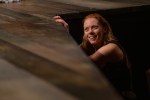
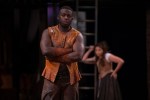
Tucked behind the main Royal Shakespeare Theatre building and constructed on the gardens by the river you can currently find the Holloway Garden Theatre, first opened in 2021 as a way of Getting Theatre Back in those miserable Covid times, and now freshly renewed for a summer season of As You Like It, the perfect outdoors play, in a brand new production directed by Brendan O’Hea.
 The perfect outdoors play? Yes, because apart from a few introductory scenes in Duke Frederick’s Court, it all takes place in the Forest of Arden, a mere hop skip and a jump from Stratford-upon-Avon; although I’m not sure lionesses ever roamed Sheep Street as they do in this particular Forest. But the play is awash with woodland glades, notes pinned on trees, shepherds and shepherdesses, and exiled gentry living the country life as best they can. Odd, perhaps, then, that Liam Bunster’s set doesn’t give one nod to greenery or flora, but instead is a rather sterile blue wooden affair that looks more like a packing crate than a grassy nook. In fact, there’s no “scenery” as such, nor indeed “furniture” anywhere to be seen – so at least that allows us the audience to use our imagination to create our own personal Ardens.
 Normally, with an RSC production, you can tell from the start that the director has a vision for the play – whether it be transplanting it to a different era or location, or discovering insights due to some creative gender-swapping, or promoting a theme from within the text to give it some extra depth. There’s no obvious vision for this production; and, at 85 minutes without a break it sometimes feels its main purpose is just to get to the end as quickly as possible. To be fair, there is some argument for doing that with an open-air production; if the weather changes at the Holloway Garden Theatre, there is no hiding place from wind and rain apart from whatever coats you brought or a classy RSC rain poncho.
 This is a distinctly shortened version; and whatever benefits that brings – concentrating on the main thrust of the plot and, dare I say it, Shakespeare’s Best Bits – inevitably it suffers in other ways. One of the cuts is to remove some of Touchstone’s pontifications; personally, I think that’s a shame, as I rather like his wordy comings and goings. Part of the charm of the play is the balance between the Courtiers and the Country dwellers; in this production, the Countryfolk distinctly play second fiddle and at times you feel the production rather ignores them. A good example of this is how, because of the doubling-up of roles, Touchstone and Audrey’s marriage is sidelined in the final nuptial scene; so there are three couples, not four, at the end. This creates an imbalance and doesn’t give equal weight to their relationship. Another side effect of rattling through the play is that some of the plot developments seem to happen extremely suddenly, making what is already a slightly unbelievable plot even more unbelievable at times.
 There are, however, some splendid aspects of this production. Nearly all the cast also play instruments throughout the show and this device fits seamlessly into the text. The play has a number of songs, which frequently today come across as archaic and somewhat out of place. However, Catherine Jayes’ music is totally beguiling and beautiful, and with the entrancing and evocative voice of Natasha Magigi as Amiens, this is the best music in a Shakespearean context I’ve heard for decades.
Also, for no apparent reason, apart from the shee r fun of it, many of the cast use strong local accents for their characters; so we have a Geordie Jaques, a Brummie Duke Senior, and an Irish Celia. Somehow, these accents add to the musicality of the production, and certainly give an extra dimension to the comedy of the play.
 The performances are universally excellent. Letty Thomas is everything you would expect from a Rosalind; and especially in her role of Ganymede leads Orlando a merry dance of humiliation in her encouragement of him to be more upfront with his wooing. Christina Tedders’ Celia is outstanding, making much more of the role than usual – full of fun and enthusiasm, giving Celia a real personality. Luke Brady is also superb as Orlando; having injured his ankle, Mr Brady played the part seated at the side of the stage – a true trouper indeed – and it’s a credit to his perfectly pitched performance that the production lost nothing as a result. This did, of course, lead to an unexpectedly humorous sequence where Orlando wrestles Charles; the sight of Peter Dukes playing the swaggering chap in a deftly choreographed sequence of one-sided wrestling holds will stay with all of us for a long time, I suggest. Mr Dukes is also excellent as the exiled Duke, serenely conveying his character’s ability to maintain courtly standards in an unforgiving environment.
 Chris Nayak gives two great performances as the usurping Duke and the wetly forlorn Silvius, and Trevor Fox is an authoritatively melancholy Jaques – strongly emphasising the character’s cynicism. Duncan Wisbey creates a light-footed and physically cheeky Touchstone the clown, and Susannah van den Berg gives great support as Le Beau and Audrey.
 This is a basic production – in the sense that it doesn’t highlight any special aspects or themes, or transport us to another time and place; this is firmly Shakespearean, set on a Wooden O. If the idea behind it is to provide a decent introduction to the Bard for children or Shakespeare-newbies, then I judge this a success. However, if you know the play well and you’re looking for some hidden depths, you might be disappointed. The production continues, with regular 2pm and 5pm performances, at the Holloway Garden Theatre until 1st September.
Production photos by Marc Brenner
 Three-sy Does It!