Review – The Southbury Child, Bridge Theatre, London, 6th July 2022

Here’s another of those plays that has spent a long time in coming to fruition, battling its way through the rigours of Covid and Lockdowns and all the other ghastly things that flesh is heir to over the last couple of years. But, as always, good things come to he who waits, and Stephen Beresford’s The Southbury Child is a fascinating, at times hilarious, at times tragic play, chock-full of trigger warnings and difficult subject matter.

The premise is very simple. Local vicar David Highland is to conduct the funeral of a child – young Tyler Southbury. Her mother’s simple wish to make the ceremony less funereal is to have the church full of balloons. Tyler loved balloons. She loved Disney. So Disney balloons would be best. David Highland is no high-and-mighty po-faced clergyman; he’s had his own share of escapades, including a drink problem and having an affair, so you might expect him to be more on the side of the experimental and flexible wing of the Church – if it’s going to make the family more able to face the awful process of a child’s funeral, what’s the harm in some balloons?

However, David has his principles – specifically where it comes to church traditions and practices – and balloons are a step too far for him. Cue a massive backlash against David and his family from the villagers. How could he be so heartless? The local bishop decides he needs to send in a new curate, Craig, as a kind of troubleshooter-cum-support mechanism but he can’t prevent things from getting truly out of hand. Will David suspend his principles just this once, for the sake of the village and the affected family? You’ll have to watch the play to find out.

Alcoholism, the death of a child, infidelity, car crashes, racial prejudice, revenge; Stephen Beresford pulls no punches where it comes to dealing with the trickier subjects. And he makes those subjects hit hard by employing a devilish sense of humour, which makes the two and a half hours of this play absolutely fly by. Mark Thompson’s domestic set has the presence of the local church looming threateningly over it as a backdrop; no matter where you go in this play you can’t escape the Church. And those principles… do they strengthen the Church, and the relationship between the church and the parishioners, or do they drive a wedge in between them, showing the Church to be anachronistic and out of touch? That’s a question for you to decide.

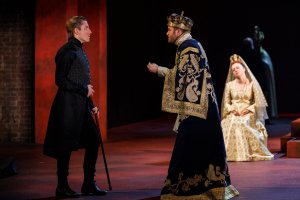
Nicholas Hytner has assembled a brilliant cast who really get to grips with their characters and give us moments of high drama as well as dishing out the comedy with enviable deftness. Alex Jennings is superb as David Highland; an amiable, good-humoured kindly man but one for whom the red mist descends when the tensions get high. Phoebe Nicholls is also excellent as his long-suffering but humourless wife Mary; together they paint a very credible picture of a couple who tolerate each other but could have wished for better. I really enjoyed the performance of Josh Finan as Tyler’s uncle Lee, negotiating the details of the funeral, getting strangely inspired by the vicar but then furious with his stance over the balloons; he too has his own deep regrets to overcome, and Mr Finan shows us expertly the anguish that a few misplaced lies and misjudgements can create.

Jack Greenlees is extremely good as the curate Craig, finding his way in a strange and strained environment, trying to balance his religious needs with his family life; Racheal Ofori sparkles (literally) as the party-girl, ex-actress daughter Naomi who gets a kick out of teasing anyone who’ll stand still, just to get a reaction; and Hermione Gulliford injects the character of the doctor’s wife Janet with just the right amount of snobbish dislikeablility. There’s also great support from Jo Herbert as the frustrated daughter Susannah, Holly Atkins as local police officer Joy and Sarah Twomey as the grieving mother Tina Southbury.

I hope I’m not giving the game away by revealing that the final scene of the play depicts the final preparations for Tyler’s funeral, tiny white coffin and all. Mrs Chrisparkle found this scene highly emotional. I must say that I didn’t. I thought it simply depicted an event that would have been best played out in our own minds; although it was delicately done I still feel that it lacked subtlety, and that as a result the play ends with a bit of a soggy bottom. Just my personal opinion – you may well not agree. This co-production with the Chichester Festival Theatre continues at the Bridge Theatre until 27th August.

4-starsFour They’re Jolly Good Fellows!

Review – The Rocky Horror Show, Royal and Derngate, Northampton, 4th July 2022

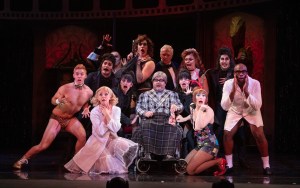
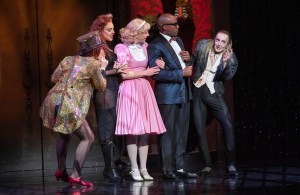
Dust off those fishnets and snap your corsets, it’s the return of those funsters from the planet Transexual in the Galaxy of Transylvania, hitting the stage again with a new production of The Rocky Horror Show, which has already been touring extensively throughout the UK and, after a pause at the end of this week, will start again later in the year. For one week only, the Royal and Derngate will be playing host to Brad and Janet’s salutary tale of what not to do when your get a flat tyre (sorry, tire) in the rain within sight of a creepy old castle. Next time, ring the AA. So much easier.

The castRichard O’Brien’s evergreen musical still has the power to delight, thrill and shock audiences. Shock? Surely everyone knows what to expect when they see this show? Apparently not, as I discovered when we took my in-laws Lord and Lady Prosecco last night only to realise they had never seen or heard anything about it. And Lady Prosecco was shocked, I tell you shocked. I remember being told that every day, someone somewhere hears Handel’s Water Music for the first time. Just because something has been around for ages, doesn’t mean to say that everyone knows it.

Dammit JanetThe last time I saw Rocky Horror was in 1999, with Jason Donovan as Frank N Furter and the late great Nicholas Parsons as the Narrator. I think things were a little more staid then than they are now, as I have no recollection of the cross-banter between audience and cast that studded last night’s show. And from what I can gather, we were a relatively reserved bunch. Heaven only knows what happens on a Saturday night.

Columbia, Magenta, Janet, Brad, RiffThis is a very simple show to critique because it’s simply excellent all the way through, with no exceptions. Staging – tick. Lighting – tick. Costumes – tick (fab). Band – tick (outstanding). Performances – tick (brilliant throughout). As for the show itself, I haven’t changed my opinion that I formed when I first saw it at the King’s Road theatre in Chelsea back in the 70s. Yes, I am that old. It’s an outstanding show – until about three-quarters of the way through when it simply loses its way. You completely believe the outrageous story and group of characters – it’s lifted from those old movies or comic books – you only have to suspend disbelief a tiny bit; until the science fiction part truly kicks in, and then we don’t believe in it anymore. It also suffers – and that is the right word I think – from having nearly all the best songs in the first half; Touch-a Touch-a Touch-a Touch Me being the obvious exception.Frank It does feel odd to have everyone on their feet doing the Time Warp barely twenty minutes into the show; then you all have to sit down again for the show to resume and there’s an obvious drop in energy. Of course, The Time Warp comes back at the end, but that’s encore, innit.

Nevertheless, it’s still a wonderful show and I can’t imagine a better production. Proving that his Strictly experience was no fluke, Ore Oduba is fantastic as Brad, with all that stuffy innocence that the role requires, and Haley Flaherty a perfect Janet, sweetly giving into sexual pleasure in her very sensible bra. Stephen Webb uses his sensational voice to great effect as Frank N Furter, and Philip Franks is superbly mischievous as the Narrator, bringing in cutting references to modern life, battering down any misplaced interventions from the audience, and having better NarratorPrince Andrew and Boris Johnson material than most stand-up comedians. Rocky regular Kristian Lavercombe gives us a Riff Raff full of physical comedy, and Lauren Ingram’s voice is perfect for Columbia’s vocal show-offs. But everyone in the cast fits their roles absolutely perfectly and turn in first-class performances all round.

A fabulous fun night at the theatre. Let your hair down, don’t chuck anything on stage, and do wear your best inappropriate lingerie.


Production photos by David Freeman

Five Alive Let Theatre Thrive!

Review – Richard III, RSC at the Royal Shakespeare Theatre, Stratford-upon-Avon, 1st July 2022

The Royal Shakespeare Company continues its trawl through the annals of the House of Plantagenet, specifically following on from the recent productions of Rebellion and Wars of the Roses, with this strikingly designed new production of Richard III, and a satisfying continuity of casting in many of the leading roles, including the welcome return of Arthur Hughes as King Richard, the first time a disabled actor has taken this part in the history of the Company.

Arthur HughesEdward IV reigns as King of England, but Richard, Duke of Gloucester has other ideas. First, eliminate his kindly brother George, Duke of Clarence. Then marry Lady Anne, who had been previously married to Henry VI’s son Edward of Westminster, who died at the Battle of Tewkesbury. Edward IV dies naturally, but Richard can’t tolerate his son, the twelve year old Edward V, being king. He enlists the Duke of Buckingham to engineer his path to the throne, but when Buckingham refuses to kill Edward, he gets professional assassin Tyrell to do the deed instead. The young prince is murdered in the tower along with his brother. But it’s still not enough; and when Henry Tudor, Earl of Richmond, arrives with an army to claim the throne, it results in the Battle of Bosworth Field and we all know what happened there. (You don’t? You’ll have to see this play then.)

Nicholas ArmfieldShakespeare didn’t hold back from presenting Richard as the architect of a lot of blood and violence, and Gregory Doran’s production rings the changes by portraying these deaths in a wide range of styles, from the literally gory to the subtly suggested. It is perhaps curious that Shakespeare does not let us see the actual death of King Richard in battle: “Alarums. Enter King Richard and Richmond; and exeunt fighting. Retreat and flourish. Re-enter Richmond, Stanley bearing the crown, with divers other Lords, and Forces.” This gives a director carte blanche to finish Richard III off in whatever manner they wish, and Mr Doran has chosen to make it rather elegant and ethereal. Matt Daw’s inventive lighting design is used extensively to convey death, with maybe a quick flash of red light to depict one dispatch, or the visceral descent of vivid red seeping down the one feature of the set, a cenotaph-style tower, to suggest others. Death’s never far away in this play.

Matthew Duckett and Arthur HughesI know this isn’t a football match, but this production really is a game of two halves. Even with some judicious cutting, this is a long play, and the first Act takes us all the way from Shakespeare’s beginning to Act Four Scene One. The second Act begins with Richard’s coronation, Act Four Scene Two. As a result, we have more or less two hours before the interval, but then little more than an hour afterwards. Although there are obviously some highlights – the wannabe king’s pretence that he doesn’t seek the crown and is much happier with his virtuous Bible study is a sheer delight –  the first Act has more than its fair share of longueurs. The second Act, however, is stuffed with theatrical magic and flies by. The exquisite grandeur of the Coronation. The knife-edge debate between Richard and Elizabeth regarding his plan to marry her daughter. The superb staging of the Ghosts that taunt Richard the night before Bosworth Field, and how they merge to become his ghostly horse for which he’d give his kingdom.

Minnie Gale as MargaretHowever, the overall vibe of the production is distinctly uneven. It veers from bloodthirsty tragedy to deep dark farce, and you can never quite pin down exactly what it is that Doran wants us to take away from it. On the one hand, for example, you have a very traditional presentation of the bereft Queen Margaret, Henry VI’s widow, with Minnie Gale giving a very accomplished portrayal of someone so destroyed by grief that they have lost all their senses. On the other hand, the two murderers almost descend to vaudeville with their interchanges and re-appear very tongue-in-cheek as the two godly clerics either side of Richard when’s he allegedly resisting being made king. Stephen Brimson Lewis’ set suggests the staging is purely of its actual era – the music, the costumes etc are all truly fifteenth century; but then you have a couple of anachronistic piece to camera moments from Richard and his rival Richmond just before the battle as if we were watching CNN.

Eloise Secker and Mical BalfourFortunately the production is blessed with some terrific performances, none more than Arthur Hughes as Richard. Because Mr Hughes genuinely has a physical disability, that frees him up from the arduousness of adopting a stoop or mimicking a hunchback, so visually it’s a much more convincing presentation than you’ve ever seen the character before. With ambition written through him like a stick of rock, he fair darts about the stage in his quest to Get Kingship Done, as the phrase might be today. He doesn’t care if we like him or not; he sees other people as either useful tools or mere obstructions and has no compunction about dismissively eliminating them – even his own wife. Mr Hughes is completely riveting throughout the play, his eyes calculating risks, his gestures mocking all those around him, his vocal delivery conveying that spoilt petulance of a man who can see no other outcome than his own preferment. It’s a wonderful performance.

Claire BenedictKirsty Bushell is also superb as Queen Elizabeth Woodville, controlling her own grief and behaviour with quiet suppression, as a perfect contrast to the brashness of the King, or the loud lamentation of Margaret. Claire Benedict has fantastic stage presence and natural authority as the Duchess of York, and Rosie Sheehy cuts exactly the right amount of fury and suffering as Lady Anne. Jamie Wilkes’ Buckingham is delightfully conspiratorial, punching the air with a very un-Shakespearean Yes! when Richard manipulates his way to the throne. Micah Balfour is excellent as the good-humoured, trusting Hastings, Nicholas Armfield is a suitably noble Earl of Richmond (he also has a terrific moment as the Bishop of Ely when King Richard commends his strawberries), and there’s great support from Matthew Duckett as Catesby and Simon Coates as Stanley.

Joeravar Sangha and Conor GleanIn addition, Ben Hall absolutely captures Clarence’s innocence and shock at being fatally lied to, and Conor Glean and Joeravar Sangha are simply brilliant as the Murderers. And huge appreciation for our Boy Treble, whose vocal purity cut through the villainy like a sword of light; for our performance on Friday night, we think he was Lysander Newton, but I am sure all four taking the role are terrific.

Jamie WilkesPart gruesome drama, part black comedy; at times slow and cumbersome, at others jam-packed with incident. A bit like life, really. But it’s the many highlights that you remember and that you appreciate, and this production is certainly a convincing and memorable end to the Plantagenets. It continues at the Royal Shakespeare Theatre all the way through till 6th August when it is joined with the new production of All’s Well That Ends Well, and then both continue until 8th October.


Production photos by Ellie Kurttz

4-starsFour They’re Jolly Good Fellows!

Review – Rock, Paper, Scissors, Crucible, Studio and Lyceum Theatres, Sheffield, 28th & 29th June 2022

It’s always fun when a playwright thinks outside the box for new ways of presenting a story. The challenge that writer Chris Bush and Artistic Director Robert Hastie set themselves was to create three pieces that would use the three locations of the Sheffield Theatres all at the same time, dovetailing into each other and making one complete whole in the process. There’s been some precedent for this, but nothing quite on this scale. Alan Ayckbourn tells the same story three times in the Norman Conquests, from different locations within the house and garden. Michael Frayn’s Noises Off gives us the first act of the generic sex farce Nothing On from three different perspectives; in rehearsal, backstage and in performance.In both these plays you can piece together a fuller account of what’s going on simply by a hilarious mixture of repetition and relocation. In Rosencrantz and Guildenstern are Dead Tom Stoppard shows what happens when characters who are not involved in the main story live out their own lives until the main play catches up with them. Here you get a sense of other lives carrying on outside of, and irrelevant to, the main plot; thus the backstage becomes the forestage (and then back again.)

Bush’s immensely inventive and hugely enjoyable triple threat of Rock, Paper and Scissors, at all three of the Sheffield Theatres simultaneously, provides another of these riveting feasts where different perspectives cast different lights on the same story all at the same time. To say it’s a technical achievement would be the epitome of underestimation; and if the unexpected happens – and this is live theatre, so it does – causing a problem or a delay in one theatre, it has a knock-on effect in the other venues, as happened when we saw them, more of which later…!

The basis for the plot is simple. Sheffield scissor makers Spenser and Son has been in business for decades. Eddie, the most recent owner, has died, and his two remaining relatives – Susie, his sister and Faye, his adopted daughter – both have plans to make something of the extraordinary building that remains.  Rock chick Susie envisages a funky nightclub, whereas Faye and her partner Mel feel a residential conversion would work. But Susie and Faye haven’t spoken for years; nor did either of them realise that Omar, the manager, still had a team of four apprentices making scissors in the workshop. Too soon, then, to adapt the building for other purposes? No matter what, there are three sets of plans and practices that completely conflict with the others!

The blurb maintains that each of the three plays can stand alone; or audiences could choose to see any combination of two plays or indeed all three. In my opinion, if you were only to see one, it should be Paper as that (I reckon at least) is the only truly standalone play; if you were only to see two you should combine it with Scissors; and if you see all three, see them in the traditional order of Rock, Paper, and Scissors, as we did. Although each play is written by Chris Bush, each has a different director, a different designer, a different lighting director, and so on. So each has a very different vibe and character.

All three plays take the same central themes, although with varying degrees of emphasis. There’s the struggle between hanging on to the past versus making way for the future. Traditional values and skills set against modern cost-cutting methods. Opportunities through hard work are compared with opportunities through privilege. Bar work is offered instead of skilled apprenticeships. Hard truths and difficult problems are balanced against credible lies and living within your comfort zone. Perhaps most of all, the take-home element of these plays is what happens when you make assumptions about people, their motivations, characteristics and private lives; people have a remarkable ability to keep secrets, and then reveal them when you least expect.

Rock is dominated by the character of Susie Spencer, the opinionated, ambitious sister who wants to create a nightclub out of the old factory space, beautifully realised on the Crucible stage by Ben Stones’ wonderful design. To kickstart the project, she plans to hold a photoshoot with a top photographer and a real band to promote the new venue. Susie tends to ride roughshod and be unnecessarily critical of others, which makes her an unsympathetic character, but Denise Black’s excellent performance invests her with all the brass neck and charisma to fill out a truly credible portrayal. She gets as good as she gives from a brilliant performance by Lucie Shorthouse, who was fantastic as Pritti in Everybody’s Talking About Jamie four years ago, as Omar’s daughter Zara,plus there’s excellent support from Andrew Macbean as her long-suffering wannabe beau Leo, and a superb comic turn from Leo Wan’s Xander (who is even funnier in Scissors) as the nervous corporate design consultant. But for me, this particular play suffers from its structure and script. It expends a lot of time and energy in a comedy of mistaken identity which is amusing at first but quickly palls as you realise that a simple conversation establishing who everyone is would put an end to the confusion. It’s too obvious a comic construct and I found these elements both unfunny and tedious. There are also passages of enjoyable but irrelevant singing, and it feels like there’s a lot of padding here.

Things get so much better in Paper, which is written with much smarter tightness and purpose. The play looks closer into the relationship between Faye and Mel, their plans and their attempts to track down missing and vital paperwork to prove ownership and Eddie’s will. Samantha Power’s Faye faces the uphill task to find the will from amongst the reams of paper stuffed into his ramshackle old office. She is uncertain as to the right way to progress, unlike the much more practical and determined Mel, who divides the office into quadrants so that they can search methodically, and who takes charge of Xander’s professional visit when Faye starts to wobble. Primarily the play is a beautiful examination of the relationship between the two; the problems that lurk beneath the surface – issues of trust, respect and faithfulness, that lead on to serious mental health worries. Natalie Casey’s amazing performance as Mel had me choking back the tears as she sits on the floor desperately trying to her explain her feelings.

This emotional space is also invaded by the comically horrendous Coco and Molly – Chanel Waddock and Daisy May on excellent form – as the squabbling, pretentious, self-serving band Co-codamol. It was during one of their sparky arguments that the stage manager had to come on stage and inform everyone that due to a problem in one of the other theatres, they would have to pause the performance; Ms Waddock and Ms May looked as stunned as the rest of us felt as they were ushered off the stage. We later discovered there had been a little fire on the stage of the Studio during Scissors – much to everyone’s gasp of horror – and they were just waiting for that to “settle down”. It was a tough moment for Coco and Molly but they resumed their argument perfectly when it all re-started. Presumably other actors in the other theatres faced the same problem!

Partly due to its modest setting in the round in the Studio, Scissors feels like a much more intimate play. Here we observe the apprentices actually doing the real work, for less than minimum wage; their relationship, their arguments, their commitment (or lack thereof) and their fears for the future. They reveal so much about themselves, and the importance of their jobs to their lives and their prospects. The whole factory is their domain, so when voices are heard in other parts of the building, they immediately assume industrial espionage or burglary, they distrust everyone who isn’t part of their group, and act as though everyone else is out to get them. That’s all except Trent perhaps, who is calmness and kindness itself when dealing with others. But they all have their secrets, which will astonish, entertain, and move you to tears. Jabez Sykes is terrific as the unpredictable and defensive Mason, and Joe Usher turns in a superb professional debut as the eloquent Trent. Maia Tamrakar is a powerhouse of energy as Liv and Dumile Sibanda shows fantastic maturity way beyond her years as the earnest Ava. All four create an incredible ensemble in this play and should have wonderful careers ahead of them. It’s up to Guy Rhys’ wounded, heavy-hearted Omar to break the news of their future to them – and it’s a complex, sad but truly beautiful ending. You may take away a different interpretation of the conclusion of the plays if you only see Scissors; you’ll have a very solid understanding of the outcome if you only see Paper. I’ll say no more!

Obviously, the very nature of this production must call for a certain degree of compromise and technical jiggery-pokery in the writing and construction. Just as the Porter scene in Shakespeare’s Macbeth allows for Macbeth and Lady M to wash off Duncan’s blood and change into their nightgowns before returning to the stage to deny all wrongdoing, Chris Bush has had to include tricks and passages to build in time to enable characters to leave one theatre and enter another. This may have some detrimental effect on the artistic integrity of the plays as a whole. I’m also unsure as to the necessity of having each character appear in each play; Mason’s appearance in Paper, for example, is totally irrelevant. I realise I am being super-critical for raising this, especially as it is the very challenge of staging three plays at the same time that is the most fascinating aspect of the entire production – more so than the actual subject matter of the plays. But the performances, the vision and the technical ability to stage this trio trump all criticisms. Really glad I caught this production – they only play until 2nd July and you won’t want to miss them.

Five Alive, let Theatre Thrive!

Review – The Dance of Death, Royal and Derngate, Northampton, 23rd June 2022

The Dance of Death is known as one of those famously morose and miserable fin de siècle plays from the dour pen of August Strindberg, the Swedish playwright who’s often lumped together with Henrik Ibsen as being the pin-up boys of nineteenth century Scandinavian drama. I’ve seen it performed just once before, back in 2003 in a portent-filled production starring Ian McKellen and Frances de la Tour, who both drifted lugubriously around the stage of London’s Lyric Theatre in silent resentment of each other with amazing prop-handling but was as boring as hell.

In case you don’t know, Captain Edgar has been married to his ex-actress wife Alice for almost thirty unhappy years, living on a forlorn fortress island, surrounded by people they despise, and who ostracise them back in return. She abuses the servants, he denies his obvious ill-health, their children are grown-up and barely in contact; in short, they eke out an existence that can hardly be called life. Occasionally they think back to glamorous days in Copenhagen just as Chekhov’s Three Sisters reminisce about Moscow – both plays written in the same year, 1900, which is a curious coincidence.

Into this drab merry-go-round comes Alice’s cousin – normally Kurt, but in Rebecca Lenkiewicz’ adaptation now Katrin – who has moved to the island to become the Matron of Quarantine. Sounds familiar? 122 years later and we’re still never too far from an intimidating and lethal new virus. Katrin doesn’t see her children anymore; there are differences of opinion as to why this is. There’s also a sexual domination frisson that occurs between Alice and Katrin which may – or may not – have contributed to both of their unhappinesses; you decide. At the end, Katrin washes her hands of both of them, leaving Edgar and Alice exactly where they were at the beginning of the play.

This Made in Northampton co-production with the Arcola Theatre, Cambridge Arts Theatre, Oxford Playhouse and the Theatre Royal Bath, finally made its way to Northampton for just three days’ performances having received a variety of reviews from four stars to one star. The Guardian’s one-star review very nearly made me avoid this production, but the thought of Lindsay Duncan and Hilton McRae cantankerising the devil out of each other was too enticing to miss. And I’m very glad I didn’t.

Why is this play considered so significant? Setting aside the modern corollary of Covid with the plague that beset the community at the time, you can see the roots of so many classic 20th century dramas emerging from the relationship between Edgar and Alice. I’m not sure we would have seen Waiting for Godot without this play – the Captain and his wife as a pair of co-dependent lost souls who end the play exactly as they started whilst life has progressed around them. Or Edward Albee’s Who’s Afraid of Virginia Woolf, with Edgar and Alice as George and Martha, deriving all their pleasure from random games of Get the Guests, but this time with Katrin and the servants. As in both of these plays, events that are presented as factual, such as Edgar’s announcement of divorce, Alice and Katrin’s sexual attraction, or even their telephone being bugged, are almost certainly not what they seem.

Technically, this is a very decent production. Grace Smart’s suitably lifeless set contains the trappings of a comfortable life, and I loved David Howe’s lighting design that creates a deliberately long shadow capturing the shape of a candelabra on the ceiling. The very quiet sounds of a distant party (to which they’re not invited) emphasise how remote their existence is, although the presence of the telegraph machine shows they can be in communication with the outside world. The women’s sombre clothes reflect their unfulfilled lives, with the only contrast being the red flashes on the Captain’s uniform that indicate that he does have some sort of presence outside these four walls. The timeless issues of the play – unhappy marriage, estrangement from children, and – if I can put it in the modern vernacular – serious FOMO, lend themselves well to a sparky new adaptation that revels in some very un-nineteenth century language.

Mehmet Ergen’s direction allows the dark comedy of the piece to bubble under the surface constantly; it never breaks through into full-scale hilarity but is always there providing an absurd sub-commentary on their appalling lives together. Suggestions of domestic violence between the two are helpfully minimised, which allows us to concentrate more on the text. Lindsay Duncan’s Alice wears her unhappiness as though it were a favourite dress, both showing it off with pride, and protecting herself like a suit of armour. She has a beautiful downbeat style with which she pings off Alice’s throwaway insults with subtle ease, and it’s a very convincing performance. Hilton McRae provides the Captain with a good deal of bluster and misplaced self-confidence, with occasional rays of warmth shining through the gloom of despair. We don’t feel sorry for him, and there’s no reason why we should, as he effortlessly conveys the sneaky manipulations behind his actions. Emily Bruni plays Katrin with straightforward, dispassionate clarity, which lurches unexpectedly into a thoroughly creepy emotional mess as she gets more and more involved.

If ever there was a Marmite production, this is it; however, Mrs Chrisparkle and I sat captivated through the whole 80 minutes (no interval). It’s almost obscene to say we enjoyed watching these two people tear each other (and a third party) apart; but it is strangely very enjoyable! The production now goes on to the final leg of its UK tour at London’s Arcola Theatre from 28 June – 23 July.

4-starsFour they’re jolly good fellows!

Review – Murder on the Orient Express, Festival Theatre, Chichester, 4th June 2022

I was in two minds about seeing the new play adaptation of Agatha Christie’s Murder on the Orient Express. On the one hand, I’ve read the book several times, seen the movie (Albert Finney, not Kenneth Branagh), and remember clearly both the crime and the (admittedly exciting) denouement and solution. So this wasn’t going to give me any of those suspenseful thrills that come from seeing a brand new murder mystery. On the other hand, I was sure that Chichester would put on a brilliant production, that Henry Goodman would be a superb Poirot, and we were going to be in town anyway to see The Unfriend so it seemed churlish not to!

You all know the story, I’m sure. Poirot needs to return home from Istanbul and his friend M. Bouc, who manages the Wagons-Lit Orient Express insists he takes a first class compartment as his guest. What a very good friend M. Bouc is! The first class compartment is unusually busy though; and his travelling companions include the Wagons Lit conductor Michel, plus a Hungarian countess, a Russian princess, an English governess and her military beau, a Swedish missionary, an extravagant American woman and the businessman Samuel Ratchett and his secretary. Ratchett – a loudmouth bully with more money than taste – wants to hire Poirot’s services and is willing to pay big bucks. But Poirot is not interested in this brute and will not take the job.

The train encounters a snowdrift and pauses near Belgrade with no expectation of moving for hours, perhaps days. And at (maybe, maybe not) 1.15am the next morning, Ratchett is murdered by multiple stab wounds. Bouc beseeches Poirot to solve the case before the Yugoslavian police catch up with them – the reputation of the train company is at stake. But Poirot’s first interest would always be justice. When he identifies the guilty party – not if, but when, this is Poirot we’re talking about – he will insist they are handed over to the police, non? But sometimes justice isn’t quite as easy to define as Poirot makes out…

Robert Jones’ design for the show is simply terrific. From the opulence of the Istanbul hotel, to the train station, and the individual compartments and dining tables, the whole thing looks stunning. There’s a wonderful optical illusion of the train moving through tunnels that works incredibly well. The costumes are superb, with some evening dresses to die for, and Christopher Shutt’s sound design is full of evocative effects and sometimes blood-curdling shocks. Whether intentional or not I don’t know, but Adrian Sutton’s music frequently put me in mind of Richard Rodney Bennett’s soundtrack to the 1974 film.

As a Christie fan, and knowing the book intimately, I was very impressed by Ken Ludwig’s adaptation. He has taken out some of the more minor on-board characters/suspects, given the role of the doctor to the Countess Andrenyi so that she is both assistant and suspect, and enhanced the moral question that Poirot must face at the end of his investigations. He has also removed some of the clues, such as the scarlet kimono, and Mrs Hubbard’s sponge bag, and added a terrific surprise just before the interval curtain which is completely different from Christie’s original but works extremely well – I’ll say no more.

The big challenge of the play is to make the denouement exciting even though most of the audience will already know whodunit. This it achieves perfectly; the denouement takes up at least the last half hour of the show if not more, and as Poirot goes through his suspects and his reasonings, you can hear a pin drop in the auditorium. The circular stage of the Festival Theatre revolves very slowly, with each of the suspects sitting on chairs, their backs to the audience, spaced out equally, so that you can witness each of them squirming in turn facing interrogation. It also irons out any blocking issues!

At the heart of the story, and the production, stands the dapper and slightly diminutive figure of Henry Goodman as Poirot. None of the caricature or pantomime dandy that some characterisations have invested in him, this Poirot is gently arrogant, takes pride in his appearance, has a swishy moustache and all the other attributes that you associate with him – but they’re all extremely believable. He Frenchifies up his accent quite a bit – so that you get 60 seconds in a minoote, or a suspect leaves a fangerprint on a clue. But he’s riveting throughout; and you can completely believe that those little grey cells are working dix-neuf á la douzaine within that intricate brain of his.

Patrick Robinson gives excellent support as the hearty and positive Monsieur Bouc, doing his best to look on the bright side and desperately hoping that Poirot can get him out of trouble. One of my favourite actors, Marc Antolin, gives a superb performance as Michel the conductor, delicately extricating himself from Mrs Hubbard’s clutches and handling the princess with the kiddest of gloves. Sara Stewart is brilliant as the aforementioned ostentatious Mrs Hubbard, appallingly flirtatious and ruthless, sparring magnificently with Joanna McCallum’s haughty and dismissive Princess Dragomiroff. Philip Cairns and Taz Munyaneza weave great intrigue together as Arbuthnot and Mary Debenham, and Timothy Watson is terrific as the mean, snarling Ratchett. But the whole cast work together as an ensemble extremely well, and keep the suspense and entertainment going right up to the final minute.

The show has now finished its run at the Chichester Festival Theatre but will be playing at the Theatre Royal Bath from 9th to 25th June. If you’re a Christie fan, you’ll love it – and if, somehow, you don’t yet know whodunit, attendance is compulsory!! Enormously entertaining and totally gripping.


Five Alive let Theatre Thrive!

Review – School of Rock, Royal and Derngate, Northampton, 6th June 2022

Confession time: I’ve never seen the film School of Rock and didn’t see the stage show during its London run. Before seeing this touring production I hadn’t a clue what it was about – I knew there were kids playing rock but that was it. So I came to this show with no preconceptions or expectations. You, gentle reader, are much more in tune with modern cinema culture than me, so you already knew that it was about lazy no-hoper and rock music aficionado Dewey Finn, who takes a supply teacher job in a posh prep school, pretending to be his ex-band member friend Ned Schneebly (who genuinely is a supply teacher), because the money’s good and he’s behind with the rent. Knee slideDewey, of course, hasn’t a clue about teaching, and knows nothing about kids, many of whom seem to be quite a lot smarter than him. All he can do is teach them appreciation of rock music; and when it turns out that they are a very musically gifted class, he prepares them to enter a Battle of the Bands contest. Obviously, this isn’t going to go down very well with snooty Miss Mullins, the headmistress; nor the parents who fork out an arm and a leg to get the kids through the exclusive exams. But music has a way of saving the day – and if you don’t know what happens, you’ll have to see the show to find out.

Dewey and the kidsThere’s a lot to admire and enjoy in this production; there are also a few things that I didn’t care for at all, but then I am an (occasionally) grumpy old git where it comes to the two things that set this show apart from most others: rock, and kids. I was surprised to see that the show really appeals to the family market – at last night’s performance there was probably even more children present than you would expect at a pantomime. Some were laughing (a lot) all the way through; others, including those nearer to us, were slumped in their seats and pretty unresponsive. I guess it takes all sorts.

the groupThere’s no doubting the full-blooded commitment to the show from the entire cast and creative team. Visually, it looks excellent. All the school scenes absolutely capture that rather stiff and starchy pristine bookishness of a prep school; the rock concert scenes featuring Dewey’s ex-colleagues in the band No Vacancy remind you of those heavy metal concerts your mother said you should never go to unless you want to ruin your hearing. And talking of the music – yes, it’s very rocky and it’s very loud. I’m no expert on this musical genre, but it sounded very proficient and genuine; I don’t know if rockstars today still wear that outrageous make up and costumery, but this lot did, and it looked impressive. Andrew Lloyd Webber’s compositions for the show (I suppose you could call them compositions) are unmemorable but authentic.

Miss MullinsThe downside of the loud music – as is frequently the case, sadly – is that a lot of the lyrics of the songs were simply inaudible. And that is a shame, because I got the feeling they were rather witty for the most part – but I reckon I only understood a third (at best) of the words they were singing. I couldn’t tell if it was an issue with over-amplification of the band, or poor enunciation of the singers; possibly a blend of the two. The clearest (and fantastic) singing comes from Tia Isaac’s Tomika, whose unaccompanied Amazing Grace is sheer joy. I also really enjoyed Rebecca Lock (as Miss Mullins)’s performance of Where Did the Rock Go, probably the outstanding song of the show.

Dewey the musical heroAs Dewey Finn, Jake Sharp throws himself into the role all guns blazing, creating a very larger than life character; a part crammed with physical comedy sometimes verging on the grotesque, but he carries it off with total conviction and the kids obviously loved him. Personally, I found the character of Dewey really difficult to get on with; in real life he’d be a laddish plonker who would really get on your nerves. But as an eccentric music teacher, I guess he’d be just about bearable! Rebecca Lock is also very good as Miss Mullins –another character that presents as either strident and humourless, or completely lets go with the help of just one drink and a Stevie Nicks karaoke. For me, not a believable character, but in the context of the show it doesn’t matter; and Ms Lock is a great singer, no question. Matthew Rowland and Nadia Violet Johnson both go over the top with the caricatures of Ned and Patty, milking the excesses of both characters to the extreme – but this is definitely what the script calls for, so – job done. Amongst the other adult cast, there’s good support from Ryan Bearpark as Zack’s demanding and unforgiving father and Richard Morse as Billy’s football-loving father.

School of Rock groupBut what the show is really all about is the kids. Twelve super-talented and eminently watchable children, who grab their characters by the throat and go all-out to entertain and impress. For me, Daisy Hanna as Katie stands out with her terrific bass playing and stage presence, and I love Harry Churchill’s attacking Zack, owning the stage with his charisma and the pure joy of playing. Local lad Angus McDougall is brilliant as the unflashy Lawrence who comes to life when he’s behind the keyboard; his unassuming personality mixed with his Elton John jacket and boots is a hilarious combination. Evie Marner’s Summer is delightfully bossy and priggish, and comes into her own when given the job as band supremo. But they are all excellent, and I am sure a lot of entertainment careers will be born out of the show.

Staff RoomI said near the beginning that there were some things I didn’t care for. Primarily I can sum them up in one word – the book. Julian Fellowes is a writer of enormous experience and success, but I found much of the text really scraped the barrel for humour and characterisation. Some of the characters are just too cartoony to be believed. Most of the female characters in the show are bossy and difficult, and the suggestion that the trouble with the head teacher is that she needs a good…. defrosting is disappointingly sexist. And then, when that largely turns out to be true, it sends an even worse anti-feminist message. Getting the kids to pretend that they’re all dying of some terminal disease to get on to the Battle of the Bands is tasteless in the extreme. Adults and kidsThe joke about Mama Cass is body-shaming, the lines about Billy’s glamrock outfit are borderline homophobic, and there’s an extremely dubious joke about paedophilia. It’s full of lazy stereotypes, very formulaic, and dependant on grossness for humour – as when Dewey rubs himself all over (intimately) with a towel and then chucks it over a child’s head, or when he’s considering eating his belly-button fluff. I’m afraid I didn’t get on with the book AT ALL and, cardinal sin of the theatre, there were plenty of scenes when I was bored. The show is at its best when the kids are rocking the joint, and when you come away from the show, that’s what you (thankfully) remember. I fear much of the rest of it is padding. But I know I’m not the target demographic for the show, and at the end everyone was on their feet, clapping and swaying away. Admittedly, that’s in part because they were told to by Mr Sharp! The UK tour continues until mid-August.

Production photos by Paul Coltas

4-stars

Four they’re jolly good fellows!

Review – The Unfriend, Minerva Theatre, Chichester, 4th June 2022

We’ve all been there. You get chatting to someone on holiday, and you get on fine. Maybe go for a drink with them or a meal. You think, what a nice person. Then someone says, we must keep in touch once we get home. And then sometimes you do, and sometimes you don’t. More often you don’t. This salutary tale will make sure you never consider this reckless activity in the future!

Whilst on a cruise holiday, Elsa from Denver, Colorado, gets talking to Peter and Debbie from suburban England. She clings to them like a limpet, and they’re too polite to discourage her. Elsa demands that they visit her in Denver when they’re next there (which would be never, obvs.) However, she corners Debbie to surrender her email address, which she triumphantly and ominously waves in the air after Debbie’s left. Would Elsa come all the way to spend a week or more in England? You betcha.

What could have been a gently amusing comedy of manners highlighting the behavioural differences between the brash, dominating American and the overpolite reserve of the English, has been transformed into a riotous comedy by a plot masterstroke. On a whim, Debbie checks Google, only to discover that Elsa is a mass-murderer. What on earth can they do now?! Peter and Debbie do everything they can to deter her, but Elsa’s more than up to the task. Are they and their family at risk of being wiped out? If not, who else will Elsa eliminate? You’ll have to see the play to find out.

Steven Moffat’s The Unfriend is two hours of unalloyed comedy bliss. There’s the successful, busy couple who self-medicate on wine to get through the day; two obnoxious, petulant teenagers who hate their parents almost as much as they hate each other; a dull-as-ditchwater neighbour who’s so boring that whenever he speaks you stop listening; and a well-meaning local bobby who treats their house as though it’s his own. Into this mix comes the bold as brass, unpredictable Elsa Jean Krakowski who – on top of everything else – has amazing insight and the ability to convince anyone of anything. A potentially lethal insight into what people are really like, in fact.

It is without doubt one of the funniest plays of the 21st century and sits perfectly among the best of Ayckbourn, Frayn or Nichols as a work that not only gives you a belly-laugh a minute, but also reveals the ridiculousness of English middle-class angst and the hoops that people will jump through in order not to offend, even to their own detriment. It also shows the unexpectedly positive power that a visitor can have by shaking up the comfortable rut into which a family can otherwise stagnate.

The structure and plotting is of the first order, and the dialogue is crisp and hilarious. There are so many ecstatically brilliant moments that turn on the inspired use of just one word. Go to see this show and you’ll be laughing at the use of “vaccinated” and “particles” for days. Mark Gatiss’ direction is razor-sharp; every one of the characters’ gestures and movements has meaning and is never wasted. Next time you want someone to sit down because you’re going to give them a good talking-to, you’ll find that you’re giving them a grand, slow arm gesture in the direction of the chair. It’s a gesture that takes on a life of its own in this show.

All the performances are staggeringly good. Frances Barber is wonderful as Elsa, always maintaining a slight air of mystery, her eyes and voice occasionally revealing the dangerous threat that lurks just a little beneath the surface. Delightfully dominating but never a grotesque caricature, it’s a fantastic comic performance. Amanda Abbington is great as Debbie, mouthing anxious messages to her husband, collapsing on the sofa without spilling a drop of wine, trying to keep order in the house when the odds are so against her.

There’s a fantastic double act from Gabriel Howell as son Alex and Maddie Holliday as daughter Rosie, whining and grumping their way around the stage as the Kids from Hell, until Elsa’s influence turns them into hilariously unbelievable sweetness and light. Michael Simkins is brilliant as the tedious nameless neighbour who is too easy to ignore, moaning about a property boundary issue. And there’s a fantastically funny performance by Marcus Onilude as PC Junkin who accidentally becomes the target of one of the funniest misunderstandings I’ve ever seen in a comedy.

Which brings me to Reece Shearsmith as Peter, in an outstanding comedy performance with remarkable timing and gloriously understated physical comedy. The sequence where he’s outside the toilet door makes your toes curl with embarrassment and your stomach cringe with agony but it’s the funniest scene I’ve seen in years. I wish I could give you more details but I don’t want to spoil any of the surprises!

The run at the Minerva Theatre is virtually sold out now, but there’s no way this production isn’t going straight into the West End; and with its many nuances, so many brilliant lines, deft deliveries and glorious gestures, it demands to be seen again. Up there with Noises Off and One Man Two Guvnors for longevity potential. As you might be able to guess – we loved it!

Five Alive let Theatre Thrive!

Review – Oklahoma!, Young Vic, London, 28th May 2022

When I saw that the Young Vic were showing the new, shaken-up Broadway version of Oklahoma! I knew it was something I had to see. Oklahoma! is one of my favourite musicals but you can never overlook the dark, violent prejudice and savagery that lurks just a little under the surface. The Chichester production from 2019 brought out all the joy of the show whilst exposing a lot of its iffy underbelly. Daniel Fish’s new production goes deeper, and a lot of what it reveals is truly horrific. But it’s also jam-packed with the humour that has always been a mainstay of this musical.

You know the show is going to be disturbing even before it starts. The transformed Young Vic auditorium is ablaze with bright light; the band sit at one end of the stage area, whilst trestle tables laden with cans of beer (that get consumed) and crockpots of chilli (that don’t) line along either side of the acting area and – for the first act – along the middle. The actors sit with their backs to us until it’s their time to join in the show. Unusually for a musical the programme doesn’t list the musical numbers, so unless you know the show intimately you don’t know what’s coming next or whereabouts in the sequence of scenes you are. You might assume from this that the music takes second place in the show’s priorities – but that’s not the case. The music is vital to the show, and frequently adds to the sense of irony and discord that permeates Daniel Fish’s vision for the production. Tom Brady’s band takes Rodgers and Hammerstein’s sumptuous score and give it a modern twist; less Broadway 1943, more country guitar-heavy, but still with stunning singing from the cast who harmonise together exquisitely, with passion and power.

The iconic opening, where Curly sings Oh What a Beautiful Morning off stage whilst Aunt Eller churns butter, now has Curly onstage accompanying himself on his own guitar whilst Aunt Eller silently looks away with the rest of the cast. In fact, gone are the Curly and Laurey of yore, the adorable young couple who win your heart, and whom you want to see living happy ever after at the end. Arthur Darvill’s Curly is vain and arrogant; his swagger barely conceals his scorn for his surroundings, and you get the sense he’s more isolated, not really part of the community; you wouldn’t believe anyone who says he’s their friend. However, this characterisation is juxtaposed with his surprisingly delicate and eloquent singing voice. Anoushka Lucas’ Laurey, on the other hand, is temperamental and sullen; she bats Curly’s approaches away as though he were just another “typical man” for whom she has neither time nor interest – until things start to get physical, at any rate. If and when this Curly and Laurey get together you feel that the sparks will fly in their relationship and not always in a good way.

Where the show is much more traditional is in the representation of the four comedy characters, Ado Annie, Will Parker, Ali Hakim and Gertie Cummings, each one played sublimely. Rebekah Hinds gets Gertie’s irritating cackle perfectly, and suggests a superb smugness whenever she gets her way over anything (or anyone). Stavros Demetraki is hilarious as Hakim, desperately trying to put more money Will’s way so that he can be freed from his commitment to Ado Annie. James Davis, who played Will in this production on Broadway, brilliantly portrays just how utterly stupid the character is, constantly infuriating himself with his own mistakes.

Although she has a lot of stage credits to her name, I’ve never seen Marisha Wallace before, but I was blown away by just how fantastic she is as Ado Annie. Filling the theatre with the most powerful and beautiful of voices, she has immense stage presence and injects everything the character does with just the right amount of comedy, as well as perfect interplay with the audience. Her performance of I Cain’t Say No is the true highlight moment of the show. All the way through, I couldn’t wait for her next appearance because she lights up the stage with such genuine pleasure. Simply marvellous!

I hardly recognised Greg Hicks as Andrew Carnes; if you’ve seen this role played as a lovable old rogue before, think again. Mr Hicks makes him a truly hard man. No sense of humour or kindness; a man who thinks with his gun first then might reflect afterwards (or might not). He’ll aim his barrels at anyone who dallies with his daughter; I thought he was going to blast a few heads off early on and finish the show before the interval. Liza Sadovy’s Aunt Eller is another characterisation that feels more remote and detached from the community, until, at least, she’s in charge of the auction of lunch baskets. There’s excellent support from Raphael Bushay as Mike and Ashley Samuels as Cord Elam; their hesitations at supporting the decision of Judge Andrew towards the end spoke volumes. But the whole cast does a great ensemble job, with terrific singing and dancing – a lot of full-bodied hard-floor thumping to get a resoundingly noisy beat effect.

One of many fascinating directorial decisions in the show – some of which work, and some don’t – is the characterisation of Jud Fry. It’s in the characters’ dealings with Jud that this show gets particularly uncomfortable. Jud is usually portrayed as a loner. Papering his bedroom walls with soft porn to make him seem like a worthless wretch, picking on his learning difficulties, or sometimes on his ethnicity, he’s often seen as the antithesis of Curly, who’s All-American Hero in comparison to Pore Jud. However, Patrick Vaill (who also played the role on Broadway) presents us with a very different Jud. He’s passive, quiet, unemotional; determined but unthreatening, and probably no more of an outsider than Curly is. Rather than being the monster or ogre that he’s normally portrayed, this Jud is just another guy. And that makes Curly’s persecution of him strangely more uncomfortable – other than the fact that Curly’s a bully and wants nothing and no one to stand in his way.

So here’s the first directorial decision that I really didn’t understand. The two scenes where Curly intimidates and interrogates Jud are played in total blackout. All you can follow is by what you hear the two men say to each other. No visual cues, no facial expressions, no physical movement. Apart from the fact that it puts the audience in an uncomfortable, vulnerable position as well, it acts as a barrier to communication; and you can feel the built-up energy of the show quickly sap away as the scene progresses. The fact that you can’t see Curly and Jud’s interactions means that you can’t really understand what goes on between them. And whilst we have seen Curly in action several times during the show, Jud’s presence has only been very minimal, apart from in these two scenes – where you can’t see him! After a while, a camera projects Jud’s image onto the back wall during the song Pore Jud is Daid, but it’s distorted and artificial, and by that time I was so exasperated at being literally kept in the dark that I resented this piece of direction. I felt it was disrespectful to the audience. <rant>Rather like the moment when Ali Hakim unnecessarily and totally out of character sprays beer (actually water but we weren’t sure) over some members of the audience, including Mrs Chrisparkle. She was genuinely concerned it might have ruined her new leather jacket. It would have done if it was beer. The poor man next to her was soaked. Come on, Young Vic, treat us like adults! This isn’t a panto! </rant>.

Odd decision number 2 coming up: it’s always difficult to incorporate the dream ballet sequence in the show. Nowadays it doesn’t fit in with our expectations and comes across as a purely historical interlude that the show would be better off cutting out. However, if you keep it in, it has to be relevant. It’s Laurey’s dream, so it should be performed by Laurey. If it has a meaning, it’s to process her anxieties regarding her forthcoming marriage to Curly. So I’m afraid I didn’t enjoy the dream dance sequence in this production at all. Nothing against Marie-Astrid Mence who throws herself brilliantly into John Heginbotham’s frankly ugly and irrelevant choreography and moves in time with the ghastly distorted musical accompaniment that’s brash, discordant and way too loud. And my word, did it go on….!

There is a third directorial decision that works well – but, good grief, is it horrible! I’m not going to give the game away too much because the shock of the staging is vital to the show’s effect. I knew that Curly was going to shoot Jud near the end – he always does, it’s part of the plot. What I wasn’t expecting was the physical aftermath, both in the actual appearance of the characters and in their change of demeanour. When Curly leads the cast for what is normally the final, triumphant rendition of the title song, so shocked is he at what has happened that he is literally like a zombie. His mouth is singing the words, his hands are strumming the guitar, but the soul inside has gone awol. Laurey joins in with demented fury, eyes on stalks, stamping and shouting like Lady Macbeth on an acid trip.

But this is the message that the show wants to send. The action takes place at the time when Oklahoma was all set to be the next state of the union. You’re doing fine, Oklahoma, goes the uplifting, unforgettable melody, as the state triumphantly sails into the next century. This show points out that the rot has already set in. There’s nothing fine about this Oklahoman society, riddled with injustice and corruption, hatred and contempt. What is normally a sweet ending is rendered bitterly sour. And the production is hugely successful at revealing this ugly truth.

But if you’re a fan of the traditional show like me, even though you appreciate its dark undercurrent and murky prejudices, watching this production left me feeling physically nauseous. My stomach was frappéd like I’d been involved in the Oklahoma Chain Saw Massacre. By far the majority of the audience stood to give it a rapturous ovation, and I completely understand why; but I was rooted to the spot, giving a slowish handclap in disbelief at what I had seen. I’m writing this five days after seeing the show and I can still feel that sense of horror and destruction that this production has created in me. I can only say that you must see this show for yourself to truly appreciate what it reveals. It’s on until 25th June, but this is too much of a landmark production for it to stop there. I only wonder if there will ever be space for a traditional Oklahoma! again.

4-starsFour They’re Jolly Good Fellows!

Review – Middle, National Theatre, Dorfman Theatre, London, 28th May 2022

We didn’t see David Eldridge’s Beginning, the first of his trilogy of love and relationships, that premiered at the National Theatre in 2017. Whether this put us at a disadvantage for seeing Middle, the second in the trilogy, I don’t know. Presumably there’ll be an End too, but that’s a post for a different day.

Middle is a two-hander set in a modern luxury kitchen diner. Maggie and Gary have been together for sixteen years now; he works hard in a job he hates but has a great income, which allowed them to buy this six-bedroomed home. She also works hard at a job that is a disappointment to her. They have a daughter, Annabelle, whom he indulges and she disciplines, which is a cause of conflict. When he’s not at work, he’s having a few drinks at the pub, or watching West Ham. She’s very lonely, and he hasn’t got a clue. And the play starts with Maggie telling Gary that she doesn’t love him anymore.

It’s the middle of the night (middle again) and she can’t sleep. Apparently, she hasn’t slept properly in ages. She gets up to make a cup of warm milk. He, realising she’s up, gets up to nip to the loo and then comes downstairs to see if she’s ok. They’re very concerned not to disturb Annabelle. A hundred or so minutes later, their life together has been thoroughly explored, secrets revealed, and dreams shattered.

Despite some moments of humour – and some of them are shockingly funny – this comes across as an extremely sad play. Neither of them has the remotest wish to hurt the other, but they do. And there appears to be nothing that either of them can do to save the situation. It feels bleak and hopeless. And even though there is a resolution of sorts at the end – well, I didn’t believe anything was going to change. The writing, and Polly Findlay’s direction, are intense, moody and dark. The bitterness of their situation creates a stark contrast to the modern comfort that surrounds them. Annabelle’s playbox particularly stands out as a symbol of the brightness and happiness that should be present, but is only a façade.

Claire Rushbrook is excellent as Maggie, a brooding, discontented presence who’s more sad than angry, trying to explain her position to her husband who gave up listening long ago. She drifts uncertainly from room to room, unable to focus on the future or the present, and resentful of much of the past. Gary is normally played by Daniel Ryan, but for our performance his understudy Mark Middleton took the role; I don’t know how much notice he had, but it’s a huge part – Gary is never off stage – and he did a terrific job. He played Gary as a rather whiny chap of few needs and simple pleasures; taking his wife for granted but genuinely wanting to put things right when his failures have been exposed.

Maggie maintains throughout that the first five years of their relationship was great; they had fun, they were successful, they did everything they wanted, and life was perfect together. Therefore I found it hard to believe that when she does her big confession to Gary about her disappointment in not getting her dream job, and her resentment against the friend who did, that she hadn’t told him that before. They had a great relationship. She would have told him. He would have empathised and supported her. This doesn’t feel believable to me.

Mrs Chrisparkle, on the other hand, didn’t believe that the character of Gary, with everything we know about him, could hold down for so many years the city job that brings in big bucks. She can’t see how he would have cut the mustard over that time. My other slight problem with the play is that I could never quite get a grasp of its purpose. It’s a slice of life, certainly, and depicts the kind of relationship problems that could beset anyone in the middle period of their lives together. But I’m not sure how it sheds light for others. I found it a very negative experience, very downbeat, and (dare I say it) self-indulgently sad. Happy to accept that I’m probably in the minority here. Middle continues at the Dorfman until 18th June.

3-starsThree-sy does it!